
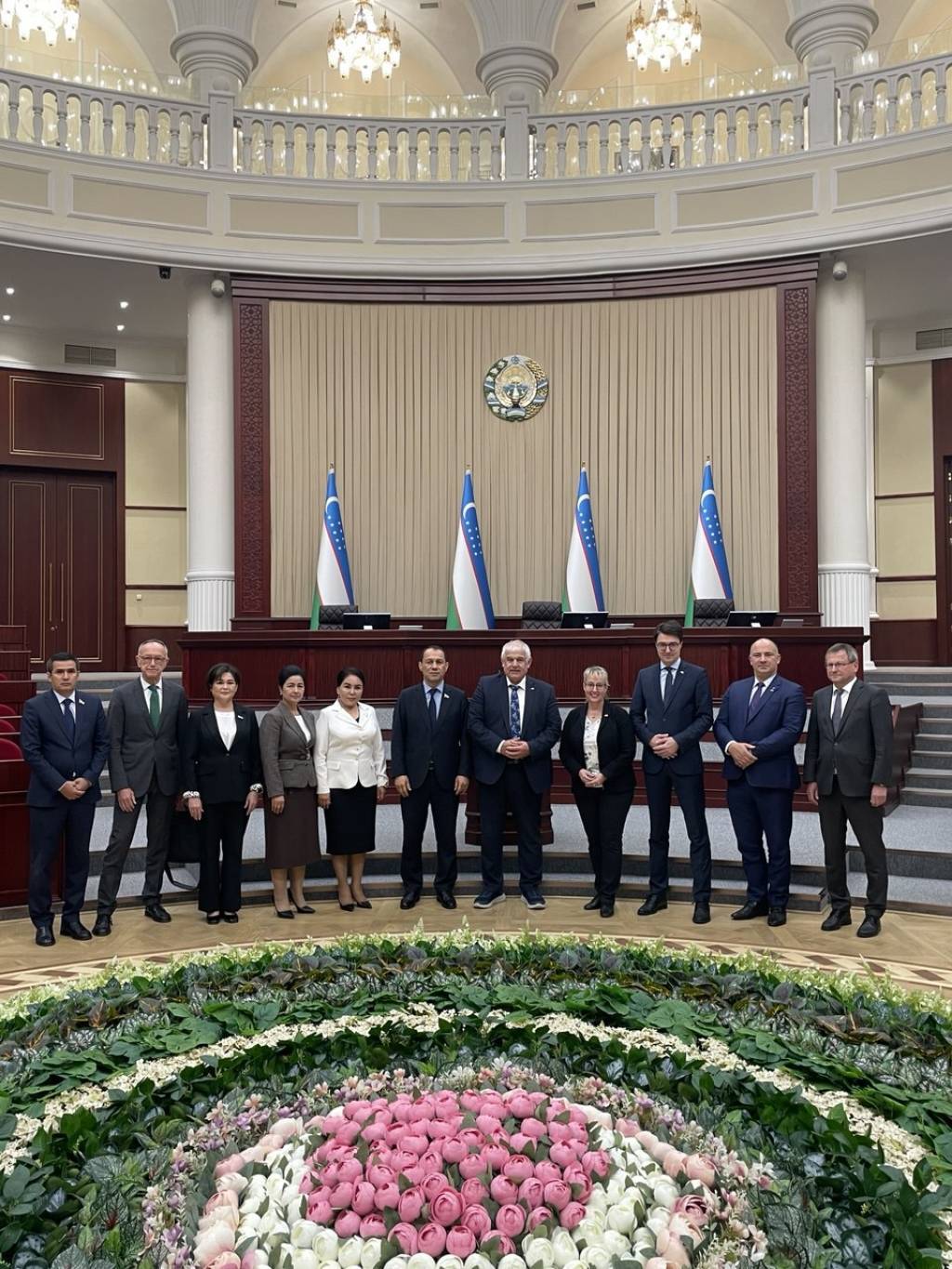
The visit to Uzbekistan by a delegation of the Committee on Agriculture, Food and Regional Identity of the German Bundestag marked a new step toward deepening practical cooperation between the two countries and developing new joint projects.

During the visit, the primary focus was on implementing joint initiatives in the agricultural and environmental sectors.

In Tashkent, members of the delegation held meetings with Minister of Agriculture of Uzbekistan Ibrokhim Abdurakhmonov, representatives of the Committees on Agrarian and Water Management Issues of the Legislative Chamber and Senate of the Oliy Majlis, the Council of Farmers, Dehkan Farms and Household Land Owners of Uzbekistan, and the Research Institute of Horticulture, Viticulture and Winemaking named after Academician M. Mirzayev. A discussion was also organized at the Tashkent State Agrarian University with the support of the Konrad Adenauer Foundation.

Over two days in the Republic of Karakalpakstan, the delegation became acquainted with agricultural and fisheries activities and studied water scarcity issues related to the Aral Sea crisis. The program included discussions with representatives of the local parliament and the Minister of Agriculture, a visit to a cotton-growing cluster, and familiarization with projects supported by the Federal Government of Germany.

Attention was given to projects implemented jointly by the International Innovation Center for the Aral Sea Basin, the German Agency for International Cooperation (GIZ), and the Karakalpakstan Institute of Agriculture, which aim to support economic development and climate adaptation in the region.

In Tashkent region, members of the delegation visited an Uzbek-German joint venture producing agricultural machinery, a textile factory, and a wine and livestock-producing farm.

Following the meetings and negotiations, agreements were reached on the implementation of several promising projects and on establishing experience-sharing between specialists of the two countries. This will strengthen practical cooperation between Uzbekistan and Germany in agriculture, food security, and climate change adaptation.

Kamola Yusupova, UzA

English
Chinese
Turkish
Tajik
Kyrgyz
Turkmen
Japanese
Arabic
English
French
Spanish
Русский
German
Ўзбек
Oʻzbek
Қазақ
Uzbekistan – Germany: A new stage of cooperation in agriculture

The visit to Uzbekistan by a delegation of the Committee on Agriculture, Food and Regional Identity of the German Bundestag marked a new step toward deepening practical cooperation between the two countries and developing new joint projects.

During the visit, the primary focus was on implementing joint initiatives in the agricultural and environmental sectors.

In Tashkent, members of the delegation held meetings with Minister of Agriculture of Uzbekistan Ibrokhim Abdurakhmonov, representatives of the Committees on Agrarian and Water Management Issues of the Legislative Chamber and Senate of the Oliy Majlis, the Council of Farmers, Dehkan Farms and Household Land Owners of Uzbekistan, and the Research Institute of Horticulture, Viticulture and Winemaking named after Academician M. Mirzayev. A discussion was also organized at the Tashkent State Agrarian University with the support of the Konrad Adenauer Foundation.

Over two days in the Republic of Karakalpakstan, the delegation became acquainted with agricultural and fisheries activities and studied water scarcity issues related to the Aral Sea crisis. The program included discussions with representatives of the local parliament and the Minister of Agriculture, a visit to a cotton-growing cluster, and familiarization with projects supported by the Federal Government of Germany.

Attention was given to projects implemented jointly by the International Innovation Center for the Aral Sea Basin, the German Agency for International Cooperation (GIZ), and the Karakalpakstan Institute of Agriculture, which aim to support economic development and climate adaptation in the region.

In Tashkent region, members of the delegation visited an Uzbek-German joint venture producing agricultural machinery, a textile factory, and a wine and livestock-producing farm.

Following the meetings and negotiations, agreements were reached on the implementation of several promising projects and on establishing experience-sharing between specialists of the two countries. This will strengthen practical cooperation between Uzbekistan and Germany in agriculture, food security, and climate change adaptation.

Kamola Yusupova, UzA