Between truth and algorithms
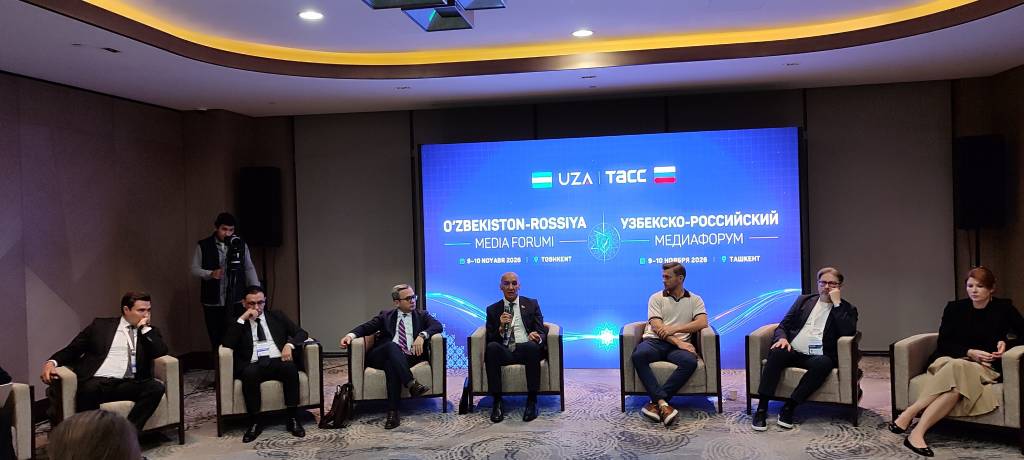
How is artificial intelligence transforming journalism, and why is trust becoming the media’s most valuable asset? These questions lie at the heart of our report on a working session of the Third Uzbekistan – Russia Media Forum in Tashkent, where a television correspondent, a deputy minister, a fact-checker and a lawmaker came together for a discussion. Their professions may differ, but they all face the same question: whom can we trust when machines can generate text, voices and videos?
Five topics are on the agenda: the development of artificial intelligence, the transformation of the media market, information sovereignty, combating fake news and cooperation between the two countries. Running through all five is a common theme: audience trust, which participants repeatedly describe as the most valuable asset of any newsroom.
First to speak is Aleksandra Kosharnitskaya, First Deputy Director General, Director of the News Directorate, and Editor-in-Chief of NTV Television Company JSC. She begins with a trend she observes every day: audiences are moving online. Television remains the primary source of news in Russia, but the direction of change, she says, is clear.
Uzbekistan has moved further along this path. Citing national research, Ms. Kosharnitskaya notes that most people in the country get their news from social media, particularly Telegram and Instagram. But she immediately makes a distinction that seems to capture the very essence of the discussion: using a platform does not necessarily mean trusting it. A significant gap exists between the popularity of social media and the level of trust people place in it.
Ms. Kosharnitskaya’s most unexpected observation concerns not technology, but people. Tasks that once took programmers weeks to complete can now be finished overnight. An employee arrives at work in the morning, receives the results and must immediately come up with the next task.
The discussion quickly moves beyond the day-to-day workings of newsrooms. Neural networks are no longer simply answering questions. They are becoming intermediaries between people and knowledge. Soon, a significant share of the audience will receive news not directly from media outlets, but from algorithms that select, summarize and interpret information themselves.
Ms. Kosharnitskaya believes that national AI models can help countries preserve their own information space, provided developers take responsibility for the information these models produce. The government’s task is to strike a balance: excessive regulation could slow technological progress, while a lack of oversight could allow unreliable information to spread unchecked.
Oleg Pekos, First Deputy Minister of Digital Technologies of the Republic of Uzbekistan, offers an unexpected comparison to describe the profession. A modern journalist, he says, is like a test pilot: the pressure keeps mounting, but there is no room for error. Journalists must respond instantly, verify facts and remain objective, all while the number of information sources continues to grow by the day.
To illustrate the scale of the threat, he proposes a thought experiment. In a short period, malicious actors create thousands of websites in different languages, filling them with articles, comments and images. These websites feature supposed “eyewitnesses” to events that never actually happened.
He identifies three areas for cooperation between Russia and Uzbekistan:
developing analytical media outlets with rigorous fact-checking standards;
jointly developing and testing AI tools for journalists;
implementing educational projects to help citizens recognize manipulation and phishing attacks.
He then turns to a concrete initiative. Uzbekistan is developing a large-scale Uzbek-language corpus containing more than 20 billion tokens. The dataset was compiled from sources including library collections and digitized archives. According to the announced plans, the corpus will be made available on the Hugging Face platform on November 15.
But language alone is not enough, the speaker emphasizes. An AI model must also understand cultural context: history, traditional clothing, national musical instruments and artistic heritage.
While the discussion has so far focused on technology and economics, Daniil Bisslinger, Vice President of the Global Fact-Checking Network (GFCN), shifts the focus to disinformation and immediately raises the stakes. He says combating it is becoming one of the most important areas of international cooperation between countries.
Ilhom Abdullayev, Chairman of the Committee on Innovative Development and Information Technologies of the Legislative Chamber of the Oliy Majlis of the Republic of Uzbekistan, approaches the issue from a lawmaker’s perspective and begins by acknowledging that technology is advancing far faster than legislation can keep pace.
According to Mr. Abdullayev, Uzbekistan’s information legislation has undergone few significant changes in recent years, while the reality it is meant to regulate has changed dramatically. In practice, however, developments have outpaced the letter of the law: the policy of greater openness among government agencies has already brought noticeable changes to the way state institutions operate.
Now, the deputy believes, it is time to take the next step – moving from information openness to digital transparency.
Abdullayev proposes introducing three legal requirements for government information systems:
record every action taken by each official within the system;
document the state of the system and all processes taking place within it;
ensure that these records cannot be altered or deleted retroactively.
Roman Bondarchuk, UzA