From reforms to an investment boom: an overview of how Uzbekistan’s economy is transforming – EDB assessment
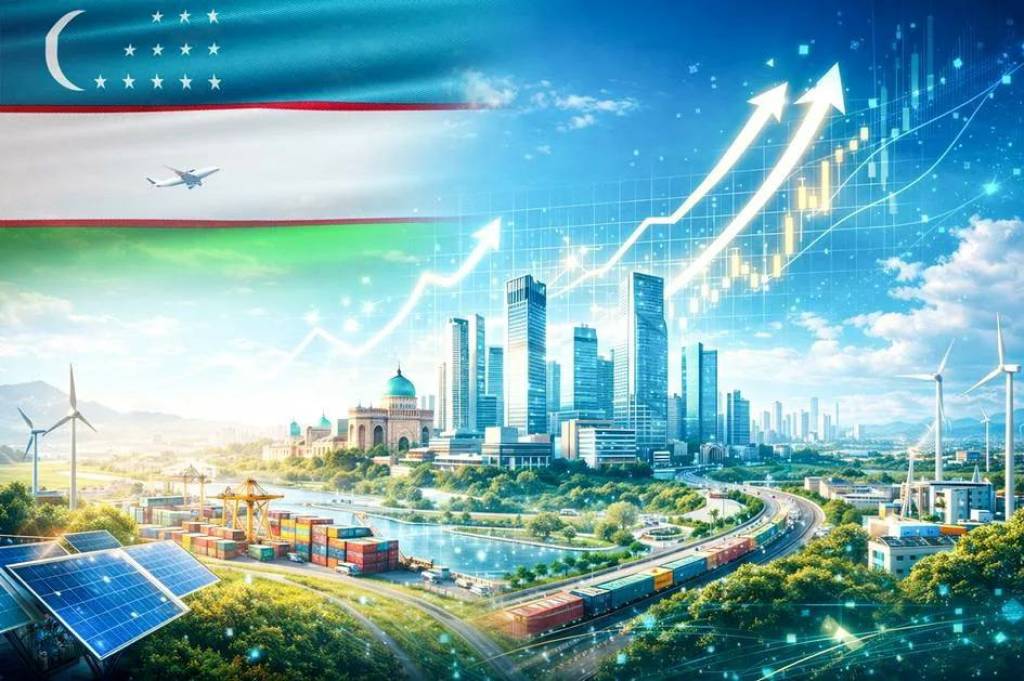
Uzbekistan’s economy keeps advancing. Celebrating 35 years of independence, the country shows robust growth, increased investment activity, and expanded production capacity, enhancing its role as one of the region’s fastest-growing economies.
In 2025, Uzbekistan’s GDP increased by 7.7 percent, marking one of the highest growth rates in the past decade. This rate was more than double the global average of 3.4 percent. Additionally, in the first half of 2026, the economy accelerated further, growing 8.5 percent.
Multiple factors are fueling growth, including consumer demand, investments, and the services sector. In the first half of 2026, retail trade surged by 20.2%, fixed capital investments increased by 17.5%, and market services grew by 16.9%. Meanwhile, real household incomes climbed by 9.2%, outpacing GDP growth.
High growth rates have coincided with declining inflation. In May 2026, inflation hit a record low of 5.5 percent and is projected to slowly approach the 5 percent goal. The Central Bank’s monetary policy supports easing price pressures. Industry also plays a vital role in economic growth, with output rising by 8.0 percent in the first half of the year. Manufacturing remains the dominant sector, accounting for 86.3 percent of total industrial output.
The state industrial development program underpins the growth in production capacity, focusing on technological modernization and enhancing value chains. This year, 782 industrial and infrastructure projects are planned to commence.
The EDB’s Monitoring of Mutual Investments reports that foreign direct investment (FDI) from Eurasian and Asian nations reached $39.6 billion, up more than 2.5 times over five years. The top investors include China, Russia, Gulf countries, Türkiye, and South Korea. Notably, Chinese FDI has surged fivefold to $11.5 billion, and Gulf country investments have expanded over twentyfold to $9.8 billion. Russia remains the second-largest investor, with FDI around $10 billion in 2025.
Accumulated foreign investment in the electric power sector has increased quickly. In 2020, it accounted for only 2 percent, but by 2025, it surged to 42 percent, amounting to $16.6 billion. This growth was driven by efforts to attract more investment in renewable energy.
Over the past five years, multilateral financial institutions have allocated $26.6 billion to Uzbekistan, including $7.6 billion in non-sovereign financing that does not rely on government guarantees. This non-sovereign share has grown to approximately 30 percent and is still increasing. In the first half of 2026, these institutions approved over $700 million in such investments.
Non-sovereign operations have seen remarkable growth, with Uzbekistan’s volume increasing nearly twelve times over 15 years – from roughly $100 million in 2008-2010 to about $1.5 billion in 2023-2025. After joining the Eurasian Development Bank in 2025, the bank has become actively engaged in Uzbekistan, broadening access to long-term financing for the country’s economy.
The interplay of foreign trade, investment, domestic demand, and the growth of industry and infrastructure is establishing a solid base for sustained high economic growth in the medium term.
Aziza Alimova, UzA