Exploring Uzbekistan’s mineral wealth: two days with geologists
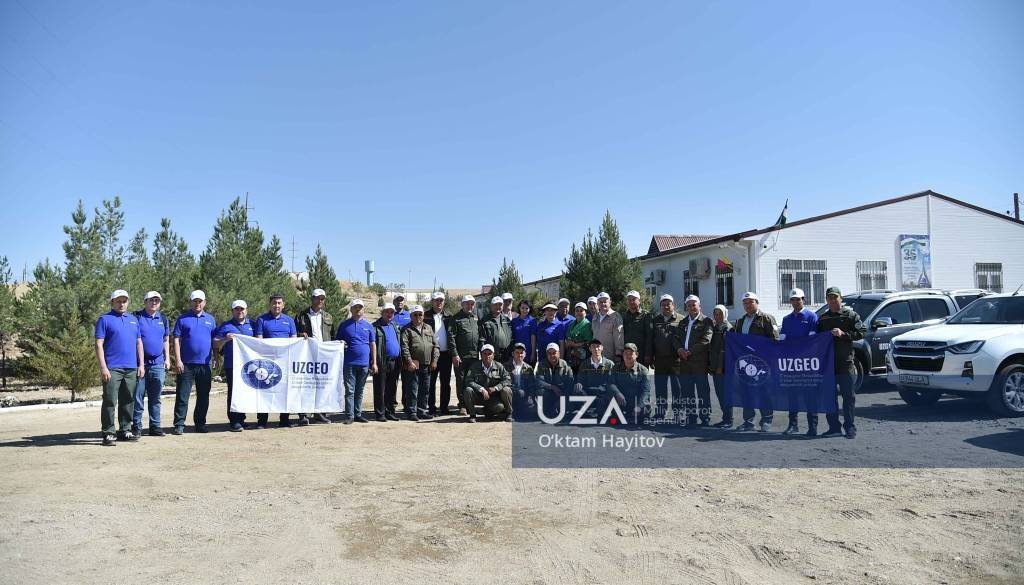
Uzbek Geological Exploration JSC, part of the Ministry of Mining Industry and Geology, organized a press tour of the Samarkand Central Geological Exploration Expedition.
The event introduced national and regional media representatives and bloggers to the company’s work, the expedition’s role in carrying out state programs to develop the country’s mineral resource base, and geologists’ daily activities. On the first day, the Samarkand Central Geological Exploration Expedition held a press conference.
B. Eshmirzayev, Deputy Chief Engineer at Uzbek Geological Exploration JSC, and other managers of the system discussed the strategic results achieved since the start of the year and the projects underway.
Today, the company conducts geological exploration across the country through its Qizilqum, Hisor, Samarkand, Tashkent, and Regional Central Geological Exploration expeditions. Its operations also include a central geological-geophysical expedition, central and analytical laboratory complexes, and a drilling services site. Together, these organizations make geological exploration more efficient and productive.
“Today, about 4,500 employees work in the system, including geologists, engineers, builders, economists and other specialists”, said Mr. Eshmirzayev. “Of course, our employees’ knowledge and experience are essential to geological exploration. We also rely on 102 modern high-tech drilling rigs, 23 other types of rigs, and 287 units of auxiliary equipment to work productively and complete our plans on time. Since the start of the year, work has been organized on 130 projects funded by the state budget and the Navoi and Almalyk Mining and Metallurgical Companies. The projects involve geological exploration, prospecting for and evaluating mineral deposits, topographic and geological mapping, drilling, and laboratory analysis. Exploration is underway for gold, silver, copper, lead and zinc, tungsten, rare metals and rare earth elements, coal, and other non-metallic minerals. Work carried out from January to August in the Republic of Karakalpakstan and the Navoi, Samarkand, Jizzakh, Tashkent, Bukhara and Namangan regions increased gold reserves by 10 tons and silver reserves by 4 tons”.
Under the State Program for the Development and Replenishment of the Mineral Resource Base, and under orders from the Navoi and Almalyk Mining and Metallurgical Companies, the country’s industrial drivers, 477,983 linear meters of exploration wells were drilled to identify gold, copper, tungsten, and other minerals. For the state enterprise Navoiyuran, 188,659 linear meters of geotechnological wells were drilled and handed over for use. In addition, the company drove 3,014 linear meters of underground mine workings and completed 234,724 cubic meters of surface excavation.
Five laboratories now operate within the company, conducting analyses for projects under the state program. In the first eight months of this year alone, the laboratories performed more than 586,000 analyses. The laboratories also serve external clients and businesses under contract.
The press tour included a visit to one of these laboratories and the rock-crushing workshop of the Samarkand Central Geological Exploration Expedition.
“Thanks to the attention of the President, the material and technical base for geological exploration has been completely renewed in recent years. New specialized equipment and drilling rigs using advanced foreign technology have been introduced”, says Sobirjon Nematullayev, head of the Samarkand Central Geological Exploration Expedition. “As a result, productivity has increased several times over. With a modern drilling rig, we now drill 2,000 linear meters in a month, more than twice what the old equipment and technology could manage. These new capabilities are helping expand the mineral base’s reserves and resources. Our expedition is working on 32 strategic projects: four are funded by the state budget, and the other 28 are carried out under contract with our close partner, Navoi Mining and Metallurgical Company. We are conducting geological work on the flanks and at depth in deposits belonging to the Combine’s Southern Mining Administration”.
“Scientific capacity in the field is also growing, with knowledgeable young specialists joining us. We work with universities and help train them. We have established research and practical cooperation with the geology departments of the National University of Uzbekistan and Samarkand State University. Professors also join our field expeditions, where students complete their practical training on site. Many investors are now entering the geology sector, and we have established cooperation with foreign companies in mining and geological exploration. We exchange experience with geologists from China, the United States, Tajikistan, Kyrgyzstan, the UAE, Mongolia, and other countries. Over the past two years, our ties with Afghanistan have improved considerably. Through international cooperation, we also participate in geological exploration abroad, drawing on the rich traditions and experience of the Uzbek school of geology. At the same time, we are working to strengthen it further by digitizing the system and making effective use of artificial intelligence. This helps make exploration more efficient and accurately assess the economic potential and reserves of discovered deposits”.
On the second day of the press tour, the media representatives visited the Zarmitan Field Expedition, located on the central southern slopes of the North Nurata mountain range in Qushrabot district.
Journalists showed keen interest in the expedition’s modern drilling rigs and the progress of its underground mining work. The expedition is currently conducting geological exploration across eight major projects.
“Our expedition conducts exploration, prospecting and evaluation work in stages around the Charmitan, Urtaliq and Gujumsoy deposits”, says Nodir Tovboyev, Lead Geologist at the South Charmitan site of the Zarmitan Field Expedition. “Our site is conducting geological exploration at the Charmitan deposit under a project scheduled for 2026-2029. The area had been partly studied before, but work stopped because the results were not promising enough. We then carried out extensive work in the area, including driving underground workings and drilling. We drilled Well No. 10, designed to a depth of 340 meters, to 342 meters, opening a new section in the south of the deposit. Laboratory results from our exploration samples were very good, indicating that the deposit is promising. Under the project, we will continue our research for three more years before submitting it to the state reserve balance”.
Participants saw firsthand how geological rock samples are crushed and how the specialized storage facilities operate. Journalists were particularly interested in the new “Sample Control” information system, which has fully digitized laboratory processes.
“I have worked in this field expedition for almost forty years”, says Malohat Hamroyeva, head of the laboratory section. “Compared with the past, laboratory work is much more modern today. We can better analyze samples collected during exploration. With equipment brought from abroad, we can now analyze 3,500-4,000 samples a month. Most importantly, our work is more accurate and faster”.
The press tour also focused on the working and living conditions provided for the workers and drilling crew who work day and night in the remote mountains.
This media event gave the public an up-close look at the challenging, honorable work Uzbek geologists do to find underground resources, a vital foundation of the country’s economic potential.
[gallery-31632]
Golib Hasanov, photos by Uktam Hayitov, UzA