Termez hosts an international roundtable discussion on Afghanistan
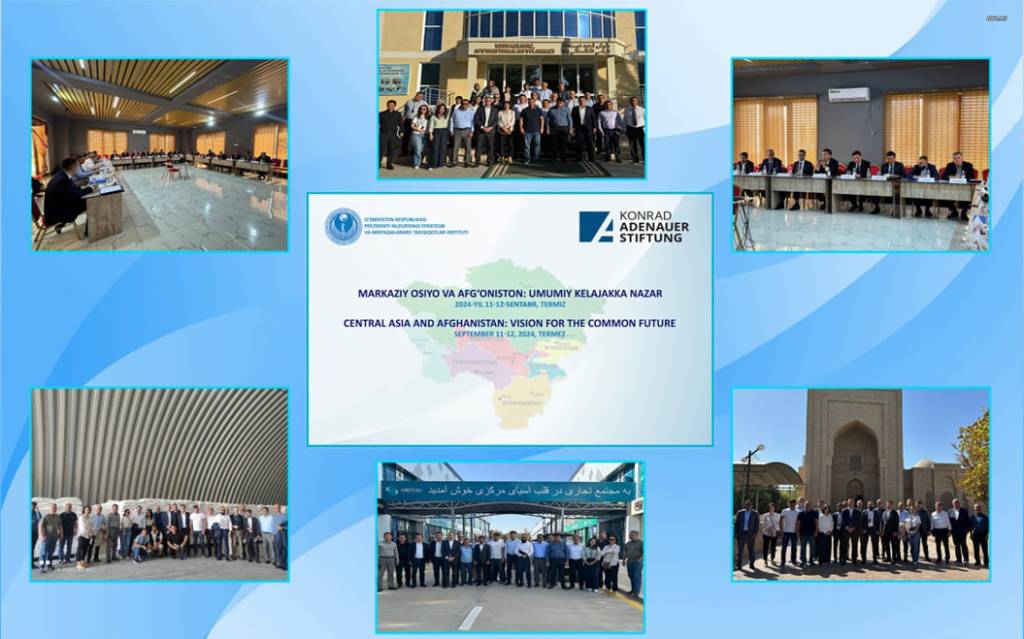
On September 11-12 this year, the Institute for Strategic and Regional Studies under the President of the Republic of Uzbekistan, together with the German Konrad Adenauer Foundation, held the international roundtable discussion on “Central Asia and Afghanistan: A Vision for a Common Future”.
The event was attended by leading experts from Uzbekistan, Central Asian countries, Afghanistan, and Germany in international relations, security, economics, and religion.
Experts from strategic institutes and leading research centers represented the Central Asian states. On the German side, specialists from the leading Konrad Adenauer Foundation, Berghof, and the Institute for Security Policy at Kiel University participated in the event.
As part of the event, the participants were familiarized with the infrastructure and practical measures taken by Uzbekistan designed to facilitate Afghanistan’s socio-economic recovery and its involvement in regional ties. In particular, the guests visited the border trade zone – the International Trade Center “Termez”, which covers 37 hectares and is 500 meters from the border with Afghanistan.
The opening ceremony of the International Trade Center “Termez” took place on August 29 this year. It was attended by the Prime Minister of Uzbekistan, the Deputy Ministers of Economy of Azerbaijan, Kazakhstan, and Kyrgyzstan, and the Acting Prime Minister of Afghanistan, Abdul Ghani Baradar.
The border trade zone is designed to create a favorable business environment and simplify transport, logistics, and administrative procedures. Thus, visitors to its territory are exempt from visa requirements for 15 days. The trading platform houses 3 thousand retail outlets.
A visit to the International Transport and Logistics Hub “Termez Cargo Center”, located close to the border between Uzbekistan and Afghanistan – less than 2 km away – was also organized for the event’s guests. The daily capacity of the hub is 1 thousand tons. The peculiarity of this hub is that it occupies a unique geographical position –located at the junction between Afghanistan, Tajikistan, and Turkmenistan.
International organizations, particularly the World Food Programme and the Office of the United Nations High Commissioner for Refugees, use the Cargo Center to deliver humanitarian supplies to Afghanistan. Since 2021, 144 thousand tons of humanitarian aid, including food (flour, grain), medicines, tents, solar lamps, and other essential goods, have been sent to Afghanistan through this hub.
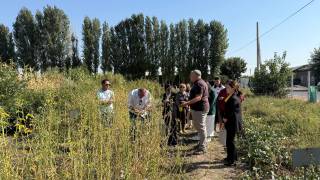
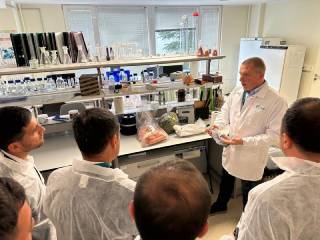
The experts also got acquainted with the activities of the Educational Center for Afghan Citizens, created on the initiative of the President of Uzbekistan Shavkat Mirziyoyev in 2018. This educational institution is the only one in the world that provides training exclusively for Afghans in higher and secondary specialized and vocational education. About 700 Afghan citizens have been trained during its operation, of which more than 200 are girls. Today, the Center offers three- and six-month courses for Afghan citizens in sewing and hairdressing, carpet weaving, modeling, handicrafts, sculpture, and other professions. The institution actively supports international relations and cooperation with donor countries and foreign organizations such as UNDP, the EU, Germany, Slovakia, and India.
The event guests also got acquainted with the work of the Termez-Hairatan checkpoint, which is equipped with new advanced customs and border control technologies.
The foreign participants highly appreciated Uzbekistan’s efforts to establish peace and stability in Afghanistan and its effective contribution to implementing programs for its socio-economic recovery. It was noted that the unique infrastructure projects implemented in Termez will create the preconditions for the revival of the Afghan economy, putting Afghanistan on the path of peaceful development and returning the country’s historical role as a link between Central and South Asia. In addition, the participants of the event visited the Hakim at-Termizi Mausoleum and the archaeological museum to get acquainted with the rich historical and cultural heritage of Termez. Due to its common history, culture, and language, Termez was and remains a point of contact between Central and South Asia.
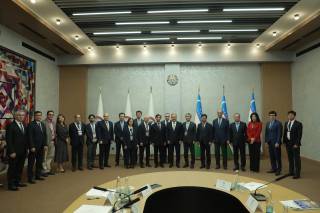
At the same time, during the roundtable discussion held on September 12 this year, special attention was focused on consolidating the international community’s efforts to achieve lasting peace and restore Afghanistan’s economy.
Opening the event, the ISRS First Deputy Director Akramjon Nematov stated that “today, more than ever, it is important to unite the efforts of the entire world community in strengthening peace and stability in Afghanistan, supporting its development and well-being”. According to him, “the isolation of this country cannot be allowed, as this can aggravate the humanitarian crisis in Afghanistan, create fertile ground for various destructive processes”.
“A peaceful and integrated Afghanistan into the world community is the key to a common future in the region, stable and sustainable interregional development”, Akramjon Nematov is convinced.
In turn, the experts also noted the importance of promoting the development of the Afghan economy and developing unified, coordinated approaches to Afghanistan.
In this context, it was especially emphasized that Central Asia currently plays a key role in Afghanistan’s socio-economic reconstruction and integration into regional ties. In general, the participants of the roundtable discussion agreed that today, it is impossible to reduce attention to the situation in Afghanistan and leave it alone with its problems. At the same time, the interests of the Afghan people should be exclusively at the center of all international efforts.
UzA