Studying in Germany: Academic exchanges and Saxon programs for Uzbekistan students
Uzbekistan and Germany are experiencing steady growth in cooperation across all sectors. Notably, recent years have seen significant advances in education, with collaboration reaching a new, higher level.
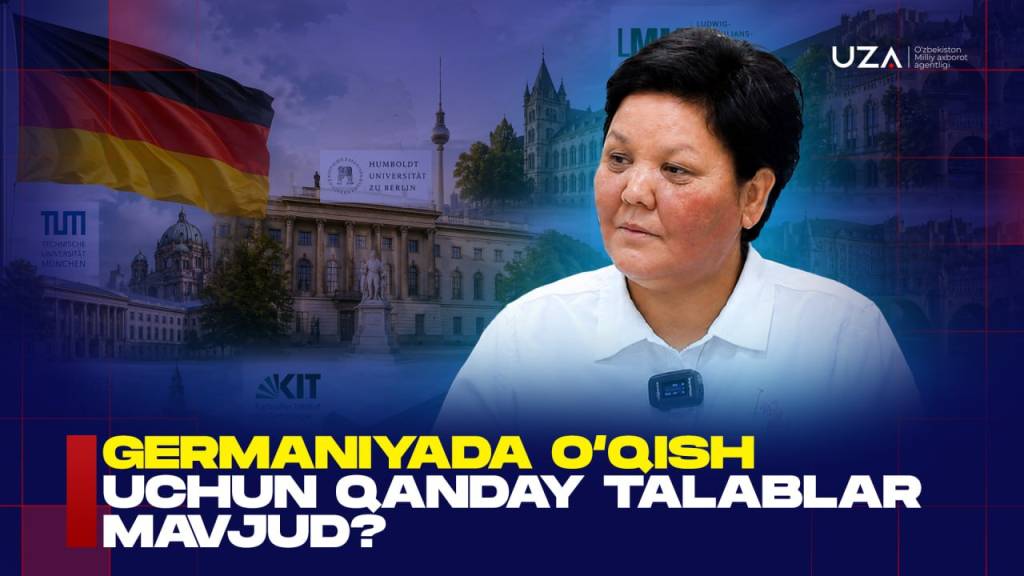
UzA correspondent interviewed Zlikha Tileuova, Head of the Saxon Science Liaison Office in Uzbekistan, regarding collaboration in higher education, academic exchanges between Uzbekistan and Germany, and the office’s activities.
– First of all, would you please tell us about the Saxon Science Liaison Office in Uzbekistan, including its main objectives and its role in developing educational cooperation between the two countries?
– As is well known, Germany consists of 16 federal states. For a broad comparison with Uzbekistan, they can be likened to regions. Saxony is one of these federal states.
In recent years, collaboration between Uzbekistan and Germany in science, higher education, and student exchanges has grown notably. A key milestone was the opening of the Saxon Science Liaison Office at the University of Geological Sciences in Tashkent on 16 November 2023, serving as the Representative Office of Higher Education Institutions of the Free State of Saxony in Uzbekistan.
The opening ceremony was attended by leaders from relevant agencies in Uzbekistan and Germany, including the University of Geological Sciences’ leadership, representatives from the Freiberg University of Mining and Technology, and officials from the Saxon Ministry of Higher Education.
The main goal of the Representative Office is to enhance scientific and academic collaboration between Uzbekistan and Germany. It aims to promote exchanges of students and academic staff, introduce young people in Uzbekistan to Saxon universities, and offer practical guidance for those planning to study in Germany.
In other words, the Representative Office provides prospective students with complete, free support – from assisting with document preparation and university selection to handling organizational issues related to academic cooperation and studies.
Additionally, the Representative Office collaborates with lecturers, researchers, and higher education institutions involved in academic exchange programs, thereby enhancing scientific connections between the two countries.
– How many students from Uzbekistan are presently enrolled in these programs in Germany?
– Following the opening of the Representative Office, the Saxon Ministry of Higher Education developed the Saxon Student Mobility Program, a grant and scholarship program for students from Uzbekistan and Mongolia. It is designed to promote academic mobility.
Under the program, students can come to Germany and spend one semester studying at a university of their choice, under the supervision of a professor in their field of interest.
In the winter semester of the 2025-2026 academic year, 26 students from Uzbekistan participated in the academic exchange under this program, with financial support from the Saxon State Ministry of Science, Culture and Tourism. Twelve of them studied at Freiberg University of Mining and Technology, while the others attended Dresden University of Technology. An academic exchange was also organized with the university in Zittau, where students from Uzbekistan studied international relations, finance and economics.
The program participants included students from the University of Geological Sciences, Tashkent State University of Economics, Tashkent University of Architecture and Civil Engineering, and Navoi State University of Mining and Technologies. All of them studied in Germany on a grant.
A total of 16 students from Uzbekistan spent one semester at German universities. In addition, the Saxon Mobility Ambassador program is currently being implemented for academic staff and researchers from higher education institutions in Uzbekistan. It provides an opportunity to undertake internships in Germany and to exchange academic experience.
– So, do these academic exchange programs also allow lecturers and researchers from Uzbekistan to work at German universities?
– Yes, that is entirely correct. The program, however, unfolds in multiple stages. Initially, professors from Saxon universities visited Uzbekistan and offered specialized courses at institutions such as the University of Geological Sciences, Navoi State University of Mining and Technologies, Tashkent Institute of Chemical Technology, and Tashkent University of Architecture and Civil Engineering. These classes were intensive, focusing deeply on particular disciplines.
Seven professors from Saxon universities visited Uzbekistan, offering free teaching for one to two weeks. To invite a German professor, certain conditions must be fulfilled. The most important requirement is that the curricula and educational programs of the universities in both countries are compatible.
For instance, if the University of Geological Sciences requires an expert in geology, mineralogy, mineral composition analysis, or another scientific discipline, it reaches out to our Representative Office.
We, in turn, reach out to professors at Saxon universities who work in the relevant field. If the scientific interests and research areas of scholars from both sides coincide, we provide practical assistance in organizing cooperation.
In this way, by addressing the needs of higher education institutions in Uzbekistan, we contribute to the development of scientific and academic cooperation. At the same time, direct collaboration between professors from the two countries plays a key role. The main objective of such cooperation is to advance scientific research and strengthen academic ties among lecturers and researchers.
In this regard, the Saxon Mobility Program covers two key areas. The first is student exchange, and the second is the exchange of researchers and academic staff. The program is currently being implemented in both areas.
– How are student visits from Saxon universities to Uzbekistan arranged for studies or practical training at local universities?
– A separate initiative, the Outgoing Program, exists for this purpose, allowing students from Saxon higher education institutions to participate in practical training in Uzbekistan.
For example, last year, 20 students from Germany, accompanied by a professor, completed a ten-day practical training program in geology, mineralogy, and mineral resource studies in Uzbekistan. It was organized at the University of Geological Sciences, Navoi State University of Mining and Technologies, and other partner universities in accordance with an agreed-upon program.
The German students highly praised the opportunities for practical training, industrial enterprises, and educational and production facilities in Uzbekistan’s mining sector. They were particularly impressed by the opportunity to participate in real production processes, which proved a truly valuable experience for them.
– For instance, students from the National University of Uzbekistan or other local universities considering further studies at Saxon universities might ask: where should they submit their applications? What are the selection requirements? And what should lecturers aiming to join academic exchange programs focus on?
– These opportunities are open not only to geology specialists but also to representatives from engineering, technical, information technology, chemical technology, and many other fields.
Applicants need to demonstrate proficiency in German to enroll in bachelor’s degree programs, since approximately 99 percent of these programs at Saxon universities are conducted in German.
For master’s degree programs, a good command of English is often sufficient. An IELTS certificate is accepted as proof of proficiency, as are international German-language certificates, including those issued by the Goethe-Institut.
The selection process consists of two stages. First, the candidate must meet the requirements of the chosen university and professor. Only after that can the application be considered for a grant or scholarship program.
In the first stage, the student submits documents directly to the selected university. One of the most important requirements is that the field of study in Uzbekistan should align with the educational program in Germany and with the research interests of the professor under whose supervision the student plans to study. Both the university and the professor set their own requirements, which the candidate must meet.
In the second stage, when a professor or associate professor at a Saxon university agrees to accept an Uzbek student, the competitive scholarship selection process starts. At this point, the candidate’s foreign language skills and the formal approval from the German professor to accept the student are crucial.
Last year, 169 students from Uzbekistan applied to the scholarship program. Following the competitive selection process, 26 candidates were recommended. This is a very high number, even compared with similar grant programs offered by other countries. It demonstrates that the English-language proficiency and professional training of young people in Uzbekistan have improved significantly in recent years.
At the same time, the process involves not only the student but also their lecturer. This is because participation is only possible after an agreement has been reached between professors at the two universities.
For example, 17 students from the University of Geological Sciences applied to master’s degree programs. Although they may have studied in the same academic group, each candidate is assessed individually in Germany. Particular attention is paid to their ability to work independently in a laboratory, the alignment between the subjects they have studied and the German university’s programs, and their command of professional terminology.
I genuinely admire students from Uzbekistan. Each year, their knowledge, eagerness for self-improvement, and passion for science continue to grow. Every one of their accomplishments brings us immense joy and pride.
As is widely acknowledged, acquiring knowledge demands considerable patience and effort. It’s never simple. Yet, with a strong desire to learn and persistent effort, success is inevitable. We are committed to offering the practical support needed for those embarking on this journey.
Interviewed by Nasiba Ziyodullayeva, UzA