ISRS Expert: Strengthening parliaments’ role can enhance the social dimension of regional cooperation
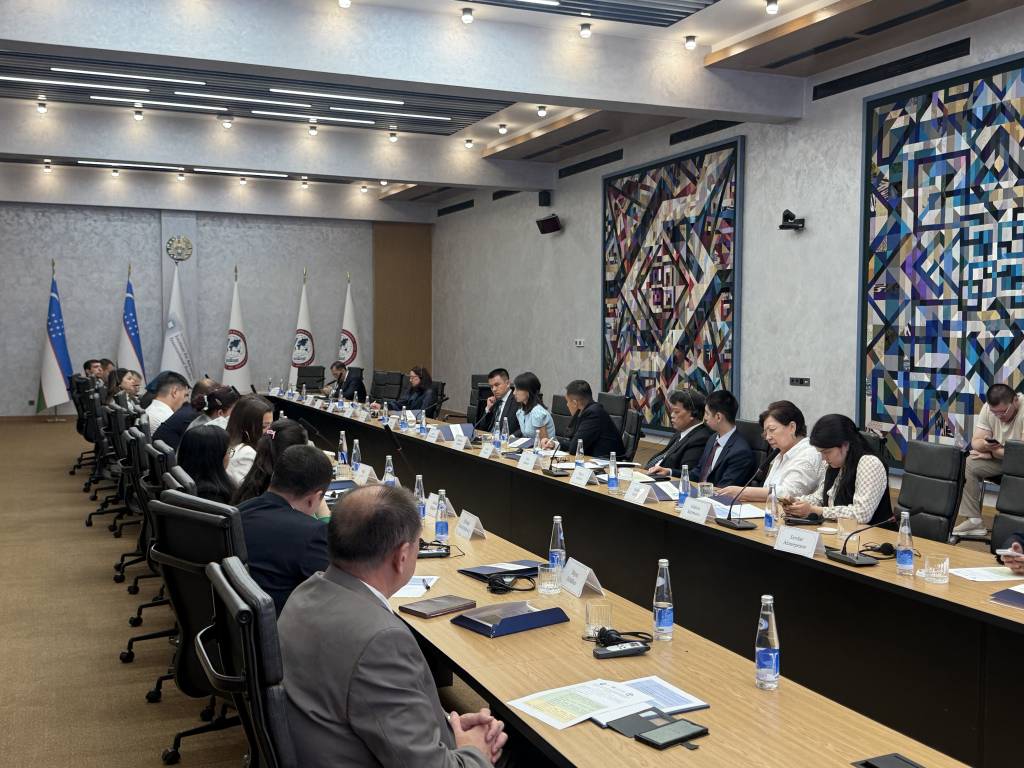
On August 18, the University of World Economy and Diplomacy hosted the conference “The role of parliaments in shaping effective and strong social policy”, organized by the Center for Foreign Policy Studies and International Initiatives jointly with the Institute for Advanced International Studies.
The event brought together members of the Legislative Chamber and the Senate of the Oliy Majlis, representatives of the United Nations, and members of the academic and analytical community.

Shakhlo Khamrakhodjaeva, Leading Research Fellow at the Institute for Strategic and Regional Studies (ISRS), delivered a presentation examining the role of legislative bodies amid ongoing regional integration in Central Asia.
The ISRS expert identified three priority areas for greater legislative involvement in advancing regional consolidation.
First, she proposed making greater use of the representative function of parliaments to promote people-to-people diplomacy. Members of parliament and local representative bodies work directly with the population, have firsthand understanding of pressing local issues, and are well positioned to identify problems emerging in border areas early.
Regular contact between legislators and representative bodies of neighboring border regions could be particularly valuable for addressing issues related to trade, transportation, water management, employment, and social infrastructure. Such mechanisms would help resolve local problems early, preventing them from developing into more complex interstate issues.
Second, the expert emphasized the need to strengthen parliamentary oversight of the implementation of existing regional agreements. As she noted, many decisions have been adopted at the level of heads of state and government in recent years. The priority now is to ensure that these decisions translate into concrete outcomes.
Parliamentary committees could systematically hear reports from relevant government agencies, analyze the causes of potential delays in implementing agreements and joint projects, and, most importantly, assess their practical impact on citizens and businesses.
Third, particular emphasis was placed on the role of parliaments in the legal and institutional consolidation of regional cooperation. Developing transport corridors, cross-border trade, labor mobility, digital data exchange, small and medium-sized enterprises, and cooperation in the water, energy, and environmental sectors requires a stable and compatible legal framework.
Embedding agreements already reached into national legislation can ensure their continuity and reduce regional cooperation’s dependence on changes in the current political environment.
At the same time, the ISRS representative noted that the necessary mechanisms for inter-parliamentary cooperation in Central Asia are already in place. Inter-Parliamentary Forums of the Central Asian states are being held, and bilateral friendship groups, parliamentary commissions, and other platforms are also operating.
Therefore, the focus today should be not so much on establishing new structures as on making fuller use of the existing institutional capacity and giving it greater practical substance – through parliamentary follow-up on regional agreements, identification of legislative and administrative barriers, exchange of best practices, and assessment of the impact of ongoing projects on people’s lives.
According to the expert, such an approach would also be a practical continuation of another important international initiative proposed by Uzbekistan – the UN General Assembly resolution “Enhancing the role of parliaments in accelerating the achievement of the Sustainable Development Goals”, adopted in 2022.
“Greater use of parliamentary diplomacy would strengthen the social dimension of regional cooperation”, the expert emphasized. As noted at the conference, parliament, as an institution of public representation, is responsible for ensuring that the interests of different social groups are considered in policymaking. According to the ISRS representative, a stronger parliamentary role in the regional agenda would make regional rapprochement more responsive to the population’s actual needs and help establish a direct link between interstate agreements and their practical benefits for citizens.
In particular, greater involvement of members of parliament would make it possible to assess major agreements in trade, transport, water resources, energy, and cross-border cooperation by their direct impact on people’s quality of life.
“Ultimately, the effectiveness of regional cooperation should be measured by the extent to which its benefits are felt by citizens: whether new jobs are being created, whether border crossings are becoming easier, whether access to markets, education, and healthcare is expanding, and whether infrastructure in border areas is improving”, the expert stressed.
In conclusion, it was noted that making fuller use of parliaments’ representative, legislative, and oversight functions would help institutionalize the trust built, make good-neighborly relations more sustainable and irreversible, and facilitate Central Asia’s transition from a region of good-neighborly relations to a region of shared development.
UzA