Uzbekistan bets on incentives and new rules to become Central Asia’s IT hub
A new business regime will allow foreign companies to test innovative products, hire international specialists, and expand into regional markets. Investors have shown interest, and the authorities are finalizing the rules ahead of the regime’s launch in early 2027.
Uzbekistan plans to offer international technology companies tax incentives on income from qualifying investments and to introduce special rules for testing new products as it seeks to make Tashkent a base for expanding operations across Central Asia.
In August, the country adopted a law establishing “Enterprise Uzbekistan”, a special business regime for technology companies and investors. The regime is expected to take effect early next year.
Tax breaks, global talent, and product testing
Under the new regime, investors will be exempt from tax on dividends and other income derived from investment activities carried out under the special regime. Companies will also be exempt from corporate income tax on priority activities conducted under the “Enterprise Uzbekistan” special regime, while sales within the center and exports by its participants will be subject to zero VAT.
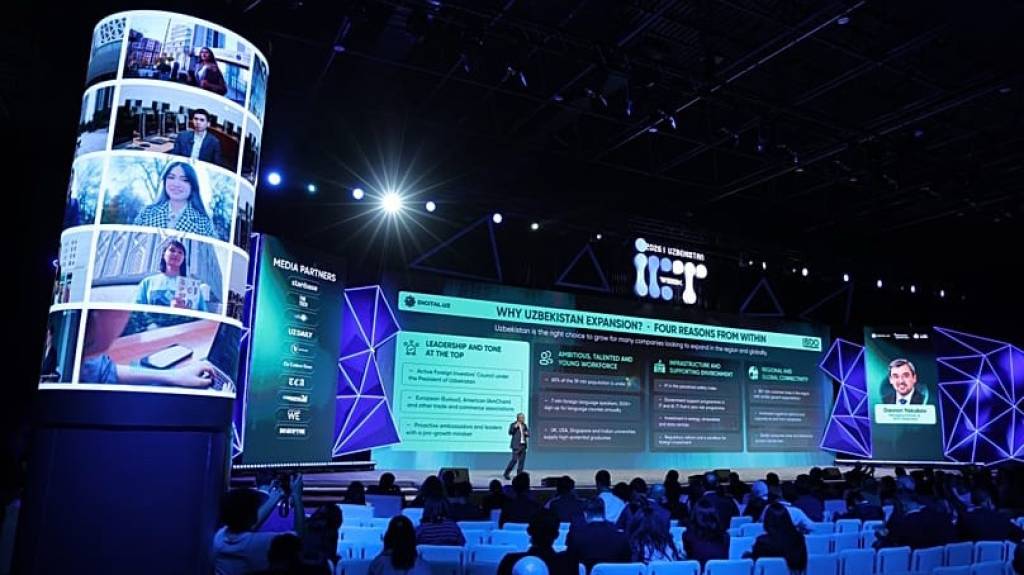
“This means a great deal, but most importantly, it means 100% foreign ownership”, Sultonmurod Rasulov, Head of Strategic Partnerships at Enterprise Uzbekistan, told participants at a summit held during ICT Week in Tashkent. “You can use investment instruments your international investors already know. You can hire employees from around the world in line with international employment standards”.
Full foreign ownership of companies is already permitted in the country. Foreign companies, along with their branches and representative offices, will also be able to operate under the “Enterprise Uzbekistan” regime.
Specialists from different countries who meet the criteria for highly qualified employees will also be exempt from personal income tax on eligible salaries and dividends. Foreign employees of participating companies will also be able to obtain visas valid for up to three years without securing separate work permits.
Another key element will be a regulatory sandbox. Companies will be able to test new technologies, generally for up to 12 months, under specially tailored rules that may provide temporary exemptions from certain requirements and simplified licensing procedures.
“And if you are building something that the existing rules were never designed for, the regulatory sandbox will allow you to test it first”, Mr. Rasulov explained. “For developers of artificial intelligence or new financial services, this could offer an alternative to navigating regulations written before their products even existed”.
Attracting international investment
International venture capital funds are already operating in Uzbekistan, financing local startups and pursuing opportunities in the country’s expanding technology sector.
In June, Golden Gate Ventures opened a Tashkent office in partnership with the Uzbekistan – Oman Investment Company. The firm plans to expand its investment activities in Uzbekistan, helping technology companies scale into markets across Central Asia and the Middle East.
Michael Lints, the Founding Partner for MENA at Golden Gate Ventures, believes the new regime could encourage other international investors to set up structures in the country.
“I think this will help foreign investors establish their funds here”, he told Euronews. “It will also facilitate cross-border deal flow, so we will have more investors and founders coming here to launch businesses”.
From Uzbekistan across the wider region
Bakhodir Ayupov, Vice President for Global Business Development at Enterprise Uzbekistan, said that international technology companies may be deterred by their unfamiliarity with Uzbekistan’s legal system.
In his view, a sign of success would be for companies to see Enterprise Uzbekistan “as an integral part of their expansion plans”, rather than merely a means to enter the local market. In the longer term, he said he would like to see “major technology companies entering the region through Uzbekistan”, using the center as a base to expand into other Central Asian markets.
First major test expected in 2027
Although the legal framework has been adopted, many detailed provisions governing Enterprise Uzbekistan’s operations are still being developed. Officials are inviting technology companies and investors to help shape the rules ahead of the new regime’s launch.
Farhod Ibragimov, CEO of Enterprise Uzbekistan, identified regulatory stability as a top concern for international investors evaluating a new market. The key questions are: How long will these incentives remain in place? Will they still apply over the next ten years?
The new regime is designed to remain in effect until 2100, providing a long-term framework for investment decisions.
Mark Beer, Chairman of the Metis Institute, noted that attracting companies at the launch stage would only be the beginning. Over the longer term, the challenge will be to maintain investor confidence and to remain competitive with other international business hubs.
“The real test for any ecosystem comes after about 10 years, because that is how long it takes to build trust”, he said. “The center needs to benchmark its performance against competing jurisdictions and adjust the rules if growth slows. Fine-tune the regime, then continue monitoring the situation”.
I. Abdukhalikov, UzA