Strategic Evolution of Uzbekistan: From Actions to National Revival
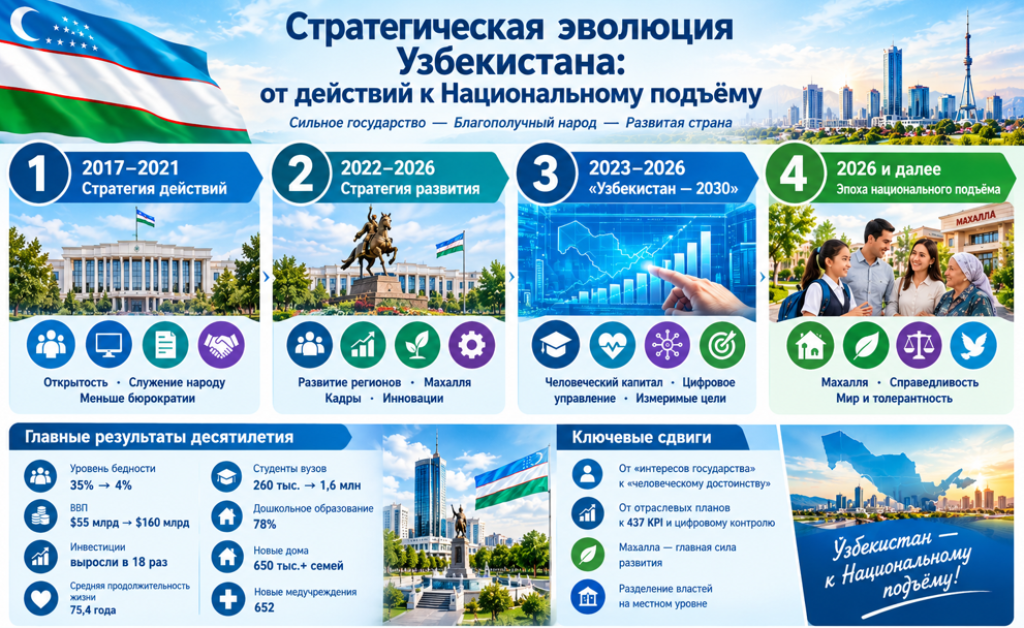
The decade spanning 2017 to 2026 represents far more than an ordinary chapter in Uzbekistan’s history. These years mark a profound historic transformation, moving the nation from insularity to openness, from administrative command to constructive dialogue, and from departmental planning to results-oriented, digital governance.
Strategic policy documents adopted in the wake of successive presidential elections have methodically unfolded, forging a qualitatively new philosophy of state and societal administration. Today, we stand before the updated edition of the Uzbekistan 2030 Strategy and seven nationwide programs inaugurating what has been proclaimed the Era of National Revival. How was this trajectory traversed, and what makes it singularly distinctive?
The First Step: The Action Strategy – Laying the Foundation
Endorsed by Presidential Decree of February 7, 2017, the Action Strategy (2017-2021) encompassed five priority development directions. Its central motto was simple yet deeply consequential: “The people must not serve the government bodies, rather the government bodies must serve our people”.
During this formative period, the institutions of People’s Reception Offices and the Virtual Reception were created. Millions of citizens’ appeals were systematically addressed. Hundreds of new legislative acts were enacted across public administration and the justice system. Under the 2017 State Program alone, measures valued at 37.7 trillion UZS and 8.3 billion USD were delivered. This served as the historic bedrock for pivoting toward openness, hearing the citizen voice, and dismantling bureaucratic obstacles.
The Strategy’s execution was overseen by designated specialized commissions alongside the Development Strategy Center. As a result, the civil service drew closer to the population, and early foundational elements of electronic governance took shape.
The Second Stage: The Development Strategy – Expansion and Deepening
Following the 2021 presidential elections, the Development Strategy of New Uzbekistan (2022-2026) was enacted via Presidential Decree of January 28, 2022. Priority directions increased from five to seven. For the first time, a structured architecture of “100 Specific Goals” was introduced.
The innovations were unmistakable. National identity, culture, and spirituality were set apart into an autonomous policy block. Tackling universal global challenges – climate change, the Aral Sea ecological crisis, pandemic response, and labor migration – through the lens of core national interests was established as a dedicated strategic direction. Projects totaling $55 billion were envisaged under the program.
This phase marked the rollout of the “mahallabay” (neighborhood-level) governance mechanism, the establishment of the “mahalla of five”, the solid codification of the state civil service legal framework, and the launch of transparent recruitment competitions via the Vacancy.argos.uz portal. Over 100,000 public servants were recruited through open, merit-based competitive examinations. The state administrative structure was streamlined, and the number of ministries and agencies was optimized.
The Third Stage: Uzbekistan 2030 – Quantitative Precision and Digital Oversight
Subsequent to the renewed Constitution and snap presidential elections in 2023 by Presidential Decree and Resolution promulgated the Uzbekistan 2030 Strategy. The priorities were re-consolidated into five domains, while preserving the 100 goals and over 400 quantitative benchmarks. The foremost focus was on human capital enhancement, education, healthcare, and social safety nets (comprising 44 targets).
By Presidential Decree of February 16, 2026, the updated edition of the Strategy for 2026-2030 was adopted. The number of KPIs was increased to 437, with every performance indicator rigorously defined on an annual timeline. Oversight became fully digitized: “green”, “yellow”, and “red” monitoring classifications firmly anchored the personal accountability of senior executives.
A Republican Commission chaired by the Prime Minister was instituted. Concurrently, 73 state development concepts and 33 sector strategies were reviewed and aligned with unified national benchmarks.
The budgetary footprint is equally expansive, identifying targeted funding resources of $252 billion. A total of 24 trillion UZS is directed into mahalla infrastructure, and 10 trillion UZS is allocated annually to Participatory Budgeting. Unambiguous milestones were set: expanding digital public services to 90%, breaking into the Top 30 of the United Nations E-Government Survey, and mandating the adoption of all local hokim resolutions through the “E-qaror” electronic system.
The Fourth Stage: National Revival – Mahalla as the Primary Client
The President’s keynote address on August 28, 2026, commemorating the 35th anniversary of State Independence, heralded a new era. The upcoming decade was officially designated as the “Era of National Revival”. Seven nationwide programs were set forth:
1) Transforming knowledge and skills into primary capital;
2) Fostering healthy living and longevity;
3) Building a high-technology economy underpinned by labor productivity;
4) Radically reforming societal stewardship of water and nature;
5) Ensuring judicial independence and the rule of law;
6) Establishing the mahalla as the primary client driving societal advancement;
7) Pursuing an unwavering policy of peace and tolerance.
The most profound shift was the pivot away from a top-down administrative vertical toward a bottom-up commissioning model. Henceforth, district municipal budgets, capital investments, and government programs are formulated strictly based on official orders submitted by mahalla residents. The state is no longer the supreme client, but rather an efficient, high-quality executor of the civic mandate.
The institutional separation of the offices of Hokim and Chairman of the Council of People’s Deputies constitutes the landmark democratic milestone of this era. Following the October 2024 regional elections, and starting January 1, 2026, across all 208 districts and cities, the practice of hokims concurrently leading the representative branch was entirely dismantled. Council Chairmen were elected from among the sitting deputies. Thirty-three distinct statutory powers were devolved to the Councils, giving tangible life to an authentic local checks-and-balances mechanism.
A Decade of Results in Figures
The authoritative indicators presented in the President’s address underscore the steady cadence of the reforms. Specifically, the national poverty rate plummeted from 35% to 4%. GDP surged from $55 billion to $160 billion. Foreign direct investment inflows escalated 18-fold. Average life expectancy attained 75.4 years. The university student body expanded from 260,000 to 1.6 million. Early childhood education enrollment climbed to 78%. More than 650,000 families secured newly constructed modern housing, and 652 new medical care facilities were erected.
Policy weight committed to human capital rose from 15% in 2017 to 44% throughout 2023-2026. The mahalla graduated from an ordinary neighborhood assembly into a bedrock frontline institution staffed by seven dedicated state representatives. Water-saving technologies, the Green Space ecological project, digital service exports, and artificial intelligence emerged as defining national priorities.
Conceptual Shifts
A holistic appraisal of the decade shows that governance philosophy shifted from state interests to human dignity. The planning architecture evolved from departmental task sheets to 437 target KPIs and an automated digital traffic light. The mahalla became a core political and economic force. At the municipal level, the doctrine of separation of powers was conclusively consolidated.
A diminished share of purely administrative goals does not denote slacking oversight; rather, it reflects the progression of administrative reform from an institutional phase into a functional and digital stage. The state machinery has moved beyond inward cycles of self-reorganization, evolving into a proactive “service state” tailored to meet citizen needs.
As highlighted by United Nations Development Programme (UNDP) and World Bank experts, Uzbekistan’s strategic planning ecosystem has evolved from traditional departmental activity rosters into integrated programmatic platforms rooted in performance accountability and digital metrics. These programs are not mere compilations of aspirations, but actionable blueprints backed by dedicated capital outlays that anchor a renewed social compact between society and the state.
Broadly speaking, Uzbekistan has decisively charted its strategic horizon. The continuum from the Action Strategy to National Revival reflects a coherent, resolute, and human-centered trajectory of national advancement.
Over the coming decade, a governance model driven by mahalla-directed commissioning, digital accountability, and human capital will undoubtedly elevate the nation onto an unprecedented developmental plane. This is not merely an agenda on paper, but the organic, logical continuation of real-world changes taking place across society.
Muhammadjon Juraev,
Head of Department,
Center for Analysis of Democratic Processes