Central Asia – Russia: priority areas for environmental cooperation discussed

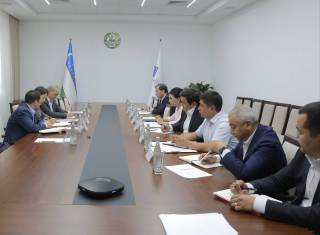
A videoconference in the Central Asia – Russia format was held at the National Committee of the Republic of Uzbekistan for Ecology and Climate Change to review the draft roadmap for implementing the Joint Action Plan for 2025-2027.
The event was attended by the Deputy Minister of Ecology, Environmental Protection and Climate Change of the Republic of Uzbekistan Jusipbek Kazbekov, the Deputy Minister of Natural Resources and Environment of the Russian Federation Dmitry Tetenkin, the Deputy Minister of Ecology and Natural Resources of the Republic of Kazakhstan Mansur Oshurbayev, as well as Head of the International Cooperation Department of the Ministry of Natural Resources, Ecology and Technical Supervision of the Kyrgyz Republic Chingiz Kochorov.
During the meeting, the activities of the six-party working group on ecology, the draft roadmap for implementing the Joint Action Plan for 2025-2027, and further mechanisms for its coordination were discussed.

J. Kazbekov noted that climate change, land degradation, the reduction of water resources, declining biodiversity, and the growing number of extreme natural events are common challenges for the countries of the region. In this regard, it was noted that these problems can be effectively addressed only through active interstate cooperation.
It was emphasized that Central Asia is particularly vulnerable to the negative effects of climate change. Accelerated glacial melting, intensifying desertification, land degradation, and increasing pressure on water resources were identified as the main environmental problems.
The Uzbek side emphasized the need to strengthen regional and international cooperation on environmental protection and climate change adaptation. The Central Asia – Russia format was recognized as an important platform for combining scientific potential, exchanging experience, and developing practical solutions.
The participants supported the draft roadmap for cooperation for 2025-2027, noting the importance of conducting joint research on climate change, developing environmental monitoring and data exchange systems, preserving biodiversity, and expanding scientific cooperation.
Following the meeting, the parties agreed to continue coordinating on the draft roadmap and to develop environmental cooperation.
Muhayyo Toshqorayeva, UzA