What opportunities does the Saint Petersburg Forum offer Uzbekistan?
In the current global economic landscape, as the world undergoes a new phase of transformation, a country’s success on the international stage largely depends on its active engagement in integration processes.
Against the backdrop of intensifying competition in global markets and deepening geopolitical tensions, diversifying foreign economic ties and seeking new forms of cooperation are becoming a strategic necessity.

As noted by Nodirbek Rasulov, a professor at the Institute for Macroeconomic and Regional Studies, Uzbekistan has pursued a pragmatic approach in recent years. A distinctive feature of the country’s foreign policy is that it is based not on ideological or political preferences but on the priority of national economic interests. In this regard, Tashkent is actively developing cooperation with such organizations as the Shanghai Cooperation Organization, the Organization of Turkic States, the Commonwealth of Independent States, the Economic Cooperation Organization, and the World Trade Organization. The practical results of this policy are already evident. Uzbekistan’s foreign trade turnover is growing, its investment attractiveness is increasing, major foreign investments are being attracted to the country’s industry, and sales markets for domestic producers are expanding.
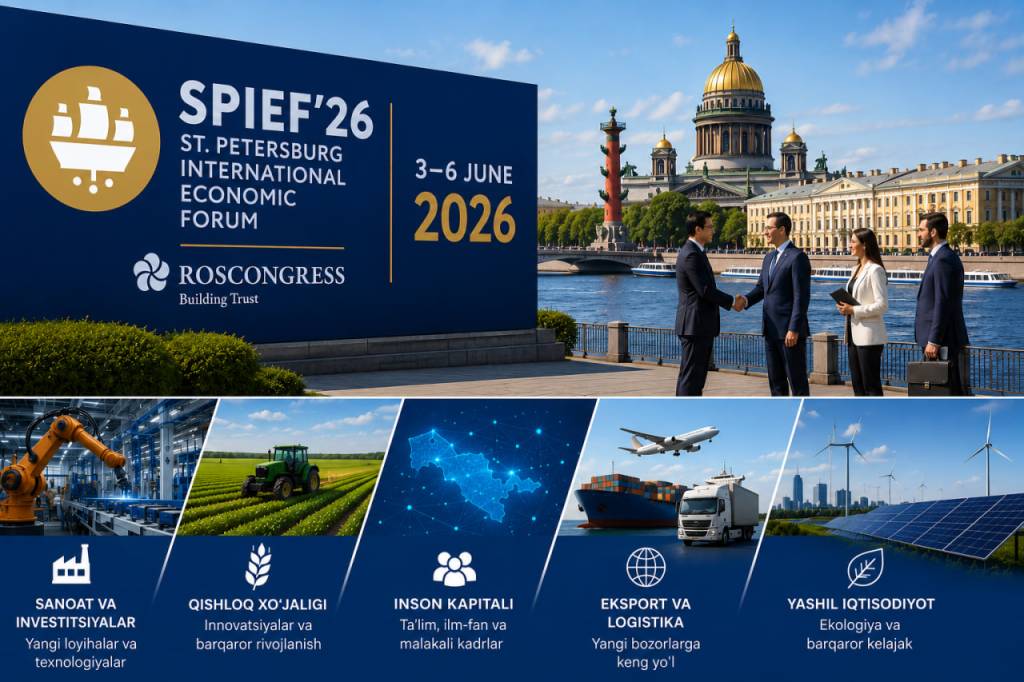
The St. Petersburg International Economic Forum, taking place on June 3-6 in Saint Petersburg under the motto “Pragmatic dialogue: the path to a stable future”, is not merely another international event but an important instrument of the country’s economic diplomacy. It reflects the growing role of economic interests and practical cooperation in modern international relations.
The global economy faces several serious challenges. Geopolitical competition, supply chain disruptions, shifts in energy markets, and the rapid development of artificial intelligence and digital technologies are prompting states to seek new solutions. The St. Petersburg Forum is gradually becoming a platform for discussing these challenges and developing practical approaches to overcoming them.
The program of this year’s forum covers five key areas that reflect the most pressing issues facing the global economy. New models of international cooperation, technological leadership, human capital development, quality-of-life improvement, and support for small businesses are considered priority areas that will shape the future of countries.
For Uzbekistan, each of these areas is particularly important, as the reforms underway in the country aim to improve the investment climate, develop human capital, expand high-tech production, and increase the share of the private sector.
President Shavkat Mirziyoyev’s participation in the forum and his address at the plenary session are important both for bilateral relations and for strengthening Uzbekistan’s role in the international economic agenda. The country is seen not only as a state implementing reforms but also as an active participant promoting initiatives for regional stability and economic cooperation.
The forum offers Uzbekistan opportunities to attract new investment, expand export markets, and strengthen technological cooperation. Participation by representatives from more than 130 countries creates favorable conditions to showcase the country’s economic potential to a broad international audience. For Uzbekistan, this is not merely another diplomatic event but a practical manifestation of its policy of pragmatic integration. The forum is becoming an important platform for strengthening international economic ties, finding new partners, and advancing national development goals.
Investment, human capital, and exports: the potential impact of the St. Petersburg Forum on Uzbekistan’s economy
The significance of the St. Petersburg International Economic Forum for Uzbekistan extends beyond political dialogue or international prestige.
The main question is what practical benefits it can bring to the national economy, particularly in priority areas like attracting investment, enhancing human capital, and increasing export potential.
One of the key drivers of economic growth is foreign investment. Significant financial resources are required to build production capacity, introduce modern technologies, and modernize infrastructure. The St. Petersburg Forum is one of the few international platforms that brings together states, financial institutions, and private companies.

According to expert Lobar Khushnazarova, the forum is an opportunity for Uzbekistan to directly present its ongoing economic reforms to international investors. Negotiations with companies interested in projects in industry, energy, transportation, agriculture, and the digital economy may help increase investment flows.
The second important area concerns the development of human capital. In recent years, education, science, and personnel training have become priority areas of Uzbekistan’s state policy. The competitiveness of a modern economy is largely determined by the quality of human resources.
The inclusion of a dedicated area for human capital and the social sphere in the forum’s program is no coincidence. The program addresses changes in the labor market, in-demand professions, the modernization of the education system, the development of digital skills, and the training of highly qualified specialists. This exchange of experience enables the study of best practices and their adaptation to the national development strategy.
Amid the rapid development of artificial intelligence and digital technologies, personnel training is becoming an important component of economic security. Meetings held as part of the forum may help form new mechanisms for cooperation among educational institutions, research centers, and high-tech companies.
The third key area concerns the expansion of export potential. One of the most important tasks for Uzbekistan’s economy is to increase the share of national products in foreign markets. To this end, it is necessary to expand the range of buyers, logistics routes, and trade partnerships.
The participation of hundreds of companies and business representatives in the forum creates broad opportunities for domestic producers. There is a high likelihood that agreements will be reached to export textile, food, chemical, and agricultural products, as well as construction materials.
The forum is of great importance for advancing economic cooperation between Uzbekistan and Russia to a new level. Joint projects in industrial cooperation, transport corridors, energy, and high technologies are important not only for the two countries but also for the entire economic space of Central Asia.
An important feature of Uzbekistan’s foreign policy is the development of multi-vector economic cooperation. The balanced expansion of ties with Russia, China, Türkiye, the European Union, the United States, and neighboring states diversifies foreign economic relations and strengthens the economy’s resilience to external challenges.
The St. Petersburg International Economic Forum serves as a key platform for economic diplomacy, aimed at boosting the country’s investment appeal, developing human resources, broadening export markets, and establishing new technological collaborations. Most importantly, the ideas exchanged and agreements made will eventually support Uzbekistan’s economic progress, generate jobs, and enhance the well-being of its people.
Musulmon Ziyo, UzA