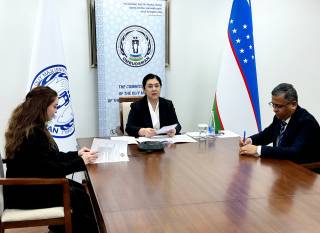
A.Nematov: The trend for regional cooperation has become stable

Addressing the roundtable discussion on “Central Asia in a Changing World: Toward the Fifth Anniversary Consultative Meeting of the Heads of State”, First Deputy Director of the Institute for Strategic and Regional Studies under the President of the Republic of Uzbekistan Akramjon Nematov noted that consultative meetings of heads of state of Central Asia launched in 2018 on the initiative of the President of Uzbekistan Shavkat Mirziyoyev have become an important platform for strengthening cooperation between the countries of the region.
At the same time, according to him, holding the upcoming fifth meeting in September this year is evidence that the trend towards regional cooperation has become stable. The chosen interaction format has proven itself as a sought-after mechanism for organizing a trusting and constructive dialogue and developing coordinated approaches to solving common issues for our countries.
On the other hand, the expert is sure that this also indicates the strong interest of the Central Asian states in further enhancing and deepening regional cooperation.
And today, when the world is undergoing a profound transformation, accompanied by an aggravation of geopolitical confrontation and confrontational rivalry, such interaction is increasing demand.
“We are witnessing an increase in geo-economic competition, increased protectionism, formation of economic blocks, a new configuration of production and supply chains. The level of interstate cooperation in addressing issues on the global agenda is decreasing, which also relates to the problems of extremism and terrorism, climate change, energy, food, and information security relevant to our region.
It is obvious that all these processes will be of a long-term nature, geopolitical and geo-economic conjuncture will continue to transform, affecting regional security architecture radically”, Mr. Nematov stressed.
In this regard, the expert believes it is even more important to unite the region’s states, strengthen mutual trust, and increase the potential of regional cooperation. Only it is possible to increase the internal stability of the region’s states and effectively resist external challenges.
According to A. Nematov, “Today, thanks to the wisdom, firm political will, and joint efforts of the heads of our states, an atmosphere of mutual trust, friendship, and good-neighborliness is preserved in Central Asia, new prospects are opening up for turning our region into a space of universal prosperity and sustainable development”.
According to the ISRS representative, “high economic growth rates remain in Central Asia. By the end of 2022, the region’s economy grew by 6%, two times more than the global indicators, which amounted to only 3%. At the same time, although growth forecasts have become more restrained, nevertheless remain among the highest in the world – at least 5%.
Central Asia is becoming an important participant in global economic relations: over the past six years, the total regional GDP of the region’s states has doubled, the volume of its foreign trade has increased three times, reaching about $225 billion, intraregional trade has grown two and a half times, the number of joint ventures has increased five times.
And this trend will gain momentum”, Mr. Nematov stressed. “Today, our countries are actively introducing and developing new forms of economic cooperation. Interstate investment funds and companies are being created, industrial cooperation projects are being implemented, border industrial, trade and industrial zones are being built, interregional business forums are regularly held”, he said.
Moreover, according to the expert, “stability and security, forming a capacious interconnected market in Central Asia increase investors’ interest in the region. In particular, from 2016 to 2022, the share of investments in Central Asia from the total volume in the world increased from 1.6% to 2.8%, amounting to about $40 billion in 2022. The cumulative accumulated volume of FDI since 2000 has exceeded $250 billion.
Powerful resources and raw materials, production, and human potential, a steady trend towards regional integration, coordinated actions of the Central Asian states, and openness to international cooperation, turn Central Asia into an independent and self-sufficient region, a space of mutually beneficial collaboration and healthy competition.
Today, Central Asia can rightfully be considered a strategically important subject of international relations. This is reflected in the increase in the formats of CA+, adopted special resolutions of the UN General Assembly, jointly promoted by the CA states.
At the same time, Central Asia’s openness to the world and its constructive interaction with external forces should remain a key imperative of the region-wide policy. This will create prerequisites for the formation, on the one hand, of a space of regional cooperation and partnership, free from conflicts and confrontations, on the other – an extensive market for goods and services, investments, and innovations. This is the optimal formula that meets both the interests of the Central Asian countries themselves and our foreign partners. This will also become essential for ensuring security and stability in Central Asia, " concluded A. Nematov.
The roundtable discussion on “Central Asia in a Changing World: Toward the Fifth Anniversary Consultative Meeting of the Heads of State”, organized by the Academy of Public Administration under the President of the Republic of Tajikistan and the SCO Center of Friendship and Cooperation in Tajikistan, brought together representatives of the research community, strategic institutions, extraordinary and plenipotentiary ambassadors of Central Asian countries and SCO Member States accredited in Central Asia.
UzA