
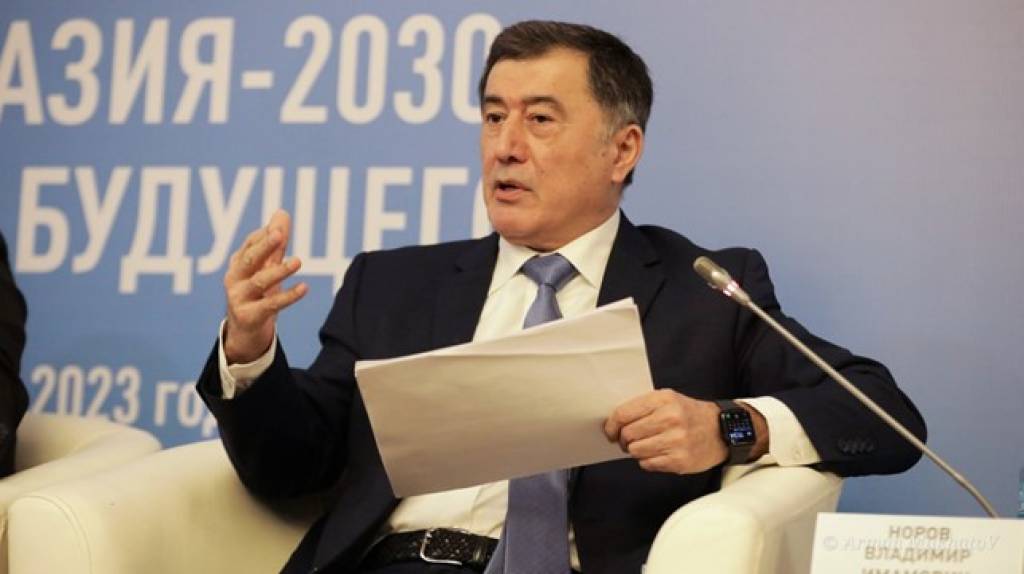
Astana hosted an Expert Meeting “Central Asia 2030: Visions of the Future”. At the meeting, current issues of development of Central Asia were discussed, the solution of which will form the strategic prospects of the region for many years to come.
Director of the International Institute for Central Asia Vladimir Norov, who took part in the event, noted in his speech that the political will and joint efforts of the leaders of the Central Asian countries contributed to the consolidation of efforts on the path to the joint development and prosperity of the region:
“We have begun to strengthen the regional subjectivity of Central Asia in global politics. Today, all over the world, the voice of Central Asia sounds louder: we are heard and listened to. Today we are creating our common future. The Central Asian region is becoming a vast area of partnership and mutually beneficial cooperation.
The mechanism of the Consultative Meetings of the Heads of State of Central Asia laid down a fundamentally new paradigm of interstate relations in the region, created the basis for strengthening unity, allowing the return of the former power of Central Asia”.
He also focused on the fact that stable Central Asia is becoming one of the important centers of economic growth. The last 6-7 years have become a breakthrough period of joint implementation of large investment cooperation projects in industry, transport, energy and infrastructure. Joint investment companies have been set up and we are actively developing interregional ties. There has never been such a dynamic before.
The total GDP of the countries of the region today is more than 347 billion dollars, having increased in recent years by more than 25%, and over the past 20 years – more than seven times.
The IICA Director cited the words of the President of the Republic of Uzbekistan Shavkat Mirziyoyev, who has repeatedly noted that “today’s realities require us to take decisive steps to form a new model of economic cooperation in Central Asia”.
In addition, Mr. Norov dwelled on the initiatives of the Head of Uzbekistan aimed at developing the region, primarily related to the need for a radical increase in the volume of mutual trade, the development of investment and industrial cooperation, the speedy implementation of joint projects to create a modern energy infrastructure, increase transport and transit potential of the region and several other important areas of cooperation.
It was noted that a free trade regime has been established between the countries of Central Asia. It is regulated by both bilateral agreements and agreements in a multilateral format.
He emphasized the importance of the speedy implementation of industrial cooperation projects, and on their basis the creation of long value chains.
At the same time, attention was drawn to the need for developing common approaches to the formation of the Central Asian space of industrial localization and import substitution.
Mr. Norov dwelt on one more important direction of cooperation, which is gaining momentum, as the creation of zones of border industrial cooperation and trade. In his opinion, they will seriously stimulate the development of interregional relations, will contribute to the creation of new industries and, accordingly, new jobs.
Another area of regional cooperation is uniting efforts and resources to attract foreign investment.
The IICA head noted that in the investment, it is necessary to create a single favorable business climate to increase the overall regional investment attractiveness, as well as to consider the possibility of creating a Central Asia Investment Fund to finance regional projects, taking into account common interests.
According to the speaker, over the next 10 years, the Central Asian region can potentially attract up to $170 billion in foreign investment, including $40-70 billion in non-primary sectors.
Along with this, the IICA Director noted the importance of building up cooperation in tourism, which can become an effective factor in the development of the economies of our countries.
He noted the need for consolidating efforts to create a mechanism for the development of intra-regional tourism, the development and implementation of the joint program “One Tour – One Region”.
At the same time, Uzbekistan and Kazakhstan are already actively working on the introduction of the so-called “Asian Schengen” – the Silk Road Visa project, in which Kyrgyz and Tajik travel companies are actively showing interest.
G.Khonnazarov, UzA