
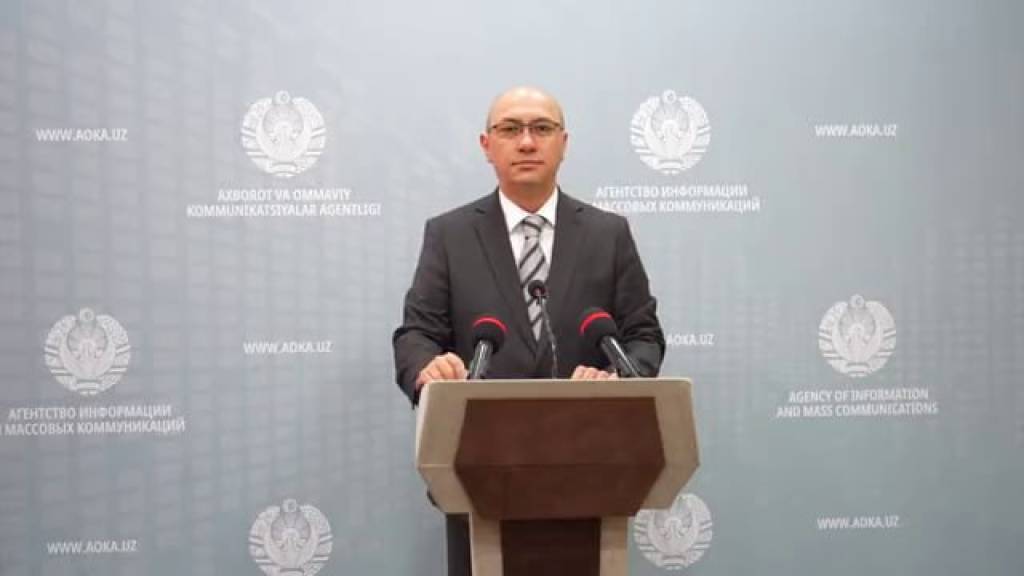
At a briefing held at the Agency for Information and Mass Communications, the Head of the Press Service of the Supreme Court, Aziz Abidov, informed about the liability for violating the electoral legislation.
– Measures of administrative and criminal responsibility for violation of the electoral legislation are outlined in the Code of Administrative Responsibility and the Criminal Code, – says Mr. Abidov. Every voter should know this. Articles 512 - 519 of the Code of Administrative Responsibility indicate measures of responsibility for offenses in organizing and holding elections and a referendum. For example, according to Article 512, interference in the activities of the Central Election Commission of the Republic of Uzbekistan, election commissions, commissions for holding a referendum, and the creation of obstacles to their work entails a fine on officials from ten to fifteen base calculated values. According to Article 513, failure to comply with the decisions of the Central Election Commission of the Republic of Uzbekistan, election commissions, commissions for holding a referendum, as well as an unlawful refusal to consider their appeals, violation of the terms for their consideration without good reason, entails a fine on officials from three to seven base calculated values.
Article 514 specifies measures of administrative responsibility for violating the rights of a candidate, proxy, observer, or authorized political party representative.
According to Articles 515-519, punishment in the form of an administrative fine is applied for: violation by a candidate, authorized representative, representative of a political party, an official of the conditions and procedure for conducting an election campaign, publication, or dissemination in other ways of knowingly false information about a candidate, political party to influence election results, deliberate destruction or damage of data, campaign materials placed on buildings, structures or in other places, during the preparation and conduction of elections or a referendum, violation of the procedure for financing elections or a referendum, violation of the process for publishing the results of public opinion polls, forecasts of election results or referendum, as well as other studies related to elections or a referendum.
Article 146 of the Criminal Code imposes criminal liability for violation of the secrecy of voting, forgery of election documents or referendum documents, making fictitious entries in ballots or signature lists, deliberately incorrect counting of votes, committed during the organization, conduction of elections or a referendum by officials, representatives of political parties or civil society institutions, members of initiative groups or election commissions or referendum commissions.
Such actions are punishable by a fine of up to 25 basic settlement units, compulsory community service of up to 360 hours, correctional labor of up to three years, restraint of liberty from one to three years, or imprisonment of up to three years.
Based on Article 147 of the Criminal Code, obstruction through violence, threats, deceit, or bribery of the free exercise by citizens of the right to elect or be elected deputies or the President of the Republic of Uzbekistan, conduction of election campaigning, the exercise by proxies of candidates for deputies or candidates for the President of the Republic of Uzbekistan of their powers, as well as obstructing the free participation of citizens in a referendum is punishable by compulsory community service up to 480 hours, or correctional labor up to three years, or restraint of liberty from two to five years, or imprisonment up to five years.
Norgul Abduraimova, UzA