
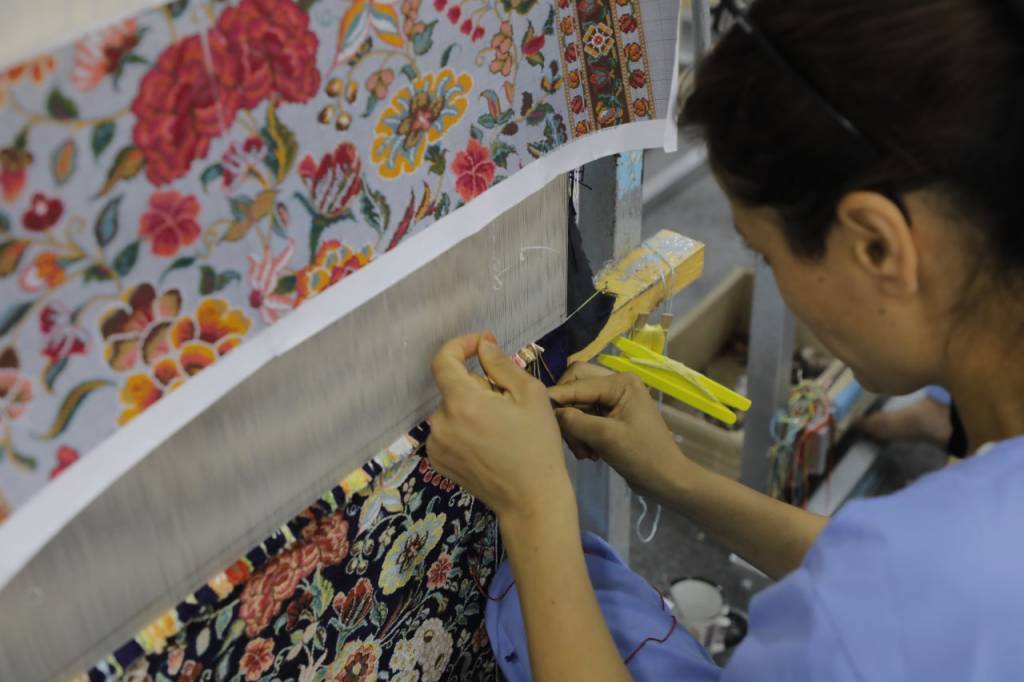
Handicraft in Uzbekistan is a traditional sphere with great potential. It employs over 25 thousand craftsmen and about 80 thousand families. Jewelry, household items and carpets created by skilled artisans leave no one indifferent.
It is worth noting that hand-woven carpets from Uzbek silk and wool have not lost their value and beauty for centuries. Today, special attention is paid to the development of this type of handicraft.
From the history of carpet weaving in the country, it is known that it became an important branch of the local industry after the establishment of a carpet production plant in Khiva in 1978. In the future, the number of carpet weaving enterprises began to increase.
Thanks to the adoption by the Head of the state on June 26, 2020, of the resolution “On measures to develop the industry of manual carpet weaving in the country”, ample opportunities were created for the development of this area. For example, in the export of handmade carpets, a subsidy mechanism has been introduced to provide subsidies to compensate up to 50 percent of the cost of transportation by road, air and rail.
Uzbekipaksanoat Association is carrying out a large-scale activity to implement the resolution.

Over the past year, the country has exported carpets to 10 countries. Carpets worth $4 million were exported to Azerbaijan, Afghanistan, Kazakhstan, Kyrgyzstan, Russia, the United States and Tajikistan.
In ancient times, carpet weaving was widespread among nomadic tribes engaged in animal husbandry. Carpets were made from cotton, linen and silk fibers, sheep, goats and camels’ wool. Wool was washed, combed with metal combs, then spun into yarn and dyed with natural dyes. Such carpets did not shed and did not lose their qualities.
Currently, carpets are also made from artificial fibers. There are carpets with piles and without them. Carpet manufacturing enterprises are equipped with modern technologies and equipment from England, Poland, Turkey and Germany.
Gulnoza Boboyeva, UzA