
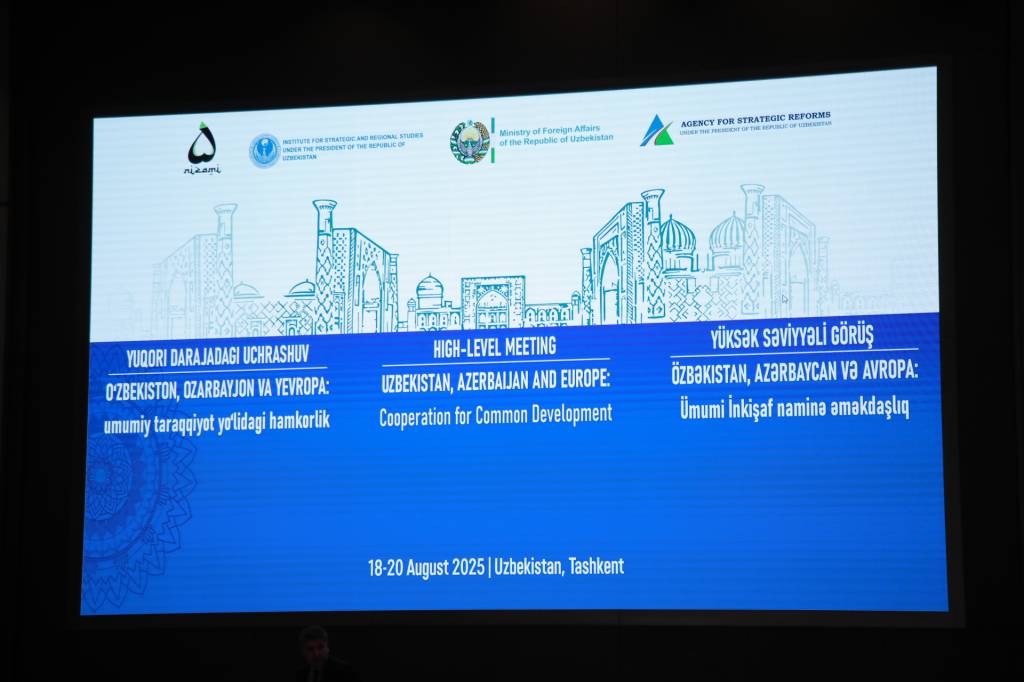
Tashkent hosts the High-Level Meeting – the International Conference “Uzbekistan, Azerbaijan and Europe: Cooperation for Common Development”.
Former heads of state, foreign ministers, and representatives of the institutions of the European Union are taking part in the event. The importance of the forum and key areas of cooperation were discussed in an interview with Bakhromjon Ismoilovich Sotvoldiyev, Head of the Department of the Institute for Strategic and Regional Studies under the President of the Republic of Uzbekistan.

– What is the significance of the current meeting in Tashkent?
– This is a platform for a substantive conversation between Central Asia, the Caucasus, and Europe. It reflects the proactive and constructive course of Uzbekistan’s foreign policy in recent years under the leadership of President Shavkat Mirziyoyev: increased trust, pragmatic cooperation, and respect for international law. The achieved level of stability in Central Asia, as a result of the policy of good neighborliness, mutual understanding, and fraternal relations, naturally attracts the attention of partners from other regions of the world.
– What are the practical results of this external line?
– We see an increase in the formats of interaction, more joint projects in the economy, transport, and humanitarian spheres. The result is a more predictable regional environment, which makes it easier to plan investments, logistics, and cultural exchanges. This is not the effect of instant decisions, but the result of consistent and balanced work.
– How do you assess the dynamics of relations between Uzbekistan and Azerbaijan?
– Relations have risen to the level of allied relations. The personal dialogue between the leaders of our countries and the practical cooperation of relevant departments facilitates this. We see systematic progress in industrial cooperation, logistics, energy, education, and culture. This strengthens not only the bilateral agenda, but also the architecture of cooperation between Central Asia and the Caucasus as a whole.
– The issue of access to sea lanes was also raised at the meeting. How does Uzbekistan approach this task?
– All the states of our region do not have direct access to the sea. Therefore, we need to diversify routes and choose short, optimal corridors for the delivery of products to seaports. Within the framework of this logic, we are actively using Azerbaijan’s transit opportunities, forming a link towards the Caucasus region and further through the Black Sea to the European market.
– What role does the Azerbaijani side play in this?
– Azerbaijan supports our efforts and provides ample opportunities to use its infrastructure and transport capacities. In turn, Uzbekistan participates in attracting Azerbaijani investments and is interested in practical cooperation on rehabilitation and modernization projects in Azerbaijan. This gives an additional impetus to business contacts and expands the range of mutually beneficial initiatives.
– Will economic cooperation affect the lives of citizens?
– Absolutely. The growth of trade and industrial cooperation takes into account the interests of our peoples, and in a broader sense, the interests of the two regions. It’s about jobs, technological exchange, improved transport connectivity, and new opportunities for education and culture. The potential is significant and opens the door to prospects that have yet to be fully realized.
– What would you highlight among the immediate practical steps?
– Continuation of work on coordinating logistics routes, increasing the capacity of corridors, simplifying procedures, and digitalizing services. In parallel, support for business missions, as well as educational and cultural programs. All of these are pragmatic measures that strengthen resilience and mutual interest.
Interviewed by Abduaziz Khidirov, UzA