
The Uzbekistan 2030 Strategy is a key strategic document that defines the country’s medium- and long-term development priorities. It aims to ensure sustainable economic growth, improve the population’s standard of living, enhance the efficiency and transparency of public administration, and develop human capital.
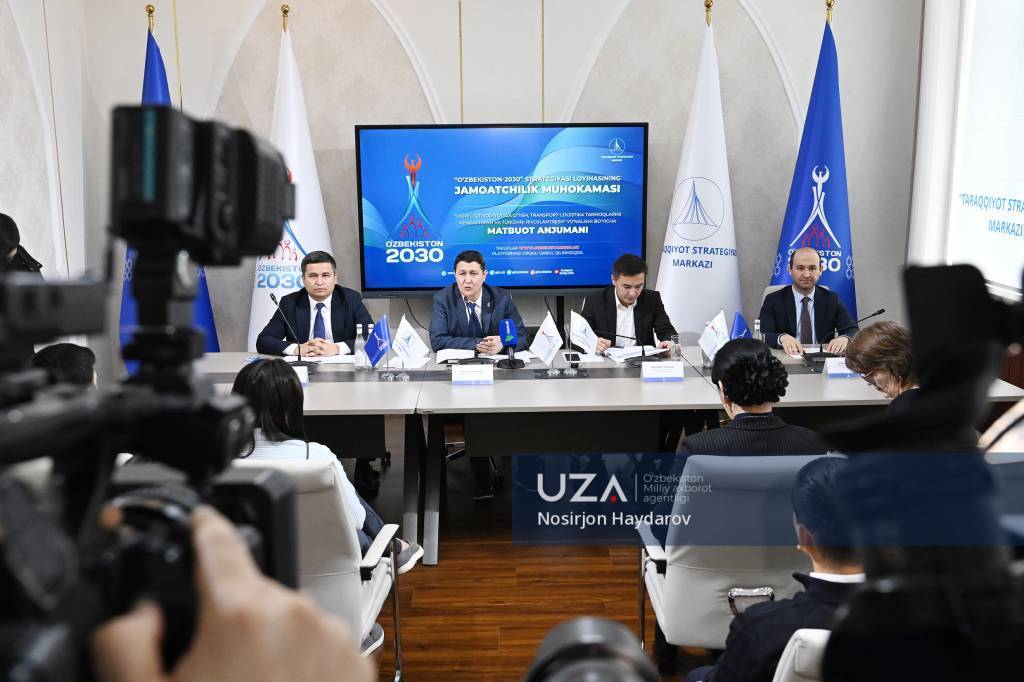
At a press conference attended by media representatives, Head of the Department of the Development Strategy Center Jamshid Sharipov, First Deputy Minister of Transport of Uzbekistan Mamanbiy Omarov, Head of the Secretariat of the Ministry of Energy Bekzod Ismoilov, Head of a Department of the Tourism Committee Oybek Hakimov, and others spoke about the key directions of the strategy.
It was noted that improving the Uzbekistan 2030 Strategy and updating the indicators outlined therein are of great importance for the country’s development and public welfare. At the same time, particular attention is being paid to ensuring the active participation of the general public in refining the document.
“In the draft Uzbekistan 2030 Strategy, priority objectives have been defined as deepening the country’s integration into global transport and logistics networks and increasing the capacity of the national transport system”, said the First Deputy Minister of Transport, M. Omarov. “It is planned to increase the volume of transport services to 301 trillion UZS, passenger and cargo transportation services to 250 trillion UZS, and to raise the number of flights to 200,000 per year, including up to 41,000 domestic flights”.
Head of the Secretariat of the Ministry of Energy B. Ismoilov noted that the updated Uzbekistan 2030 Strategy envisages a transition to a green economy by 2030, a significant increase in the share of renewable energy sources, and the stable provision of the economy and the population with the necessary energy resources. The capacity of renewable energy sources will be increased to 25,000 MW, while electricity supply to economic sectors and the population will reach 120 billion kWh.
According to the Head of the Department of the Tourism Committee, O. Hakimov, by 2030, the number of foreign tourists will reach 20 million per year, and the volume of exports of tourism services will amount to $6 billion. In the country’s regions, 4,000 new hotels, guest houses, and hostels will be established.
Following the press conference, representatives of the relevant agencies emphasized that discussions on this project will continue regularly.
[gallery-27159]
Nasiba Ziyodullayeva, UzA