
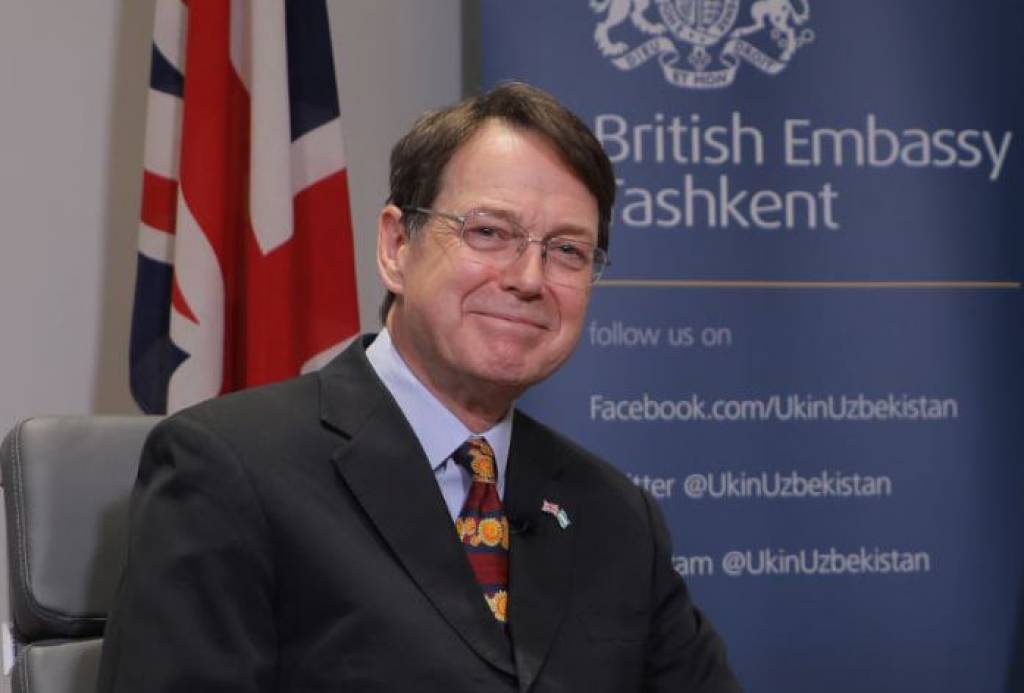
Uzbekistan National News Agency – UzA regularly organizes conversations with the heads of embassies and international organizations in the country. Another guest of the project is the British Ambassador to Uzbekistan Tim Torlot:
– Every country is different. One of the joys of doing this job is that every time I move country I move to a completely different job. With different cultures, different political systems, different languages, different histories, different sets of challenges. Uzbekistan is no exception to that. This was a completely new part of the world for me. I had not been to Asia before. I had not worked in the former Soviet Union. I didn’t speak Russian or Uzbek. I think that for me what is most fascinating is watching the country which is changing so very rapidly thanks to the reforms carried out by President Shavkat Mirziyoyev.
What drew my attention was – what a fantastic country this is to explore and discover. It’s beautiful, the mountains, lakes and rivers are wonderful, and I’ve loved getting to grips with the stunning architecture and cultural heritage of iconic places on the Silk Road. I’ve loved music, dance, textile, art, ceramics, woodcarving. I really enjoyed the food. It’s been an entirely positive experience, except the COVID, which stopped me from doing as much as I wanted and it’s only now that I am restarting that voyage of discovery.
– What do you think about the reforms being carried out in our country?
– My first thought is that they are essential. This is a world that is changing very fast, with the arrival of transformative technologies, which are requiring new skills from young people and not so young people. Which in turn require education, government and business systems, which are very different from the ones that traditionally all of us have worked with. That change is happening all over the world. But it is essential, a reform of the education system more than anything else. For me it’s the most important thing that this country needs to be doing, to equip its young people for the challenges and the requirements of the 21 century, which is very different from what we all lived through.
Those changes also mean that the economic and social changes that this country is going through are vital too. To reduce the amount of business that is in government hands, to free up the entrepreneurial talents, the skills of the millions of Uzbeks that could be working in business, in the private sector, to develop the small and medium-sized sectors of the economy, which in most developed economies is the most important sector and here in Uzbekistan it is still very modest. So much of business is still in the state’s hands and that’s not in the long-term interests.
I think what the government is doing to empower women in the workforce, education, public life is important, to harness the talents and skills of 50% of your population. That alone is going to be transformational. And I think it is important to have confidence in yourself as a country, to allow the people to play a bigger part in public life through stronger, more resilient media, through stronger, robust civil society, all of these are important developments which will create a stronger Uzbekistan.
– Let’s talk about Uzbek-British relations in the cultural and humanitarian sphere, including cooperation in the field of education. We are aware of the Chevening programme which is carried out by the Embassy. What criteria are used to select students who receive this grant?
– I love to talk about Chevening and I am really proud of it. But it’s not all we are doing in education. For me, at the moment, education is the most important area for the partnership between Britain and Uzbekistan. An increasing number of British educational institutions, particularly universities looking for relationship with Uzbek counterparts. We all know about Westminster International University in Tashkent, but there are probably now somewhere between 20 or 30 British universities that have some sort of partnership with Uzbek institutions. And that’s growing all the time. We signed another three at the Uzbek-British Trade and Industry Council last year.
Chevening is the highest profile scholarship scheme that we have. It is sadly relatively modest in size, we would love to be able to send more Uzbek students to the UK, because we get some great scholars. What we are looking for is real leadership potential, someone who is going to benefit from a full-time masters-level course of study at a top British university to acquire the skills, the mentality, and the confidence to go on to the very top, of whatever it is that they choose to do. Whether it is public life, politics, business, healthcare, working on climate issues – it does not matter, but we are looking for people who can be real leaders in the future. A strong knowledge of English is required, because they are going to have to do a very demanding academic course in considerable depth, once they get to the UK. So we require leadership potential, strong English, and a real motivation to study in the UK as well. There are lots of international scholarships, but why particularly the UK? So an understanding of what makes Britain and British academic qualifications special. Finally, we are looking for someone who has a clear career plan and an understanding of how Chevening will help achieve it.
– It is known that many Uzbek students are currently studying in Britain. Hundreds of our young people are studying in various higher education institutions in the UK through the “El-Yurt Umidi” Fund alone. What advice would you give them?
– First of all, I would say I really hope that they enjoy life and study in the UK. It’s a great country, though it’s not always an easy country to get to grips with. The three pieces of advice I would give to anyone going there is first of all make the most of your time. Travel as much as you can, see as much of the country as you possibly can. Britain has an amazing cultural heritage and a diversity of people and landscapes. So take the opportunity to discover Britain, and Europe, which are very close.
Second, reach out to make the most of the university that you are at. Once you are a member of that university you don’t just have to go to lectures and classes in the discipline that you’re studying. If there is something that interests you in a completely different area of work, go and enjoy doing that. And finally, do something that gets you out of your comfort zone – that you’d never try if you stayed in Uzbekistan.
– How is the direction of the projects implemented by the United Kingdom, in particular, the Embassy, determined? Development of which other areas do you think you can contribute to by allocating grants in the future?
– There are three principle sources of funding for the project work we do here. Our flagship programme is called Effective Governance for economic development. And it works from the principle that good government policy is best designed and implemented by working closely with people, it is evidence-based policymaking. We have chosen to run our first projects in that program in six key areas:
- Labor market reform
- Governance of state-owned enterprises
- Public procurement
- Green economy
- Planning
- Taxation
Those were agreed jointly between the government of Uzbekistan and ourselves and with the World Bank, who are our implementing partners. We chose areas in that we thought we could make a difference. We are reaching a point where we going to go to the second phase of that programme. So we will be thinking through with our various partners where we go next. I think what we will end up doing is consolidating some areas where we have worked successfully, perhaps looking for one or two new areas as well. That is a work in progress.
We also have a series of projects around our trade relationship, our business relationship. So we’ve done some work, for example, around creating an international financial centre for Tashkent, using the City UK. We’ve done work to support Uzbekistan’s accession to the WTO that’s ongoing at the moment. And there is potential to support other areas of business development. We’ve just started, for example, a programme working with USAID to support aspects of helping the textiles and agricultural sectors in Uzbekistan to export their products and services to UK markets, taking advantage of our developing countries trading scheme, of which Uzbekistan is a member. And then finally, we’ve been doing other project work around climate change particularly, helping young people to understand climate change, to advocate for climate change and to support climate change in their community and in public life. But we also have really important work around gender-based violence and women’s empowerment. Those will continue, I think, to be the key areas that we work on in the future.
In the past we’ve done good projects also around freedom of expression, media development, working both with independent journalists here, but also with government communications to make sure government is better equipped to communicate the changes that are going on. We’ve also done some work to create “Madad” which is based on a British model and continue to provide funding for Madad, which helps ordinary citizens, particularly in vulnerable communities, to understand the benefits of government reform to be able to access those benefits and when something goes wrong, to be able to advocate for sorting out problems which are based on a British model.
– British Prime Minister Rishi Sunak spoke about reducing the country’s foreign aid spending. Will this affect the projects in Uzbekistan?
– Well, I think the background to this is quite clear. We, as a government, committed to using 0.7% of our gross national income for our overseas development and administration funding. Because of the hit to the economy that we all suffered during COVID, the government took the decision temporarily to reduce that to 0.5%, which has had quite an impact on our development spending all over the world, not just in Uzbekistan. The government has said that they want to get that back up to 0.7%, but we don’t yet have a timescale for that. So we have seen a real term reduction in our development expenditure in Uzbekistan as elsewhere in the world. But we’re still doing really good things in this country and the UK was still the world’s fourth biggest contributor in 2021.
– What do you think about the media in our country? What publications or websites do you follow? How would you rate the level of freedom of speech in general?
– First of all, I think freedom of speech and the media is a work in progress in Uzbekistan. I think if you compare it with the environment for media six years ago, this country has made enormous progress. There is a more robust, independent media, particularly online. There is an entire blogosphere that didn’t exist before and which is transformational in terms of how people, particularly young people, communicate with each other and talk to each other and get their news and opinions. And that’s a good thing. There is of course also a downside, as it makes for very sometimes confrontational and opinionated news. But it’s part of a free modern society and the challenges of the blogosphere are ones that every country on the planet is dealing with.
So I think in simplistic terms, Uzbekistan is in a better place, but it clearly still doesn’t have free media. There is still quite considerable self-censorship, and control of the media. There are still issues that are difficult for the media to write about. The standards of journalism are slowly improving.
I get most of my news about this country from uza.uz, gazeta.uz, and kun.uz.
– You are well aware that in recent years the European Union has been paying special attention to the expansion of relations with Central Asia and Uzbekistan in particular. In such a situation, won’t UK’s departure from the EU affect the development of cooperation with our country negatively?
– I think we have a strong relationship with Uzbekistan. It’s a relationship that we as an independent sovereign state are working hard to develop. This Embassy has doubled in size in terms of the number of British diplomats working here in the last four years to reflect the importance of the relationship we have with this country. This is a region that is increasingly important for all of us. And I think that we and the EU and other partners in Europe are increasingly important for the government of Uzbekistan and your business community and your educational community and others. So I think there is mutual benefit in developing a much more diversified set of relationships, whether that’s with the EU, whether it’s with Britain, whether it’s Japan or Korea or India or Pakistan or Türkiye. This is a very positive aspect of Uzbekistan’s foreign policy.
Interviewed by Guzal Sattorova, UzA