
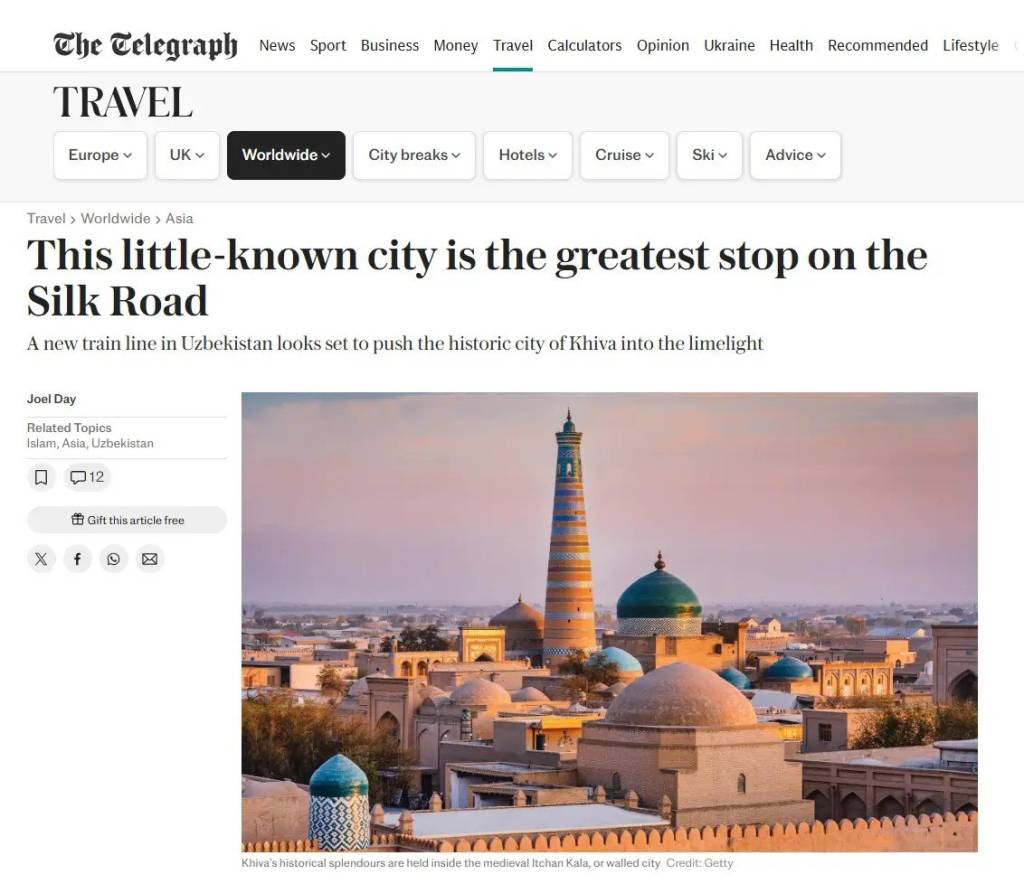
The Telegraph, a leading British daily newspaper, published an article on Khiva, one of the oldest cities in Uzbekistan and an important center of the Great Silk Road.
The publication’s author, British journalist Joel Day, notes that in the 21st century, such places rarely stay hidden gems. And so it is with Khiva.
The prized Silk Road site does not attract as many visitors as its sister cities Bukhara and Samarkand – a combined 2.5 million fewer annually – but the Uzbek government intends this year to launch a new high-speed train between Khiva and the capital, Tashkent. It will reduce the journey from the current overnight sleeper of 15 hours to a relatively brisk daytime venture of just seven. This is a development that is set to change Khiva forever.
Almost all of Khiva’s historical splendours are held inside the medieval Itchan Kala. An open-air museum littered with palaces and mosques, madrasahs and mausoleums, visitors may guffaw when arriving at its main entrance, the Western Gate.
The author notes that the majority of Islam’s most important and oldest places of worship sit in the Middle East, but the Juma Masjid is one of its forgotten sanctuaries. Built in the 10th century, just 300 years after Islam emerged, it is propped up by more than 200 wooden pillars, some of which are 1,000 years old.
The author emphasizes that Khiva is an immensely walkable city, and just a minute from the mosque lies a structure that signalled an era of change. At the end of the article, the author writes about the availability of direct flights from London to Tashkent and the possibility of further travel to Khiva by high-speed train, as well as recommendations on accommodation and booking.
Aziza Alimova, UzA