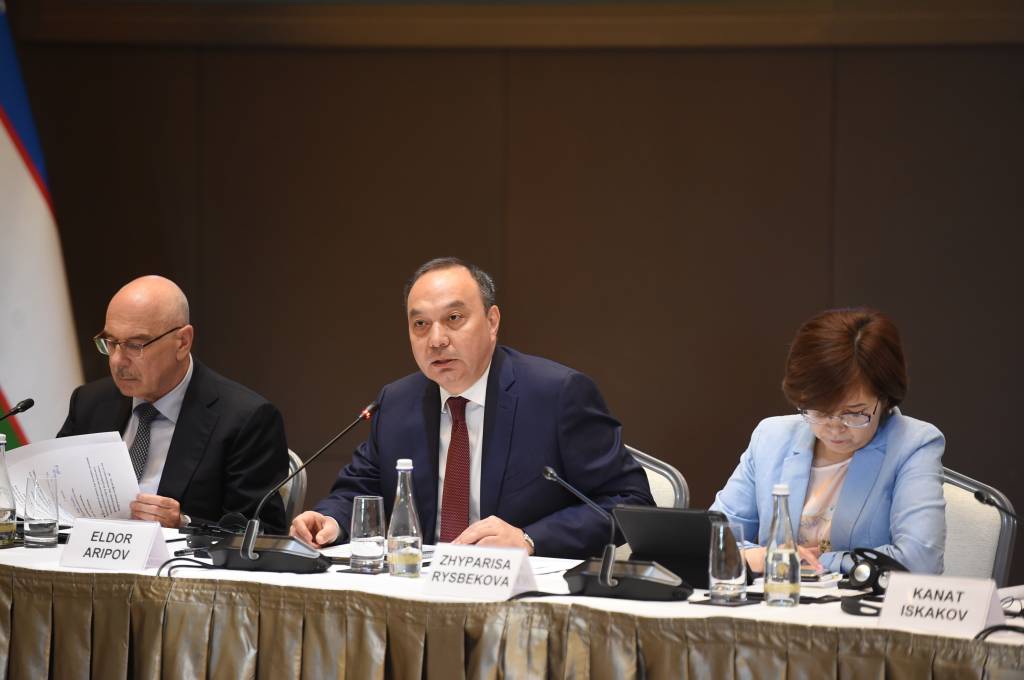
Addressing the first meeting of the Central Asia Regional Expert Council on rehabilitation and reintegration, which takes place in Tashkent, the Director of the Institute for Strategic and Regional Studies (ISRS) under the President Eldor Aripov emphasized the importance and significance of this Council, the initiative to establish which was forwarded by the Leader of Uzbekistan Shavkat Mirziyoyev in 2022.
As the ISRS representative noted, the fight against terrorism is becoming one of the international community’s priorities. In such conditions, the joint search for practical solutions to combat this dangerous phenomenon, which knows no borders, nationality, or religion, becomes especially relevant.
“The representative composition of participants gathered at the event personifies the regional consensus on general principles and methods in countering terrorism. By launching the activities of the Council, for the first time, we are witnessing the institutionalization of regional cooperation, designed to increase the effectiveness of our collective efforts in this direction”, E. Aripov said.
It was noted that the Regional Council’s creation complies with all recommendations of the UN Office of Counter-Terrorism and the Executive Directorate of the UN Security Council Counter-Terrorism Committee. Its activities are based on an integrated approach that includes prosecution, social support and reintegration, theological deradicalization, and involvement in local communities and civil society.
In this regard, the expert is convinced that only a whole-of-state and comprehensive approach, relying on multilateral cooperation, can give effective results in countering terrorism.
“As the President of Uzbekistan rightly noted, our policy in this area is based on a comprehensive, inclusive, consistent approach using preventive and prophylactic measures. Not only government bodies, but also civil society institutions actively participate in these processes. It is gratifying that such an approach is inherent in all Central Asian states”, the ISRS Director emphasized.
The expert added that since 2019, Uzbekistan has repatriated a total of more than 530 people from Syria, Iraq, and Afghanistan during five “Mehr” operations.
It was also noted that based on consultations with UNICEF, UNDP, and UNOCT, a comprehensive, targeted rehabilitation program was developed and implemented, including access to educational, medical, and social programs. In addition, work has been done to create the conditions for the full integration of repatriates into society, reuniting them with their families and returning to local communities.
The result of these efforts was that during the 47th session of the UN Human Rights Council (July 2021, Geneva), the Uzbek repatriation experience was praised as a unique approach based on family values and close social relations.
“This is evidenced by the statement of the UN Special Rapporteur on the promotion and protection of human rights and fundamental freedoms while countering terrorism Ms. Fionnuala D. Ní Aoláin. According to her, the Uzbekistan model, implemented effectively, humanely, and with respect for human rights, is an example of best practice in reintegration, puts family unity and community support, the interests of the child and women at the center of political, legal and social action”.
G. Khonnazarov, UzA