
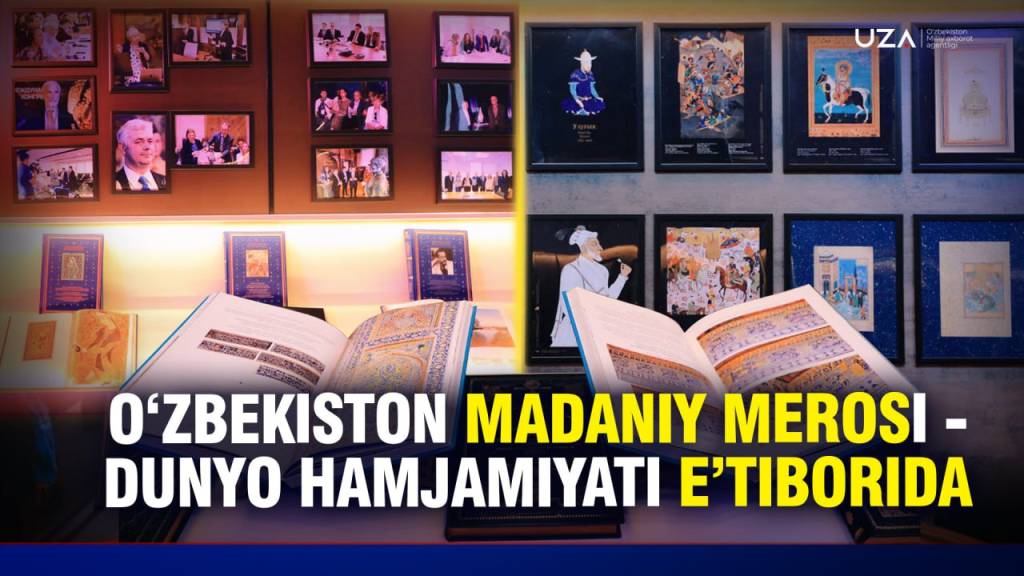
Samarkand hosted the events of the second day of the 7th International Congress “The Cultural Legacy of Uzbekistan: The Foundation of a New Renaissance”.
The congress, organized by the World Society for the Study, Preservation and Popularization of the Cultural Legacy of Uzbekistan, is attended by more than 300 representatives of the field, orientalists, art historians, and scientists from 40 countries.
An UzA correspondent interviewed the participants about the significance of this international congress and the expected results.
Firdavs Abdukhalikov, Chairman of the World Society for the Study, Preservation and Popularization of the Cultural Legacy of Uzbekistan:
– Our main goal is to study, preserve, and popularize the cultural heritage of Uzbekistan. This goal was announced by our President and raised to the level of state policy.
Scientists and specialists from 40 countries help us achieve our goal. Together with them, we are preparing for the publication of a book album from the series “Cultural Legacy of Uzbekistan”. At the current congress, we presented the 10th volume of this series. The total number of volumes will be 70. Every year, we publish ten volumes.
Preparing such a publication is not an easy job and requires a lot of work. Foreign scientists trust Uzbekistan, so they provide access to their museums, funds and cooperate with us.
At the same time, the preparation of the book album is the result of the open policy pursued by the President.
Abdulrahman Al-Salimi, orientalist (Sultanate of Oman):
– This is the first time I am taking part in the activities of the World Society for the Study, Preservation and Popularization of the Cultural Legacy of Uzbekistan. Therefore, there are a lot of impressions. Many books have been published, and scientists are actively participating, presenting detailed materials.
I would like to note that relations between Uzbekistan and the Sultanate of Oman have deep historical roots.
Our countries are connected by the Great Silk Road, Uzbekistan – by land, and the Sultanate of Oman – through rivers and the ocean.
Bakhrom Abdukhalimov, Vice President of the Academy of Sciences of Uzbekistan, orientalist scientist:
– Most of the ten books presented at the congress are especially important because they relate to scientific activities.
International scientists are delivering reports that present unknown and essential historical information for us.
For example, the famous scientist from Türkiye Halik Eren, in his report, presented information that at one time, the Khan of Kokand Umarkhon sent gifts to the Sultan of Türkiye Mehmed II. Among the gifts was a manuscript. It turned out that this was a copy of the Quran, rewritten in Kokand.
At the congress, we talked with this specialist from Türkiye. He presented a lot of exciting information. We will make arrangements to publish this facsimile. We hope that by the following international congress, this manuscript will be included in one of the editions of this collection.
Nasiba Ziyodullayeva, UzA