
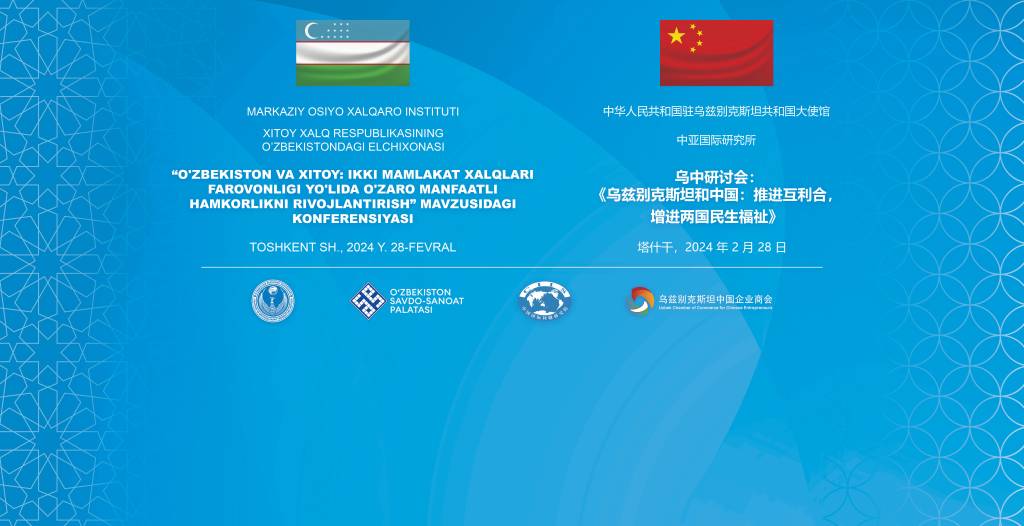
On February 28, the International Institute for Central Asia and the Embassy of China in Uzbekistan will host an International Conference “Uzbekistan and China: Advancing mutually beneficial cooperation for the peoples of both countries”.
The forum partners are the Institute for Strategic and Regional Studies under the President of the Republic of Uzbekistan, the Chamber of Commerce and Industry, the China Institute of International Studies, and the Chamber of Commerce and Industry of Chinese Enterprises in Uzbekistan.
The forum will be attended by leading think tanks from both nations, representatives from ministries and agencies, and heads of Chinese companies in Uzbekistan.
A discussion will take place on the results of President Shavkat Mirziyoyev’s state visit to China on January 23-25 this year and his negotiations with the President of China, Xi Jinping.
The Joint Statement signed by the heads of state announced the establishment of an “all-weather, all-round strategic partnership in a new era”. During the visit, 15 intergovernmental, interagency, and interregional agreements were concluded. Decisions were made to expand project financing by Chinese banks, open a representative office of the Export-Import Bank in Uzbekistan, and create a new investment platform with the Silk Road Fund. Agreements were reached to expand infrastructure development and industrial cooperation programs.
During the conference, views on deepening strategic partnerships and further promoting sectoral and interregional cooperation will be exchanged.
In the speeches of representatives of the business community of Uzbekistan and leading Chinese companies in the country, special attention will be paid to the issues of the social impact of ongoing projects.
Conference participants will make proposals to expand mutually beneficial cooperation in key areas and enhance its positive impact on the two countries’ socio-economic development.
G. Khonnazarov, UzA