
The state visit of the President of Uzbekistan Shavkat Mirziyoyev to Azerbaijan on August 22-23 became an important historical event and demonstrated the highest level of bilateral interaction.
This is evidenced by signing a solid package of documents covering all areas of cooperation, from politics to cultural and humanitarian interaction.
At the same time, the parties paid particular attention to the development of cooperation in transport and logistics. In particular, during the negotiations, an agreement was reached on implementing projects for building new supply chains and infrastructure construction, a partnership in introducing an electronic exchange information system.
The implementation of these measures will make it possible to unleash the transport and logistics potential of the two countries, including simplifying the procedures for exchanging permits for international road transport by introducing the E-Permit system, and also contributes to a phased transition from paper to electronic permit forms using secure information technologies.
It should be noted that taking into account geographical features, Uzbekistan and Azerbaijan are united by a common desire to form an extensive system of transport and logistics corridors, increase the volume of mutual cargo transportation, and increase the transit potential of not only our two countries, but also the regions of Central Asia and the Caucasus.
Undoubtedly, Uzbekistan needs to use the transit potential of the Baku – Tbilisi – Kars railway, which is part of the Trans-Caspian international transport route, known as the “Middle Corridor”, which ensures the entry of Uzbek goods to the world market. Since 2018, measures have been implemented to pilot the transit transportation of foreign trade goods along this railway route. Uzbekistan expects to increase deliveries via this transport route, considering that its throughput capacity will be increased to 5 million tons per year by 2024.
In this direction, increasing cargo transportation through the Baku International Sea Trade Port seems promising. It should be noted that in 2022, the volume of export-import cargo transportation from Uzbekistan through the Baku port amounted to 904 thousand tons, which is 65% more compared to 2021. Food cargo transportation volumes, including raw sugar, mineral fertilizers, and containers, have noticeably increased.
Moreover, Uzbekistan is currently working on opening its terminal in the Baku port of Alyat on the principles of public-private partnership. The issue of creating infrastructure in this port for warehousing and storage of goods from Uzbekistan is at the stage of study. By the end of the year, Uzbekistan plans to increase deliveries through the ports of Azerbaijan and Georgia to 1.5 million tons.
Another example of successful cooperation in the transport sector is the CASCA+ project with the participation of Uzbekistan, Azerbaijan, Georgia, Türkiye, Kyrgyzstan, and Turkmenistan, due to which goods are transported both between the participating countries and from China to Europe and vice versa.
The achievement of agreements between the participants on the provision of preferential tariffs within the framework of CASCA+ allowed Uzbekistan to increase the export transportation of goods in containers to Türkiye and the countries of the European Union.
In general, it can be stated that in the context of the observed reorientation of transportation and the development of logistics along land transcontinental routes in the north-south and west-east directions in the implementation of the “Middle Corridor”, CASCA+ projects, Azerbaijan becomes a gateway to Europe for Uzbekistan. At the same time, Uzbekistan, for Azerbaijan, is a gateway to Asia.
In turn, Baku’s interest in extending the China – Kyrgyzstan – Uzbekistan railway lines to the Caspian Sea, as well as the opening up prospects with the creation of the Trans-Afghan Railway, will strengthen the positions of Uzbekistan and Azerbaijan in the international transit system and turn the Central Asian states into a key land artery connecting Azerbaijan with China and the South Asian region as a whole.
In conclusion, I would like to note that the Uzbekistan – Azerbaijan Summit once again demonstrated the achieved high level of mutual trust and the readiness of the parties to increase practical cooperation, including in the transport, transit, and logistics areas. This, in turn, will contribute to the further sustainable and stable development of our countries and regions.
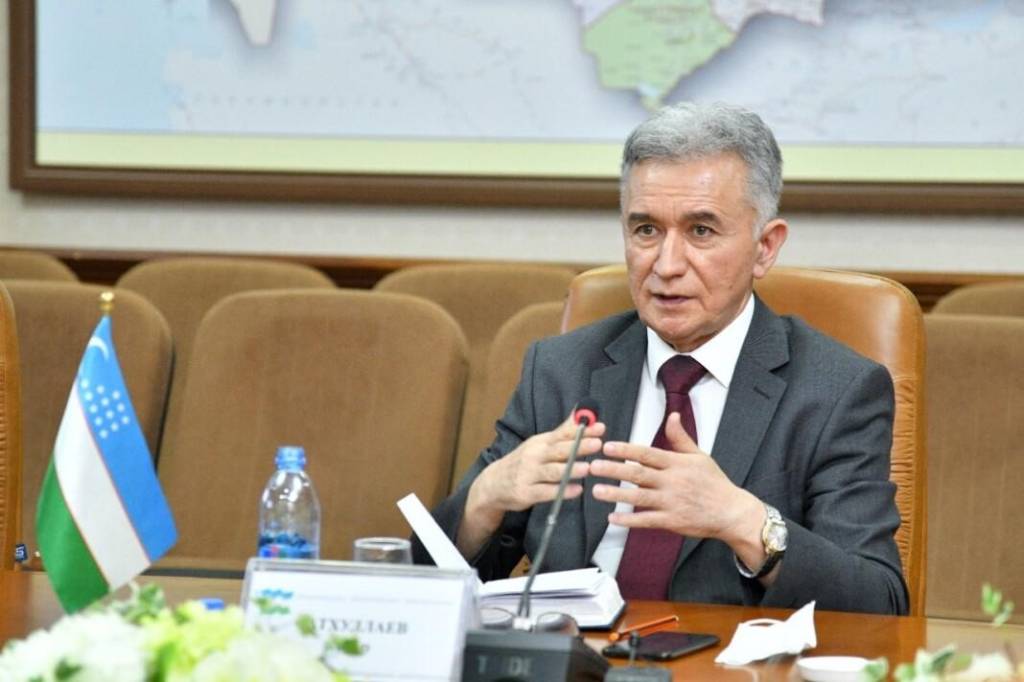
Abror Fatkhullayev,
Department Head at the Institute for Strategic and Regional Studies under the President of the Republic of Uzbekistan.