
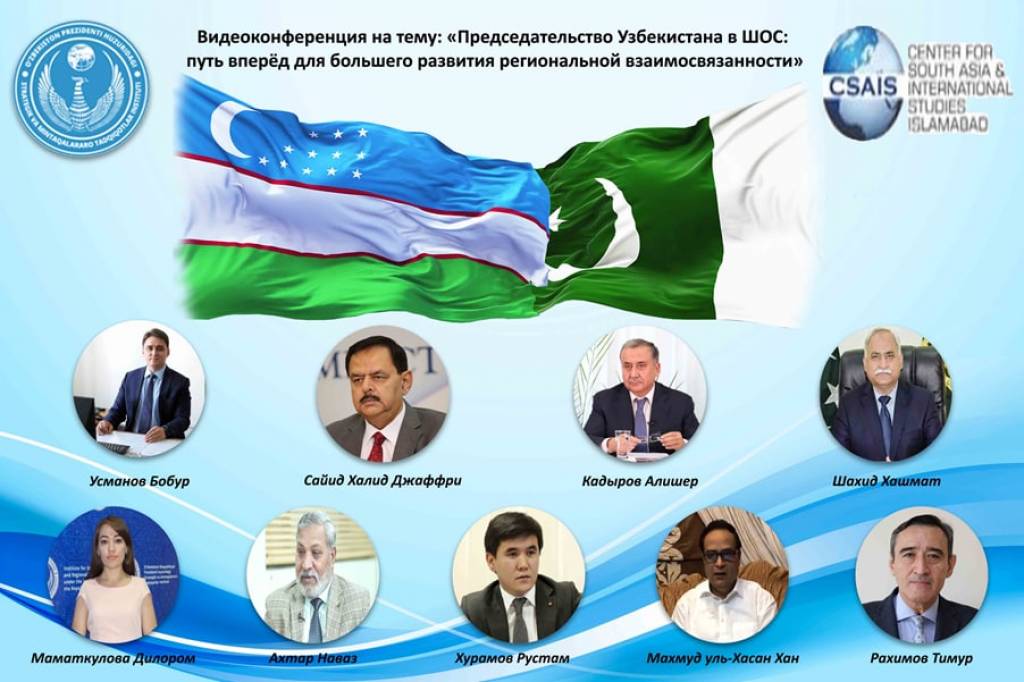
On 5 July 2022, an international online conference was held on “Uzbekistan’s chairmanship in the SCO: the way forward for greater development of regional connectivity”.
Leading experts of analytical structures, diplomats and prominent representatives of the academic community of the two countries took part in the webinar, organized by the ISRS under the President of the Republic of Uzbekistan together with the Center for South Asia and International Studies (CSAIS) of Pakistan with the assistance of the Embassy of Uzbekistan in Islamabad.
The representative composition of the participants of the event made it possible to discuss in detail the current state and prospects for the development of Uzbek-Pakistani relations within the framework of the SCO, issues of the Afghan settlement, as well as the strengthening of interregional connectivity between Central and South Asia.
 Opening the event, ISRS Deputy Director Bobur Usmanov emphasized that for Uzbekistan the SCO is one of the priority multilateral foreign policy platforms for implementing a political course focused on the development of interregional connectivity.
In this context, he added, “our state is interested in the full realization of the potential of the SCO in the new conditions of its development, primarily through increasing practical cooperation in promising areas that meet the interests of all member countries”.
To this end, Uzbekistan is making great efforts to fill the activities of the SCO with new content. Thus, the plan of the current chairmanship of the Republic of Uzbekistan envisages holding more than 80 major events that cover not only the already established areas of interaction, but also new areas in demand within the Organization.
At the same time, Bobur Usmanov placed special emphasis on the need to develop Uzbek-Pakistani cooperation within the framework of the SCO. According to him, this is deeply connected with the issues of restoration and expansion of ties between the regions of Central and South Asia.
 Supporting the opinion of his Uzbek colleague, CSAIS President Syed Khalid Jaffery expressed his satisfaction with the growing Uzbekistan-Pakistani ties and the prevailing high level of political trust, which today allows the two countries to develop multilateral cooperation within various international platforms, including the SCO.
In this regard, he pointed to the mutual interest of the two states in expanding the SCO cooperation agenda. The Pakistani expert also expressed his conviction that current Uzbekistan’s chairmanship in the SCO opens up new opportunities for all members and partner countries of the Organization to consolidate efforts to form a common economic future.
 In this context, Shabir Ahmad Khan, Director of the Center for Central Asian Studies at Peshawar University, emphasized that global trade is moving to the Asian continent and there is significant economic development in the SCO space and nearby regions.
In this regard, the Pakistani expert noted the need for developing investment ties between the SCO member states. In particular, he called for the use of the Organization’s financial institutions for the implementation of interregional infrastructure and economic projects.
 Speaking positively about the practical initiatives of Uzbekistan within the framework of the SCO, Shahid Hashmat, an expert of the CSAIS, emphasized the high productivity of current Uzbekistan’s chairmanship in the Organization.
At the same time, he noted that strengthening cooperation between Uzbekistan and Pakistan could become a catalyst for further expansion of trade and economic exchanges in the Shanghai G8 space. In this vein, he noted the need for including issues of restoring trans-regional connectivity between Central and South Asia in the agenda of the SCO. “All SCO member states are interested in creating a reliable overland transport route capable of ensuring the continuous exchange of goods and services”, he explained.
 Commenting on the above-mentioned opinions, Akhtar Nawaz, a Senior Member of the Board of Directors of the CSAIS, noted the importance of normalizing the situation in Afghanistan for the implementation of interregional projects. The expert emphasized that the Afghan issue should not be left out of the attention of the SCO member states.
 In this context, Akhtar Nawaz noted that Tashkent and Islamabad act as reliable and trusting partners in helping to overcome the humanitarian crisis and establish long-term stability on Afghan soil. “Peaceful Afghanistan will open a reliable path to broad and multifaceted interregional cooperation and will act as a link between the two parts of the SCO space”, the Pakistani expert added.
Elaborating on the opinion of a colleague, Dr. Mehmood Ul Hassan Khan, Director of CSAIS, emphasized that Afghanistan and Pakistan have great potential to connect the Center.
“In this regard, the planned construction of the Trans-Afghan corridor will create unique opportunities for expanding not only interregional trade and economic ties, but also ensuring the rapid socio-economic growth of the states of the two neighboring regions”, Mehmood Ul Hassan Khan stated.
UzA