
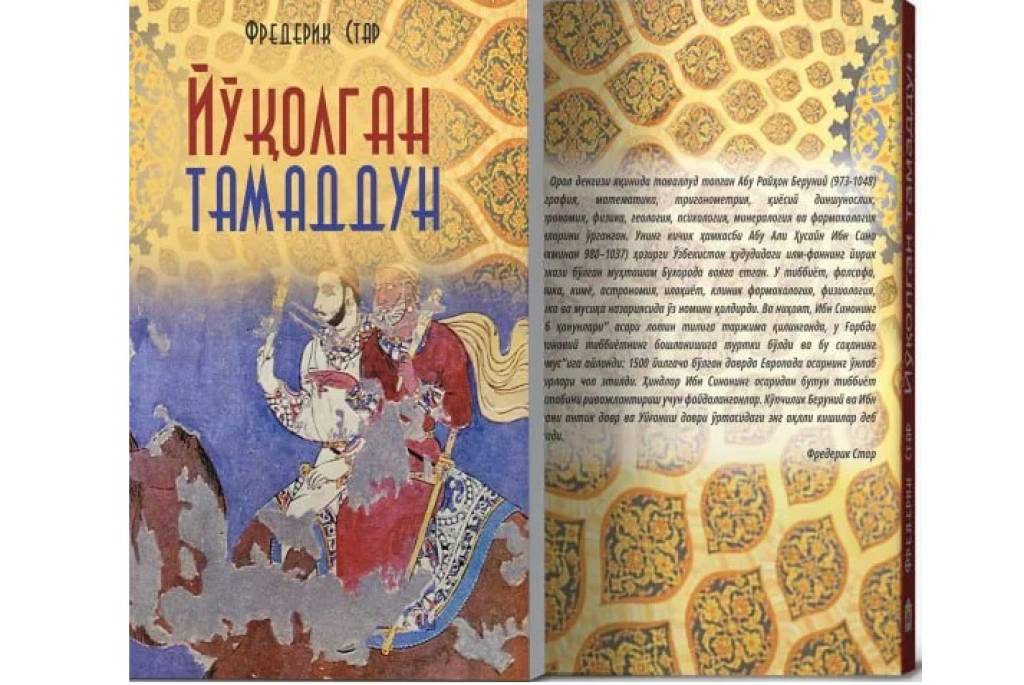
The Imam Maturidi International Scientific Research Center has translated the internationally acclaimed book “Lost Enlightenment” into Uzbek by the renowned American historian and journalist Frederick Starr.
In this sweeping and richly illustrated history, Frederick Starr tells the fascinating but largely unknown story of Central Asia’s medieval enlightenment through the eventful lives and astonishing accomplishments of its greatest minds – remarkable figures who built a bridge to the modern world. Because nearly all of these figures wrote in Arabic, they were long assumed to have been Arabs. They were from Central Asia – drawn from the Persianate and Turkic peoples of a region extending from Kazakhstan southward through Afghanistan and from the easternmost province of Iran through Xinjiang, China.
Lost Enlightenment recounts how, between the years 800 and 1200, Central Asia led the world in trade and economic development, the size and sophistication of its cities, the refinement of its arts, and, above all, in advancing knowledge in many fields. Central Asians achieved signal breakthroughs in astronomy, mathematics, geology, medicine, chemistry, music, social science, philosophy, and theology, among other subjects. They gave algebra its name, calculated the earth’s diameter with unprecedented precision, wrote the books that later defined European medicine, and penned some of the world’s most outstanding poetry.
During the book’s preparation for publication, a dialogue was held with the author, facilitated by the Embassy of Uzbekistan in the United States, and official permission for publication was obtained. The book, published by the Imam Maturidi International Scientific Research Center, will be distributed across all educational institutions in Uzbekistan. It is worth emphasizing that “Lost Enlightenment” serves as an essential and valuable resource for the academic community and all readers interested in the history and culture of Central Asia.
UzA