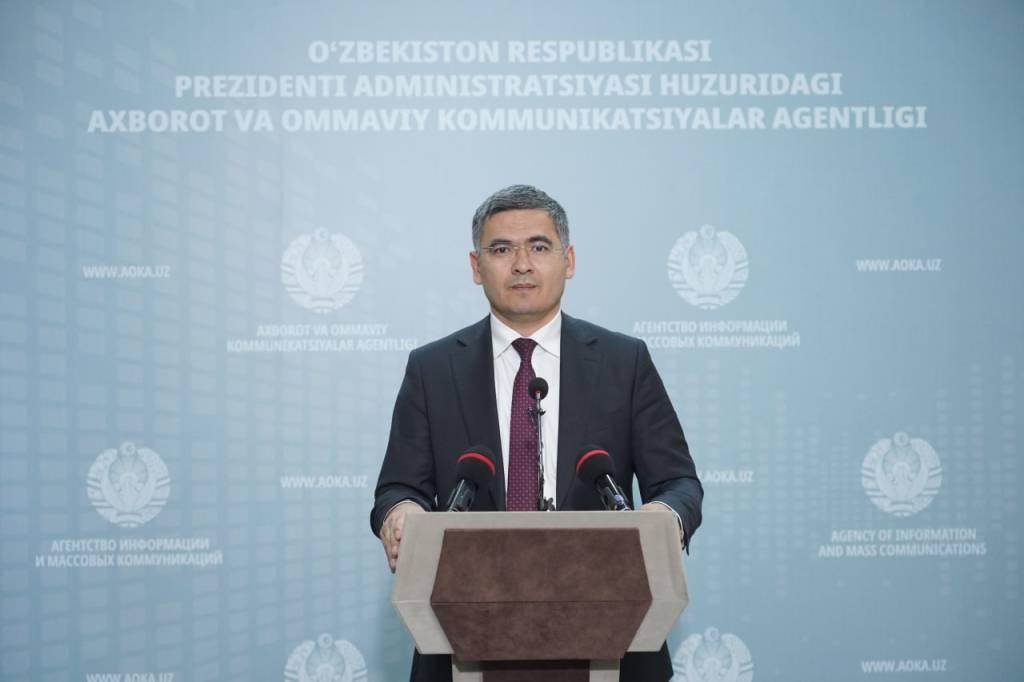
What work has the Anti-Corruption Agency of the Republic of Uzbekistan carried out within the framework of international cooperation? The Head of the Agency’s Information Service, Sherzod Saparov, provided insights:
– On January 29-30 this year, the Anti-Corruption Agency, in collaboration with the UNODC Regional Office for Afghanistan, Central Asia, Iran and Pakistan, organized a two-day training session on “Mechanism for Reviewing the Implementation of the UN Convention against Corruption”.
The training featured expert participants from 26 agencies, including the General Prosecutor’s Office, the State Security Service, the Ministry of Internal Affairs, the Supreme Judicial Council, and the Ministry of Higher Education, Science, and Innovation.
The training aimed to enhance knowledge of the UN Convention against Corruption and its review mechanism and develop practical skills necessary for the successful implementation of the convention’s second phase.
As is known, in accordance with the Presidential Decree of June 29, 2020, the Anti-Corruption Agency was designated as the national coordinator for implementing measures related to the UN Convention against Corruption and other international agreements of Uzbekistan, as well as activities in this field.
Uzbekistan is undergoing the second phase of the convention’s review process. The Anti-Corruption Agency is responsible for Chapter 2 (Preventive Measures Against Corruption), while the General Prosecutor’s Office oversees Chapter 5 (Asset Recovery Measures). Two working groups have been established to facilitate this process, consisting of leaders from relevant agencies.
The training covered the key requirements for implementing these UN Convention against Corruption chapters.
The state visits of the leaders of Uzbekistan and Malaysia and the agreements reached during these meetings, particularly on joint anti-corruption projects, have elevated cooperation between the two countries to a new level.
The visit of the Uzbekistan delegation to Malaysia in February this year further contributed to expanding and strengthening practical collaboration to combat this negative phenomenon.
During a meeting between Azam bin Baki, Chief Commissioner of the Malaysian Anti-Corruption Commission, and Akmal Burkhanov, Director of the Anti-Corruption Agency of the Republic of Uzbekistan, the Malaysian expert expressed satisfaction that the international community recognizes Uzbekistan’s progressive anti-corruption policy. He also noted that President Shavkat Mirziyoyev has become a regional leader in this field.
He further emphasized that, for the first time in Malaysia’s international relations history, the issue of expanding cooperation in the fight against corruption was included in the agenda of high-level talks between heads of state.
As a result, the Anti-Corruption Agency of Uzbekistan and the Malaysian Anti-Corruption Commission signed an Action Plan for 2025-2026. Within this framework, an agreement was reached to expand partnerships in anti-corruption training for government officials and law enforcement personnel and promote regular exchanges of best practices in this field.
During a dialogue with the Head of the Malaysia Anti-Corruption Academy, Saiful Ezral Ariffin, the Malaysian side highly appreciated Uzbekistan’s efforts to create a zero-tolerance environment for corruption. They also expressed readiness to provide technical and expert support for the launch of Uzbekistan’s Virtual Anti-Corruption Academy.
At a meeting held at the Malaysian Institute of Integrity, the Institute’s Chief Executive Officer, Tuan Haji Rahman, stated that Malaysia’s Integrity Screening Process for public officials has yielded positive results. He expressed willingness to work closely with Uzbekistan to implement this practice in the country.
As part of the technical assistance project “Support for Anti-Corruption Measures to Improve the Investment Climate” for 2024-2025, implemented in cooperation with JICA, the Uzbekistan delegation is participating in an anti-corruption training program in Japan. The delegation includes representatives from the Anti-Corruption Agency, the General Prosecutor’s Office, the Ministries of Justice, Economy, and Finance, the Law Enforcement Academy, and the Tashkent State University of Law.
The training covers key topics such as the effective implementation of public procurement legislation, prevention of violations during tender processes, scientific research on anti-corruption monitoring, detection of corruption cases, compliance with ethical standards for public officials, and training systems for civil servants.
Currently, in collaboration with Japanese experts, Uzbekistan’s Anti-Corruption Agency is finalizing the development of a manual on corruption prevention in public procurement.
Interviewed by Norgul Abduraimova, UzA