
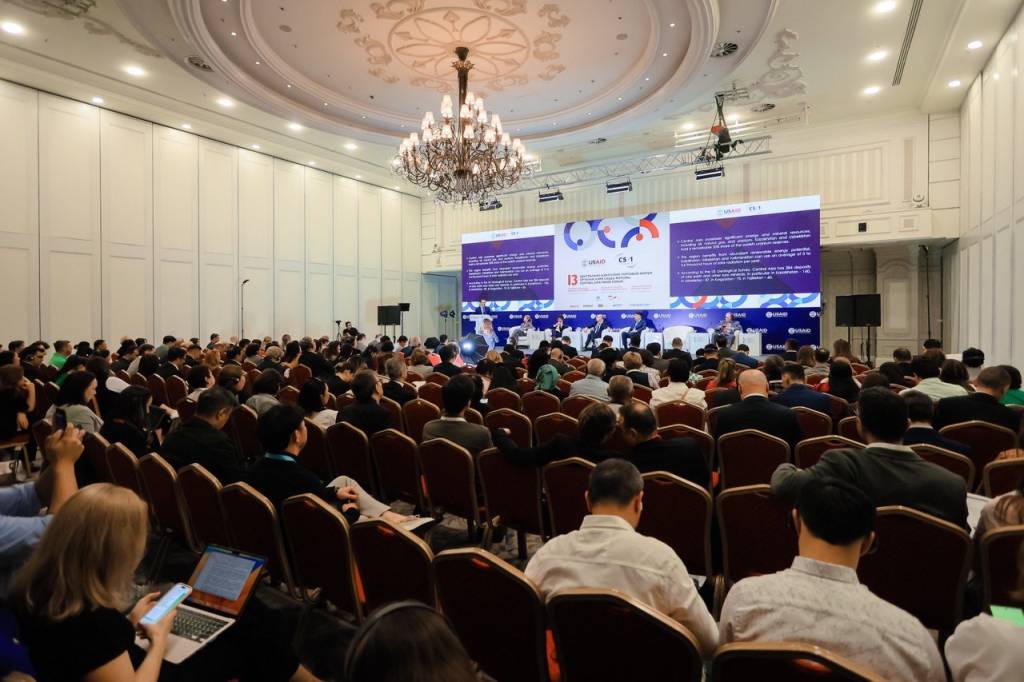
Almaty hosted the 13th Central Asia Trade Forum (CATF) on “Trade Integration: Reaching Global Levels”.
The event was organized by the U.S. Agency for International Development together with the Ministry of Trade and Integration of the Republic of Kazakhstan and the German Society for International Cooperation (GIZ).
The forum’s purpose is to expand trade cooperation and strengthen ties between Central Asian countries by digitalizing trade procedures, optimizing transport and logistics processes, standardizing customs clearance, and harmonizing trade regulation in accordance with WTO standards.
More than 300 representatives of business and government agencies from Central Asia, the Middle East, the UK, and the USA attended the event.
The forum also included a trade exhibition, in which more than 40 companies from Central Asian countries participated, and the 11th Regional Meeting of National Committees for Trade Facilitation, attended by business leaders and officials from the region’s countries.
Opening the forum, Senior Deputy Assistant Administrator for Asia at USAID Zeinah Salahi noted that over the past ten years, more than 10,000 representatives of government and commercial structures from 25 countries have participated in CATF events.
According to her, this forum will help shape the future of trade in Central Asia and promote inclusive, integrated economic growth that will benefit the entire society.
In this regard, the experts highly appreciated the role of the President of Uzbekistan, who is pursuing an active course toward the unification and integration of the Central Asian region.
At the same time, analysts emphasized the significant role of the Consultative Meetings of the Heads of State of Central Asia, which laid a new paradigm for interstate relations and created the basis for strengthening the region’s unity.
In turn, the IICA Director, speaking at the first session “Entering New Markets”, explained in detail to the forum participants the goals of the ongoing reforms in Uzbekistan and the initiatives of the Head of state put forward within the framework of the Consultative Meetings, which are aimed primarily at developing trade and investment cooperation between countries of the region.
As a result of the efforts of all Central Asian countries, over the past 6-7 years, the total GDP of the region’s countries has grown by 70% and exceeded $450 billion. The volume of intraregional trade has reached $11 billion, having increased more than 2.5 times over the past ten years. The total foreign trade turnover of the Central Asian countries has reached $225 billion, almost twice as much as seven years ago.
Despite the positive dynamics, the IICA Director emphasized that the lack of transport connectivity of the countries in the region acts as a limiting factor in the development of economies, where, according to the World Bank, the share of costs for transporting goods to foreign markets can reach 50% of the final price of goods.
According to him, the remaining barriers in the transport system do not provide an opportunity for the region to be actively included in global value chains.
To further expand trade between the region’s countries, experts noted the importance of uniting efforts to implement important projects that unite the region, such as the China-Kyrgyzstan-Uzbekistan and Uzbekistan-Afghanistan-Pakistan railways, as well as the Middle Corridor connecting the Central Asian region with Europe.
Implementing these projects will contribute to transforming Central Asia into a key transit hub in Eurasia. In particular, implementing the Trans-Afghan route, initiated by the Leader of Uzbekistan, can reduce the delivery time of goods to Pakistan by about five days and reduce transport costs by at least 40%.
In general, the event confirmed the relevance of the expert trade forum and the interest of all its participants in continuing the exchange of knowledge, experience, and ideas to enhance trade and investment cooperation between the countries of Central Asia.
G.Khonnazarov, UzA