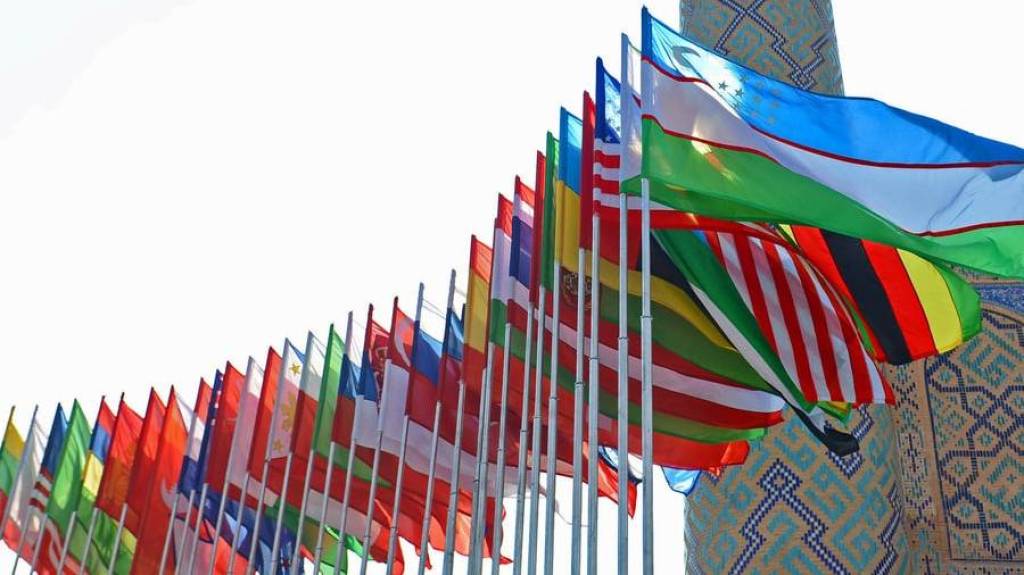
In today’s rapidly changing world, the Republic of Uzbekistan confidently occupies the position of one of the key players in the international arena. The country’s foreign policy, which received a new impetus with the election of Shavkat Mirziyoyev as President in 2016, demonstrates impressive results, turning the country into a significant regional and global diplomacy center.
Thus, the foreign policy of the New Uzbekistan demonstrates significant versatility and dynamism. It is built on the principles of peacefulness, mutually beneficial cooperation, and openness to the world. The key aspects in this area are the following areas:
– regional cooperation: relations with all Central Asian countries are actively developing, and regional security and economic integration are strengthening.
– global partnership: ties are expanding with leading world powers such as the United States, Russia, China, and the European Union, as well as with international organizations and financial institutions – the UN, SCO, CIS, OTS, BRICS, WB, ADB, EBRD.
– economic diplomacy: special attention is paid to developing trade and economic relations, attracting foreign investment, and modernizing the economy.
– cultural and humanitarian ties: the country actively participates in international cultural events, strengthening inter-civilizational dialogue.
Uzbekistan’s foreign policy is based on the norms of the Constitution, relevant laws, the principles of the United Nations, and obligations arising from international treaties and agreements ratified by the Oliy Majlis.
In 2016, under the leadership of the President, a new comprehensive Foreign Policy Doctrine was formulated. It defines the vision and approaches to current international and regional security issues, modern challenges and threats, and forming a new world order. It provides for the development of multifaceted cooperation with developed countries based on equality, mutual respect, trust, and consideration of each other’s interests.
A systemic analysis of the basic principles and characteristics of the modern foreign policy strategy of Uzbekistan demonstrates the deep thoughtfulness of the foreign policy, which today could serve as an exemplary model for many countries, especially in conditions when international relations are experiencing a crisis of trust, a lack of dialogue and mutually beneficial cooperation.
The role of the public in shaping the foreign policy agenda has significantly increased, and the range of entities involved in its implementation is expanding. In particular, the activity of parliamentary and public diplomacy is growing.
Today, the new regional policy of Uzbekistan has created conditions not only for a radical improvement in interstate relations with neighbors, but also laid the foundation for further consolidation and integration of the region in a new format.
As a result, in 2018, on the initiative of President Shavkat Miziyoyev, the mechanism of Consultative Meetings of the Heads of State of Central Asia was launched. This format has become not only a dialogue platform, but also a place for making important political decisions that set the main vectors of interaction between the fraternal countries.
In other words, today, thanks to the political will and joint efforts of the leaders of the countries of the region, it has been possible to change the modern appearance of Central Asia and transform it into a space of good neighborliness, mutual trust, and cooperation. Our states have created a unique regional model that is resilient to external challenges, demonstrating their readiness to take responsibility for the common future and ensuring security and stability. As a result, Uzbekistan has raised the status of relations with all countries of the region: to the level of strategic relations with Turkmenistan, a comprehensive strategic partnership with Kyrgyzstan and an alliance with Kazakhstan and Tajikistan.
Central Asia is a capacious consumer market with powerful resources, raw material potential, and rich human capital. This is evidenced by the active dynamics of the region’s economic indicators. The region’s economy has steadily grown (6.2%) over the past ten years, twice exceeding the world average (2.6%). Since 2016, the total regional GDP has increased by 60%, reaching $450 billion by the end of 2023.
At the same time, the region is becoming an essential participant in global economic relations: the volume of foreign trade has more than doubled over the past 7 years, reaching about $225 billion. At the same time, intraregional trade has increased 4.5 times – from 2.4 to 11 billion dollars.
These circumstances increase the interest of extra-regional partners in Central Asia, turning the region into a point of attraction for world powers and leading states. This is also reflected in the created dialogue format “CA Plus”. Today, more than 10 such dialogue platforms are functioning, 6 of which were created over the past 5 years. Moreover, starting in 2022, many of these formats are held at the level of heads of state – with China, the United States, Germany, and the EU. Nextyear, South Korea will join their number.
Increasing interaction with the UN and its institutions has been possible in recent years. As a result, 140 joint programs and projects are being successfully implemented. Over the past few years, Uzbekistan’s initiatives have been recognized by adopting 10 special resolutions of the UN General Assembly.
The Shanghai Cooperation Organization is another important platform where Uzbekistan cooperates on regional security, economic cooperation, and cultural exchange. The state actively participates in the SCO activities and has chaired the organization four times.
Since 2017, the Leader of Uzbekistan has proposed 91 initiatives to improve the effectiveness of cooperation in the political, trade, and economic sectors, transport and logistics, innovation, and other areas. Of these, 75 initiatives have already been implemented, 16 are in the process.
Trade and economic cooperation within the SCO is developing rapidly: in 2023, Uzbekistan’s trade turnover with other member countries increased by 18.5% compared to 2022, reaching $31.36 billion.
Uzbekistan participates in the work of all CIS statutory bodies, having joined each sectoral cooperation body, and pursues a proactive and initiative policy within the Commonwealth.
In fact, in recent years, Uzbekistan has become the diplomatic center of the Commonwealth, where meetings of statutory bodies and sectoral cooperation structures are regularly held. It is no coincidence that in 2024, Tashkent was declared the Youth Capital and Samarkand the Cultural Capital of the Commonwealth.
Trade and economic ties are rapidly expanding. By the end of 2023, Uzbekistan’s foreign trade turnover with the CIS countries amounted to $20.6 billion, which is 32.9% of the total. In January-June 2024, this figure reached $11 billion. A third of the country’s foreign trade turnover, or 34.4%, is with the CIS countries.
Uzbekistan became a full member of the Organization of Turkic States in 2019 and has since actively participated in regional and international forums, exerting significant influence on decision-making and forming the organization’s overall political agenda.
Trade and economic exchanges are also actively developing. Over the past 7 years, the country’s foreign trade within the OTS has grown almost 3 times. In 2023, this figure reached $10 billion, showing an increase of 4.6%. At the same time, the number of foreign enterprises with capital from Turkic countries operating in the country is growing, the number of which has increased by 50%. In 2017-2022, the OTS countries invested more than $4 billion in the economy of the Republic of Uzbekistan, which is 8% of the total volume of foreign investment for the specified period.
Cooperation with European countries and the European Union is one of Uzbekistan’s new proactive foreign policy priorities.
Today, the Organization of Islamic Cooperation is one of the largest international organizations in the world, uniting 57 member countries with a population of 1.7 billion people.
The OIC fully supports the projects and programs initiated by Uzbekistan, which occupies a significant place in the structure.
In 2022, the OIC Tourism Ministers declared Khiva the Tourism Capital of the Islamic World in 2024. The 12th session of the Islamic Conference of Tourism Ministers was held in Khiva in June this year under the slogan “Khiva – the Tourist City of the Islamic World 2024”.
Since 2017, Uzbekistan has intensified cooperation within the Economic Cooperation Organization. In 2022, the country assumed the chairmanship for the first time under the motto “Year of Strengthening ECO Connectivity”. In November last year, the 16th ECO Summit was held in Tashkent on “Together towards economic stability and development”.
In general, the foreign policy of New Uzbekistan demonstrates the successful implementation of the strategy of openness and pragmatic cooperation based on the principles of multi-vector and mutual benefit. The achieved results not only strengthened the country’s international position, but also created a reliable platform for further prosperity as a modern, dynamically developing state playing an essential role in regional and international politics.
Gayrat Khonnazarov, UzA