
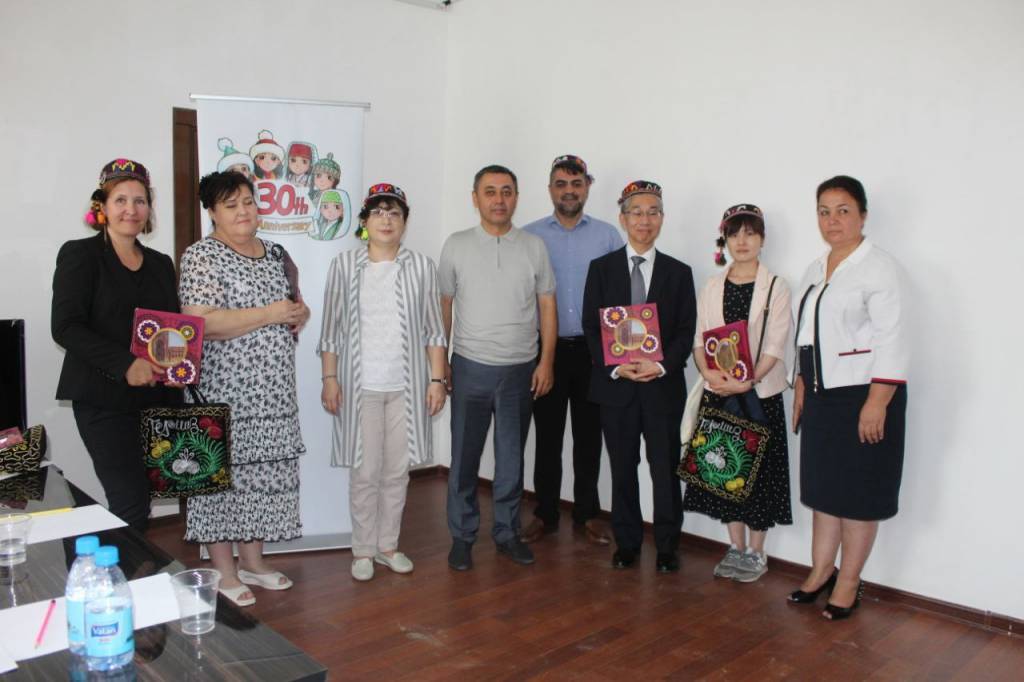
Shinsuke Toda, Counsellor and Deputy Chief of Mission and Tae Sato, First Secretary, of the Embassy of Japan in Uzbekistan jointly with representatives from UNICEF visited the Centre for social-psychological support of children, under the Termez district department of the Ministry of Public Education of Surkhandarya region.
They met the staff of the center as well as beneficiaries of the Japan-supported program on enhancing child protection in emergency preparedness. They underlined that child protection in emergencies becomes an absolute priority since children are among those who suffer the most in such situations.
The Japan-funded program was aimed at strengthening child protection systems in the communities in Surkhandarya region through the development of inter-agency Standard Operating Procedures (SOPs) and training of key social service workers.
“Japan decided to support this Project to strengthen child protection system because children tend to be exposed to the negative impact under emergencies. I sincerely hope that the SOP, trained professionals and those psychosocial support centers will contribute to strengthening the child protection system, including in emergency preparedness, and better address the challenges of children and their families in need”, said Mr. Shinsuke Toda, Counsellor and Deputy Chief of Mission.
“Child protection needs to be integrated in all areas of humanitarian work, and children need to be at the center of all emergency preparedness, response, and recovery efforts”, said Zhanar Sagimbayeva, Acting Deputy Representative of UNICEF. “The SOPs provide a solid foundation for creating stronger national and local child protection systems in Uzbekistan which can protect children from violence, abuse, neglect and exploitation. This prevents unnecessary separation of children from their families, as well as promotes child and family wellbeing”.
The government of Japan also funded specific interventions for WASH in the health care facilities of Termez district. They include the building of water pipelines, installment of water tanks, water softeners and filters, and solar panels for electricity, and hot water.
It is expected that investments into WASH in healthcare facilities and better quality of primary healthcare will contribute to the improvement of maternal and child healthcare in the Surkhandarya region.
Kholmumin Mamatrayimov, UzA