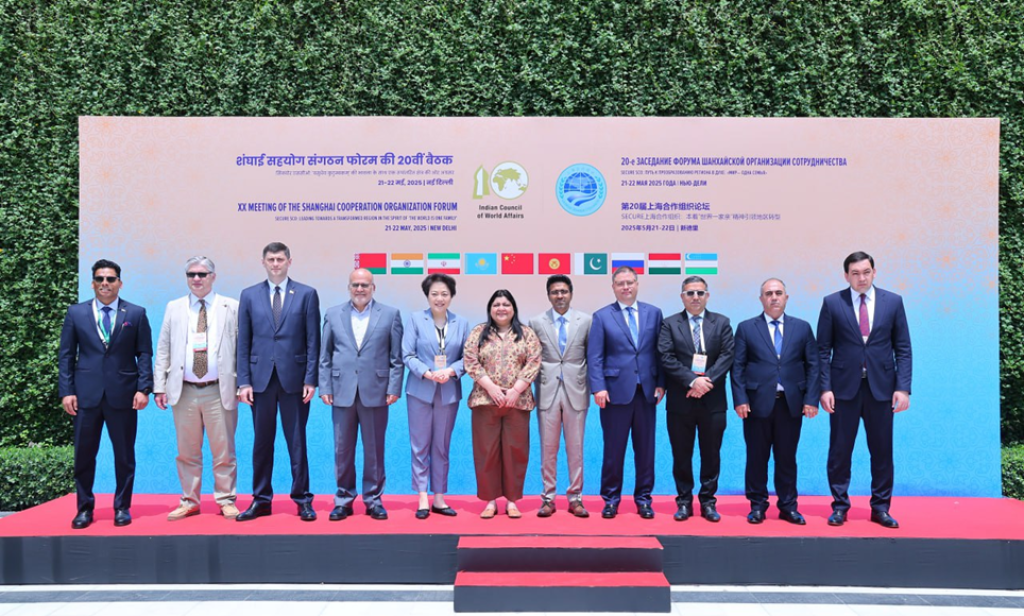
On May 21-22 this year, the 20th meeting of the SCO Analytical Centers Forum was held in New Delhi, organized by the Indian Council of World Affairs. The event's theme was “SCO: Toward Regional Transformation in the Spirit of 'One Earth, One Family’”.
The forum brought together over 30 experts from SCO member states, including heads and representatives of leading national think tanks and research centers from Belarus, India, Iran, China, Russia, Tajikistan, and Uzbekistan, as well as a delegation from the Shanghai Cooperation Organization Secretariat.
The participants engaged in a comprehensive and constructive exchange of views on the key areas of the SCO’s work.
The discussions focused on strengthening strategic dialogue in politics and security, expanding economic and investment cooperation, implementing joint projects in industrial collaboration, deepening cultural and humanitarian ties, and enhancing the Forum of Analytical Centers’ effectiveness as an essential expert platform within the SCO framework.
Following the event, a final Protocol was adopted, reflecting the agreed approaches and shared vision of SCO member states on key agenda issues.
In accordance with the established procedure, the chairmanship of the Forum for the 2025-2026 period was officially handed over to the SCO National Research Center of the Islamic Republic of Iran.
During the first session, titled “Expanding the Role of the SCO: Advancing a Collective Vision for a Safe and Stable Region”, the ISRS Deputy Director Bakhtiyor Mustafayev delivered a presentation. In his speech, he emphasized that cooperation with Afghanistan is key to ensuring security within the SCO region.

The expert also drew participants’ attention to the recent Termez Dialogue on interregional connectivity between Central and South Asia, which was held in Termez with the participation of leading figures from both regions’ political and expert communities. He noted that this event was a logical continuation of Uzbekistan’s consistent efforts to engage Afghanistan in regional cooperation processes and to create the socio-economic conditions necessary for achieving long-term peace and sustainable stability on Afghan territory.
As B. Mustafayev noted, a stable Afghanistan offers significant economic prospects. For SCO member states, this represents an opportunity to diversify transport routes, build an interconnected regional economic model, and boost trade and economic relations.
At the same time, amid the growing multi-level challenges of the modern era, SCO member states are called upon to demonstrate even greater determination, unity, and strategically calibrated cooperation.
In this context, Mr. Mustafayev emphasized the need to focus joint efforts on two key areas.
First, ISRS representative Mr. Mustafayev believes that the activities of the “SCO – Afghanistan” Contact Group should be revived. This mechanism has proven to be an effective tool for seeking coordinated solutions on the Afghan agenda. Revitalizing the group’s work would restore the SCO’s role as a key regional platform for addressing Afghanistan’s stabilization. Most importantly, through this format, SCO member states could reestablish the practice of coordinating efforts to contain the humanitarian crisis in Afghanistan.
Second, according to the ISRS Deputy Director, providing systematic socio-economic support to Afghanistan is necessary. In this context, SCO participants could actively leverage the modern infrastructure established in Termez. Implementing educational programs for Afghan youth, healthcare projects, and other humanitarian initiatives would enhance the SCO’s standing as a responsible and long-term donor to Afghanistan.
UzA