
Eco-Industrial Parks (EIPs) are emerging as a vital component of Uzbekistan’s strategy to modernize its industrial sector while ensuring environmental sustainability.
As the country’s economy grows, the need to balance industrial expansion with resource efficiency and pollution reduction is becoming more critical. EIPs offer a solution by promoting industrial symbiosis, where businesses collaborate to reduce waste, share resources, and implement cleaner production methods. This approach aligns with Uzbekistan’s broader goals of fostering a circular economy and improving industrial competitiveness.
The UNIDO “Eco-Industrial Parks Project” in Uzbekistan, funded by the German Federal Government through the Deutsche Gesellschaft für Internationale Zusammenarbeit (GIZ) GmbH, plays a pivotal role in implementing EIP principles in the country. The project focuses on two pilot zones: the Fergana Mechanical Small Industrial Zone and the Urgut Free Economic Zone. These zones have been selected as testing grounds for introducing innovative approaches to resource efficiency, waste management, and cleaner production.
UNIDO’s role is to provide technical expertise, policy guidance, and capacity building for local stakeholders, ensuring the effective implementation of EIP frameworks. By fostering collaboration between the private sector, government bodies, and international partners, the project aims to create a model for sustainable industrialization that can be scaled across Uzbekistan. The GIZ’s support drives this initiative, contributing to Uzbekistan’s long-term vision for a greener, more sustainable industrial future.
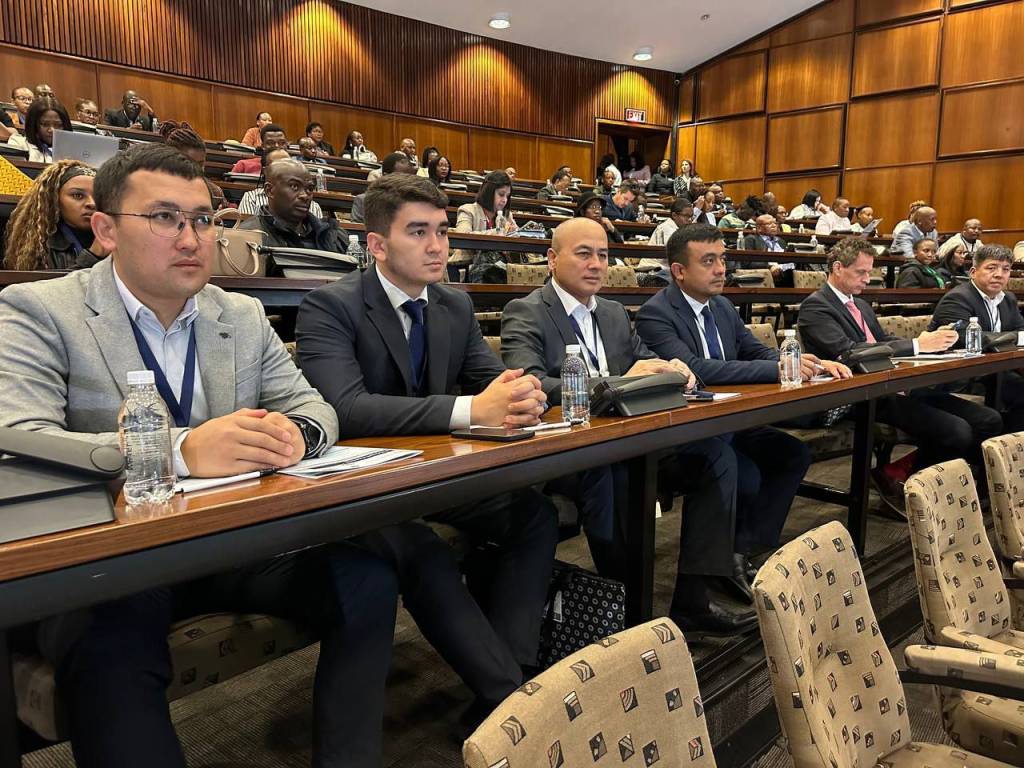
The 6th Biennial Conference of the National Cleaner Production Centre South Africa (NCPC-SA), held at the CSIR ICC in Pretoria on September 11-12, 2024, provided a valuable platform for international collaboration on eco-industrial parks (EIP). The delegation from Uzbekistan’s “Eco-Industrial Parks Project”, consisting of the key UNIDO partners from the Ministry of Investment, Industry and Trade of Uzbekistan, Chamber of Commerce and Industry of Uzbekistan, and representatives from the management of two pilot zones of the project (Mechanic SIZ and Urgut FEZ) participated in this significant event. The conference offered in-depth knowledge sharing on circular economy principles, decarbonization, and sustainable industrial practices.
Mr. Aripov, Head of Heavy Industry Department of Ministry of Investment, Industry and Trade of Uzbekistan, member of project steering committee, emphasized the importance of the conference in expanding Uzbekistan’s approach to integrating circular economy principles into industrial development. “The speakers from the UNIDO Global Eco-Industrial Parks Programme and GIZ shared actionable strategies that can be directly applied to our pilot zones in Fergana and Samarkand. The emphasis on resource efficiency and waste minimization aligns with our national goals for industrial modernization”, he stated. Mr. Aripov also highlighted the need to adopt best practices shared by countries already implementing EIP frameworks, particularly regarding policy support and enabling tools for decarbonization.
Mr. Khabibidinov, Director of the Fergana Mechanical SIZ, was particularly impressed by the practical applications of cleaner production methods presented at the conference. “What stood out for me was how industrial zones can integrate circularity into their operations without disrupting current production. The case studies on industrial symbiosis, where waste from one company becomes a resource for another, gave me several ideas to implement back home. Our pilot zone in Fergana has immense potential to benefit from such symbiotic relationships between companies”, he said.
The Uzbekistan delegation’s participation in the NCPC-SA conference provided it with actionable knowledge and critical insights into implementing eco-industrial parks in the home country. From understanding global EIP best practices to networking with international experts, the experience has laid a strong foundation for the future development of Uzbekistan’s pilot zones in Fergana and Samarkand. The lessons learned, particularly around decarbonization, green finance, and industrial symbiosis, will inform the next steps in advancing eco-industrial park frameworks in Uzbekistan.
Nasiba Ziyodullayeva, UzA