
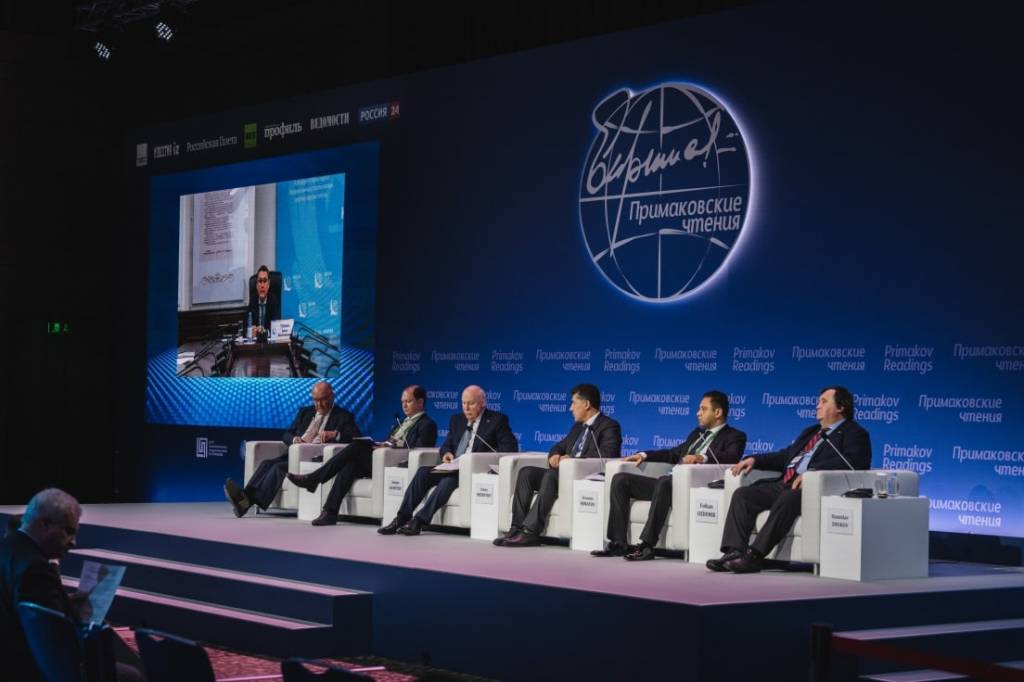
Moscow hosted the International Forum “Primakov Readings” on “Transformation of the world order: The Eurasian dimension”.
The forum was attended by the Head of the Organizing Committee, Aide to the President of the Russian Federation, Yuri Ushakov, Deputy Chairman of the Council of Federation of the Federal Assembly of the Russian Federation, Konstantin Kosachev, President of Primakov National Research Institute of World Economy and International Relations (IMEMO), Alexander Dynkin, Director of the Institute for Strategic Studies under the President of the Republic of Kazakhstan (KazISS) Yerkin Tukumov, Director of the International Institute for Central Asia in Tashkent Anvar Nasirov, First Deputy Director of the Institute for Strategic and Regional Studies under the President of the Republic of Uzbekistan Akramjon Nematov and other leading experts of research institutions.
According to IICA Director Anvar Nasirov, Central Asia on global platforms is more and more regarded as a consolidated region, and not as separate states united by a common history, traditions, and culture.
The region is becoming an important center of economic growth. The aggregate GDP of the Central Asian states has grown by 25% over 4 years. The trade turnover between Uzbekistan and its neighbors increased by 2.5 times.
Acute issues related to international terrorism and extremism, organized crime, drug trafficking have gone into the shadow of world politics. The situation in Afghanistan also receded into the background.
Today, cooperation between our countries continues to develop intensively in almost all areas, and the countries have a large reserve for enhancing such interaction.
In addition, experts noted that 2022 is a turning point in the development of the modern system of international relations. There is a rapid change in the agenda of world politics.
Experts stressed that today the system of the interdependence of key world actors that has developed over the past decades is being eroded, as well as the dominance of a certain group of countries in world politics is being eroded.
At the same time, the world is again becoming more anarchic and less predictable. There is more and more room in it for uncertainty and risks that accompany the inexorable pace of history.
The question is how the various phenomena unfolding in world politics change the dynamics of development in Eurasia and influence the issues of ensuring the security of the region as a whole.
G.Khonnazarov, UzA