
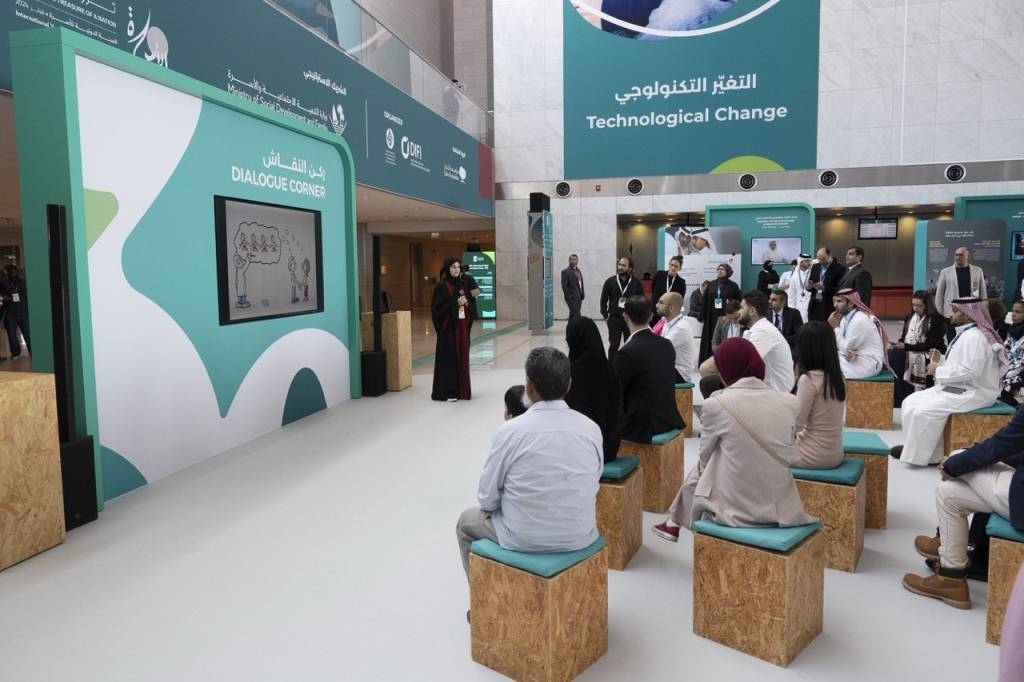
Policies to protect families in countries affected by conflict, the global impact of population decline, and striking a balance between work and family life were focused on the opening day of the 30th Anniversary of the International Year of the Family Conference on Family and Contemporary Megatrends.
The conference, organized by Qatar Foundation’s (QF) Doha International Family Institute, brought together experts and policymakers worldwide to explore key global megatrends affecting families and policies and programs that strengthen the family’s place at the heart of society.

Speaking in a discussion on ‘Work-Family Reimagined’, Dr. Maimoonah Khalil Al Khalil, Secretary General, Family Affairs Council, Saudi Arabia, highlighted the main challenges and opportunities facing working families in the country, saying: “Research has shown that when both parents are both working and away from home for long hours, it affects fertility, marriage age, and divorce rates, so initiatives must be introduced to ensure that women are active in the workforce, but also to ensure that we are practicing the role of parenting well. While encouraging families to provide a better life for their children, we must support them with flexible work, active parenting, and early childhood resources. We’re organizing workshops, guides, and frameworks to support remote work for women, enabling them to continue breastfeeding and build strong bonds with their newborns. Employers need to realize that these policies will make working women more productive and focused at work and contribute better to national development”.
The panel ‘Saving the Earth, Securing the Family’ explored the impact of climate change on families, focusing on the effects of climate-induced migration, food security, water scarcity, and eco-anxiety. “Climate change is multidimensional, and we need to deal with it holistically”, Her Excellency Mahinur Özdemir Göktaş, Minister of Family and Social Services, Türkiye, said.

“To find solutions, what is most important is that we bear collective responsibility. Government institutions globally require qualified human personnel and financial support. We need cooperation between countries to exchange our experiences and engage in environment coalition through effective and sustainable policies to address climate change challenges”.
Dr. Mohammed Behnassi, Senior Environmental Expert at the Economic, Social and Environmental Council, based in Rabat, Morocco, highlighted three interconnected climate change phenomena affecting families. “First is climate-induced displacement; second is food insecurity, which is worsened by climate change; and finally, war insecurity”, he said. “These interrelated challenges are triggering what we call climate migration – a migration that is triggered by environment issues and is amplified by water stress, flooding, desertification, and deforestation”.
Speaking at the conference on the issue of declining fertility rates, data scientist and demographer Stephen Shaw said: “Four out of five women who remain childless for life were planning to have children. Life is complicated – ‘not yet’ and ‘I’m not ready’ are the most common phrases I heard in every country I visited during my research. I believe society needs to help women have children, as some are waiting for the right time and others are searching for a good partner”.

And during a session titled ‘Family Time X Screen Time: Finding the Right Balance’, Abeer Al Khalifa, President of Pre-University Education, QF, emphasized the importance of cooperation between families and schools to ensure a positive environment for students using technology.
“Parents face many challenges, including the digital trust gap, as there is a big difference between parents and children in terms of their ability to use various technologies or electronic platforms”, she said. “The second challenge is differentiating between screen time for education and entertainment. The school plays a major role in collaborating with parents to become part of the student’s educational journey by involving them in events that raise their awareness of how students use technology at school. School can also help parents set controls for technology use at home, which helps achieve a common goal”.
The Ministry of Social Development and Family is the strategic partner for the conference, while the Permanent Committee for Organizing Conferences within the Ministry of Foreign Affairs is an executive partner, with support from the United Nations Department of Economic and Social Affairs (UNDESA). QatarDebate, founded by the Qatar Foundation, is the conference’s youth partner.
Bekhruz Khudoyberdiyev, UzA