
The invaluable literary heritage of the great poet, thinker, and distinguished statesman Alisher Navoi holds a special place in the history of not only Uzbek but also world literature, national culture, and the literary-aesthetic worldview of Uzbekistan people.
In recent years, extensive efforts have been undertaken to deeply study Navoi’s unique and multifaceted creative legacy, promote his works widely, and honor his memory.
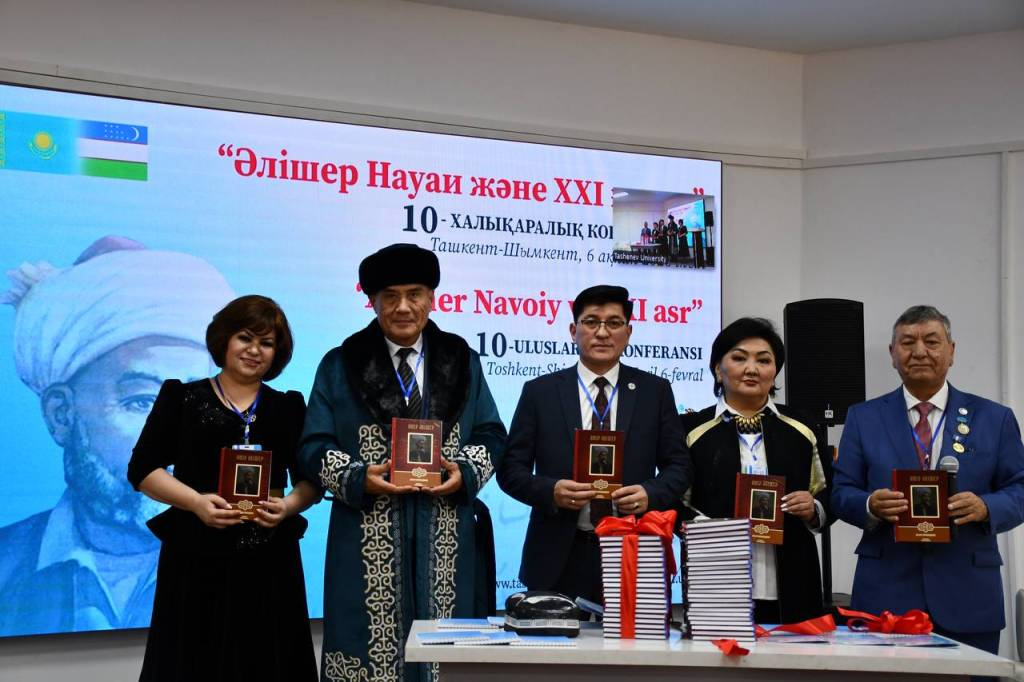
Shymkent, Kazakhstan, hosted the 10th International Scientific and Practical Conference titled “Alisher Navoi and the 21st Century”.
This event is organized annually on the initiative of the Tashkent State University of Uzbek Language and Literature named after Alisher Navoi. Since 2023, the conference has also been held outside Uzbekistan, reflecting the growing global interest in Uzbek literature, particularly Navoi’s works, which continue to be studied by scholars worldwide. In 2023, this prestigious event was held in Baku at the Institute of Literature named after Nizami Ganjavi of Azerbaijan National Academy of Sciences. In 2024, it took place in the ancient Turkish city of Bursa at Uludağ University.
The 10th International Scientific and Practical Conference, dedicated to the 584th anniversary of the renowned poet, great thinker, and prominent medieval figure Alisher Navoi’s birth, was held at Zhumabek Tashenov University in Shymkent, Kazakhstan.
Organized in collaboration with two universities and the “Dustlik” Association of Uzbek Ethnocultural Associations of Kazakhstan, the event was attended by members of the Writers’ Union of Uzbekistan, Navoi scholars, international speakers, honorary professors, university faculty, cultural figures, and students.
The conference’s opening featured speeches by academician Shukhrat Sirojiddinov, Rector of Tashkent State University of Uzbek Language and Literature named after Alisher Navoi and Parida Baineeva, Vice-Rector for Academic Affairs at Zhumabek Tashenov University, and Ikram Khashimjanov, Chairman of the “Dustlik” Association.
Speakers at the conference highlighted that Alisher Navoi, rightfully recognized as the founder of the Uzbek literary language, introduced readers to his people’s vibrant and expressive world. His public service and scholarly works are a unique model of dedication to his nation and homeland. The poet’s writings continue to be translated into multiple languages and published in various countries, reaffirming that Navoi’s legacy is not only the spiritual heritage of the Uzbek people but of all humanity.
Academician Shukhrat Sirojiddinov expressed deep gratitude to Navoi scholars whose research significantly contributes to studying and promoting the poet’s legacy. He emphasized that in line with Navoi’s timeless views and noble ideas, such research should strengthen friendship, brotherhood, and further unity among Turkic nations.
In this context, the proactive role of national leaders was underscored. A key symbol of the deepening cultural ties between Uzbekistan and Kazakhstan was the inauguration of a monument dedicated to Alisher Navoi in Astana in August last year, attended by the heads of both states. Additionally, in 2020, as part of the 175th anniversary celebrations of the renowned Kazakh poet and philosopher Abai, his works were translated into Uzbek, while Navoi’s masterpiece, “Khamsa,” was published in Kazakh.
As part of the conference, a presentation was held for the book “Amir Alisher” by Academician Shukhrat Sirojiddinov, now published in Kazakh. This unique work, dedicated to the life and contributions of the great thinker Alisher Navoi, was based on manuscript sources and prepared for publication by Shakhlo Naraliyeva, Head of the Academic Mobility Department at Zhumabek Tashenov University. The book reveals previously unknown aspects of Navoi’s life and literary journey, presenting the results of years of research in chronological order.
The event continued with a musical performance of Navoi’s ghazals, masterfully performed by renowned singer Aziz Rajabi.
A highlight of the conference was a theatrical staging by students from the Department of Russian and Uzbek Languages at Zhumabek Tashenov University. They brought a fictional conversation between Navoi and Abai to life, symbolizing the intellectual and cultural dialogue between two brotherly nations. The flawless performance of these young talents vividly recreated the atmosphere of a bygone era. The audience was also profoundly moved by emotionally charged recitations of Navoi’s poetry and ghazals. These artistic performances created a profound atmosphere, reaffirming that Navoi’s literary heritage continues to inspire younger generations, even beyond Uzbekistan’s borders. The growing interest and admiration for his works among neighboring nations highlight his timeless influence and the enduring appeal of his creative genius and high ideals.
The conference continued its work through four panel sessions covering the following topics: “The role of Alisher Navoi’s literary legacy in world civilization”, “Studies on Navoi’s poetic, prose, and scientific heritage”, “Sources and textological research of Navoi’s works”, “Translation of Alisher Navoi’s works into foreign languages and their study abroad”.
During the discussions, participants analyzed Navoi’s phenomenon from a scholarly perspective, paying special attention to humanism and creativity in his works. A significant part of the dialogue centered on the representation of Navoi in the literary and prose works of other authors. Additionally, the linguistic and lexical peculiarities of his texts were examined in detail.
In conclusion, it is essential to emphasize that Alisher Navoi’s legacy, embodied in his immortal verses, remains a guiding ideal for all of us today, urging kindness, compassion, generosity, and a willingness to help those in need. He once wrote: “Recognize as the worthiest person who brings the greatest benefit to the people”. His progressive and humanistic worldview, coupled with the unparalleled artistic excellence of his works, continues to shape the moral values of younger generations and enrich the spiritual life of society.
Alpomish Mashrabkhanov, UzA