
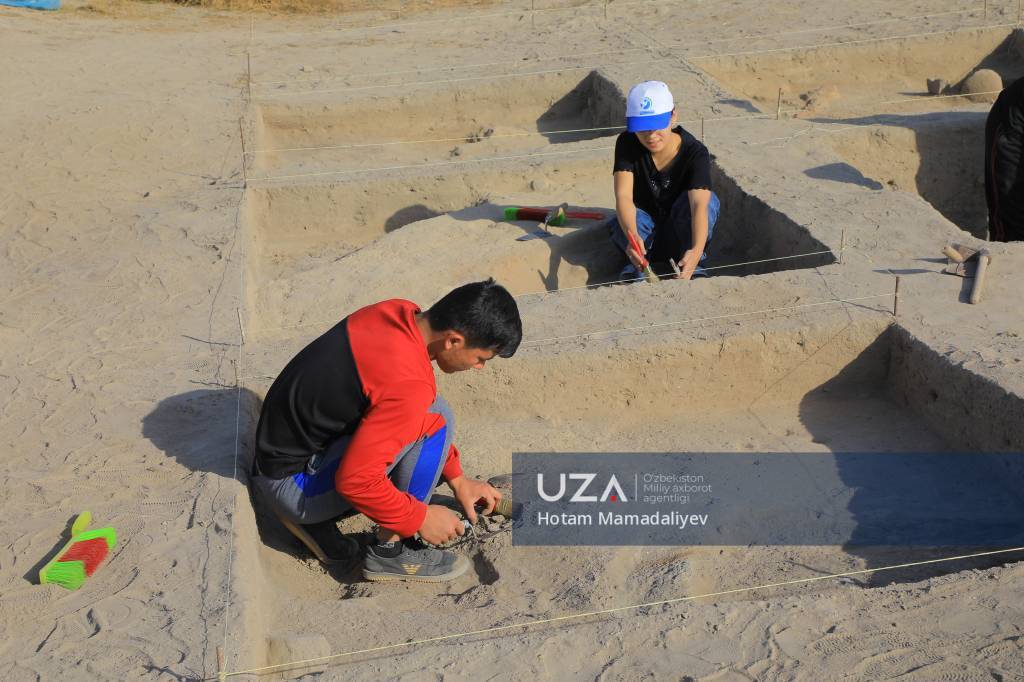
Excavations are being carried out on the territory of Bibiona, in Uzbekistan’s Chust district.
There have been several speculations about Chust’s age. After archaeological research conducted in 1953, 1957, 1959, 1961, it was established that the culture of this area is related to the end of the Bronze Age – the beginning of the Iron Age. At the beginning of the 16th century, Chust consisted of several fortresses surrounded by a wall. The city was expanding, since 1886 it was considered the center of Chust.
60 pits were discovered during the excavations. Some scientists believed that the pits served as a dwelling, others – for grain.
“Brick dwellings appeared here at the second stage of the history of the Chust culture”, says a Senior Researcher at the National Institute of Archeology of the Academy of Sciences of Uzbekistan, historian Sergey Baratov. – Before that, Fergana farmers lived in dugouts and huts.
Animal bones and plant remains were also found. Paleozoological and paleobotanical studies should be carried out on the monuments using modern methods. Current issues are the definition of the boundaries of the defensive wall and the development of measures to protect the remaining part of the wall from external influences.
[gallery-9092]
Photos by Khotam Mamadaliyev, UzA