
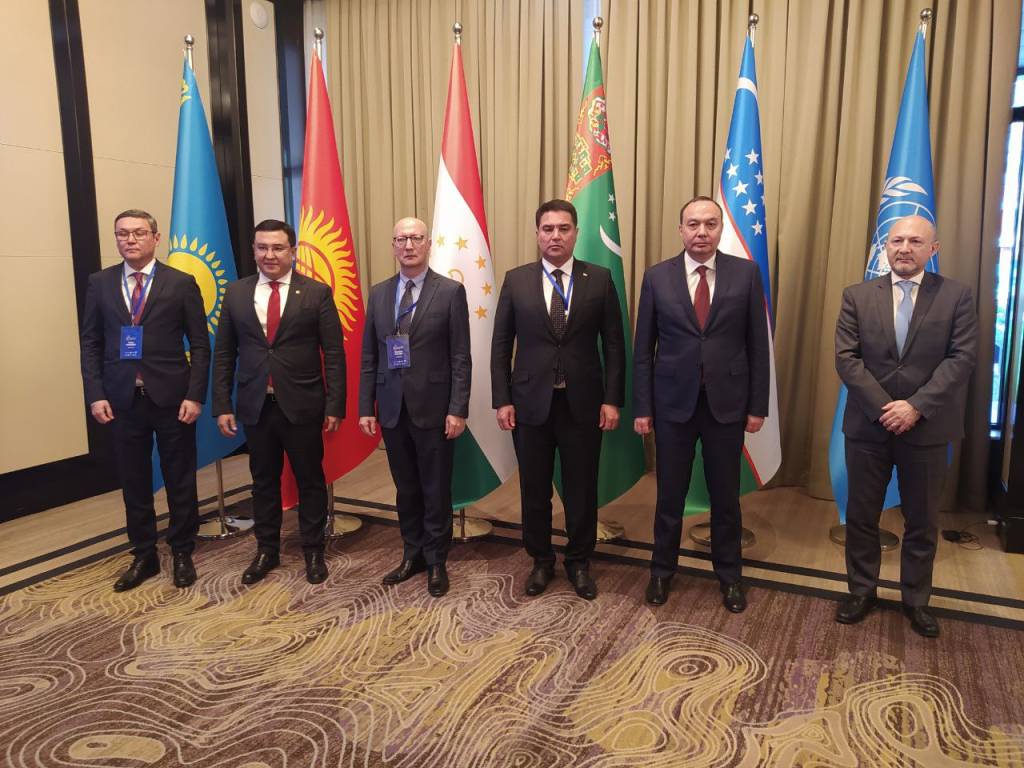
On October 12, Bishkek hosted the 6th Central Asian Expert Forum. It was organized by the National Institute for Strategic Studies under the President of the Kyrgyz Republic (NISS) with the assistance of the United Nations Regional Centre for Preventive Diplomacy for Central Asia (UNRCCA).
The event was attended by the Chairman of the Cabinet of Ministers – Head of the Presidential Administration of the Kyrgyz Republic Akylbek Japarov, the Head of the UNRCCA Kaha Imnadze, the Deputy Minister of Foreign Affairs of Kyrgyzstan Avazbek Atakhanov, as well as heads of strategic institutions of Central Asia, representatives of diplomatic missions accredited in Kyrgyzstan, independent think tanks and the media.

Director of the Institute for Strategic and Regional Studies (ISRS) under the President of the Republic of Uzbekistan Eldor Aripov addressed the panel session “Towards deepening cooperation between Central Asian countries, increasing the level of trust and sustainable development”.
In his report, he emphasized the importance of meetings held regularly in the format of an expert forum of Central Asian countries. As the ISRS head emphasized, this indicates high trust and partnership between countries.
Eldor Aripov admitted that before 2017, there was practically no need to talk about processes of regional consolidation. Unresolved issues regarding water and borders were very pressing. The formats of the Central Asian Economic Union and the Central Asian Cooperation Organization launched at one time, have not received proper development.
“Not all countries in the region then took part in forming the CAEU and CACO models. Many decisions remained declarative”, the expert noted.
According to him, November 2017 was a turning point in this regard. Then, on the President of Uzbekistan Shavkat Mirziyoyev’s initiative, a Central Asia conference was convened in Samarkand. All foreign ministers of the region’s states attended the event. The initiative of the Uzbek leader to establish a Consultative Meeting of the Heads of State of Central Asia was supported.
It is essential, stated Eldor Aripov, that the call to adopt the UN General Assembly Resolution on Central Asia was accepted. A kind of Samarkand Consensus was formed. All Central Asian countries confirmed their readiness to develop regional cooperation. This desire was supported by the foreign policy partners of the region’s states, acting as co-sponsors of the mentioned resolution.
“Now, for the first time in many years, we have become more clear and precise in understanding that the fate of each country in Central Asia will be determined not only by itself, but will also directly depend on the process taking place in our common region. This awareness is vital. And in this regard, we are on the right track”, the expert emphasized.
At the same time, to maintain the given dynamics, in Eldor Aripov’s opinion, it is necessary to strengthen the political, economic, cultural, and humanitarian connectivity of the region, maintain its openness to the world, and continue to convert challenges into opportunities for the formation of a new model of regional cooperation in changing conditions.
In this regard, the ISRS head considers it essential to begin the implementation of the initiatives of the President of Uzbekistan put forward at the summit in Dushanbe, in particular:
– to form a full-fledged free trade zone without exemptions and restrictions, which will increase the trade turnover;
– develop a Strategy for developing industrial cooperation in Central Asian countries for the long term. This will give a systematic character to joint efforts in this sphere;
– create the Economic Council of the Central Asian States, which will become an effective mechanism for ensuring cooperation on the entire complex of trade and economic agenda.
Particular attention was paid to strengthening regional identity in Central Asia. As the ISRS Director stated, it should become the primary, supporting structure of cooperation in Central Asia.
In his opinion, regional cooperation can be practical when it is based not only on common interests but also on shared values and traditions.
“Otherwise, such cooperation will only have a tactical, changeable nature. Unlike permanent values, interests tend to change and evolve”, Mr. Aripov concluded.
UzA