
In recent years, relations between the Republic of Korea and Central Asian countries have been rapidly developing, expanding into new spheres – from economics and technology to education and sustainable development.
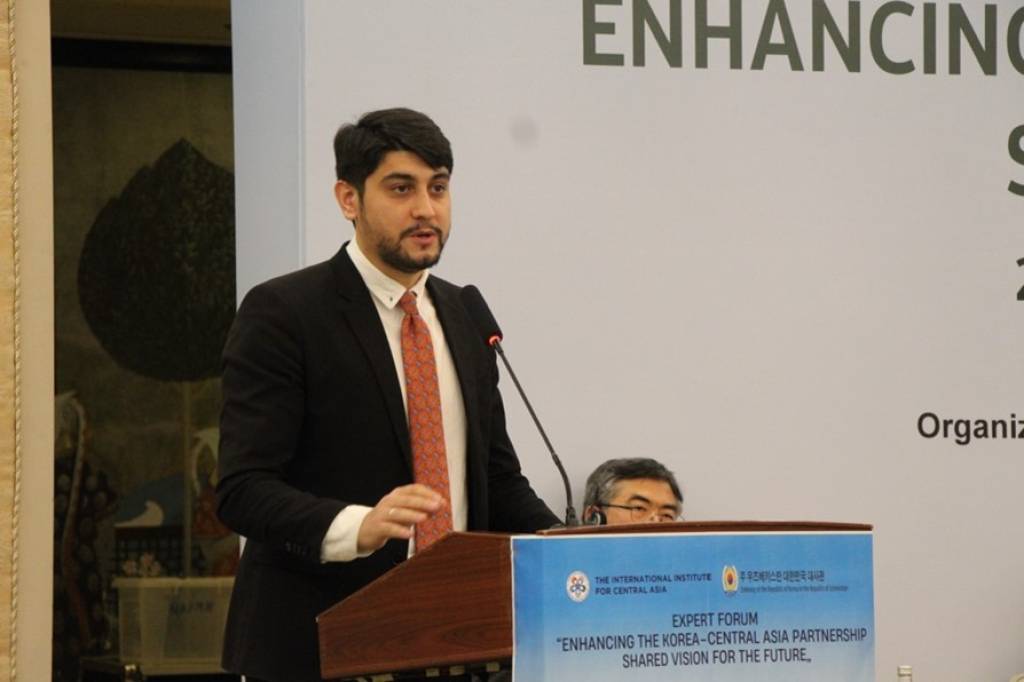
Against the backdrop of a strengthening partnership, Tashkent hosted the international expert forum “Deepening partnership between the Republic of Korea and the countries of Central Asia: A shared vision of the future”. The event became an essential platform for discussing the strategic directions of cooperation. One of the speakers was Eldaniz Gusseinov, a research fellow at the Haydar Aliyev Center for Eurasian Studies at Ibn Haldun University. The expert shared his views with the UzA correspondent on the significance of the forum and its conclusions.
– How do you assess the outcomes of the expert forum and its contribution to preparations for the first “Central Asia – Republic of Korea” summit in 2026?
– The forum made a powerful impression with its depth and substance. Most presentations offered practical recommendations for strengthening cooperation between the Republic of Korea and Central Asian countries. Experts proposed several new and even original ideas – from developing urban mobility to introducing artificial intelligence into infrastructure projects and expanding cooperation in renewable energy. Notably, the forum fostered an understanding of the need to move beyond traditional trade and build a comprehensive cooperation ecosystem. For example, students from Central Asia who study in Korea can later work at Korean enterprises in the region, contributing to technology transfer. This involves creating joint ventures, research centers, and university initiatives – a system that will function not only through diplomatic support but also due to its own sustainability. The presence of government representatives confirmed their interest in expert recommendations. I am confident that many proposals will be reflected in the summit’s final documents. Moreover, an initiative was announced to compile a catalog of the forum’s recommendations.
– Which ideas or proposals presented at the forum do you consider most significant for developing the partnership between the Republic of Korea and the countries of Central Asia?
– In my view, the most crucial element is defining the conceptual guidelines for our cooperation. Among the most noteworthy ideas is the initiative to develop cooperation in the field of critical raw materials under the formula “from extraction to co-production”. This approach creates opportunities to establish value chains, introduce new technologies, and form sustainable production clusters in the region. Also deserving attention is the concept of “small AI” adapted to Central Asia’s linguistic, cultural, and socio-economic realities. Such an approach enables the creation of truly relevant digital solutions that reflect the specific features of our societies and enhance the effectiveness of public administration, education, healthcare, and business. In addition, an important proposal concerns the expansion of scientific and educational exchanges, including the establishment of joint research centers and training programs in high-tech fields. This would form a foundation for sustainably developing human capital capable of supporting long-term projects. And, of course, great significance lies in the focus on the green economy – from joint initiatives in the water-energy sector to the introduction of Korean renewable and energy-efficient technologies. Environmental sustainability is becoming a shared priority that unites all countries in the region.
– Which areas – green energy, critical minerals, digital transformation, or humanitarian cooperation – received the most attention?
– These areas are interconnected, and that is precisely what makes them valuable. Given the long-standing partnership between Korea and Central Asian countries, the forum highlighted topics of mutual interest. Experts also raised more specific issues, and I am sure many participants noted them for further work. For example, if cooperation in the field of critical minerals deepens, questions of transportation, education, personnel training, and technology transfer will inevitably arise. In other words, the development of one area automatically creates new points of convergence. Humanitarian cooperation also received an interesting perspective. Beyond cultural initiatives, the discussions touched on doing business in Korea and Central Asian countries. Understanding cultural mindsets is a key factor in successful partnerships. For example, I was struck by the various forms of the Korean greeting “annyeonghaseyo”, which differ depending on a person’s age and status. Such details remind us that behind major projects, there are always people, and it is the human dimension that makes cooperation truly successful.
– Which challenges and growth points in regional cooperation were most actively discussed by experts, and which solutions or approaches do you consider the most realistic?
– The main challenge remains ensuring sustainable economic development both in Central Asia and in the Republic of Korea. For this reason, experts proposed a wide range of solutions. But in my view, the most essential task is to define the partnership’s conceptual framework and build the strategy based on it. I am convinced that this will become a key guideline in preparing for the upcoming summit. In addition, it is essential to consider the practical aspects of implementing these strategies, including developing infrastructure, training personnel, introducing new technologies, and creating mechanisms for knowledge exchange. Only a comprehensive approach will allow ideas and initiatives to be transformed into concrete projects with tangible benefits for all stakeholders.
Interviewed by Aziza Alimova, UzA