
Every inch of land in Samarkand region keeps the secrets of antiquity. From time immemorial, this land had settlements, cities, and mounds. Around Samarkand, with a three-thousand-year history, life has always been in full swing, and the population has been engaged in various activities.
In particular, more than 60 archaeological and architectural monuments were discovered in Narpay district of the region. By periodicity, they belong to the Paleolithic, antiquity, and early and late Middle Ages.
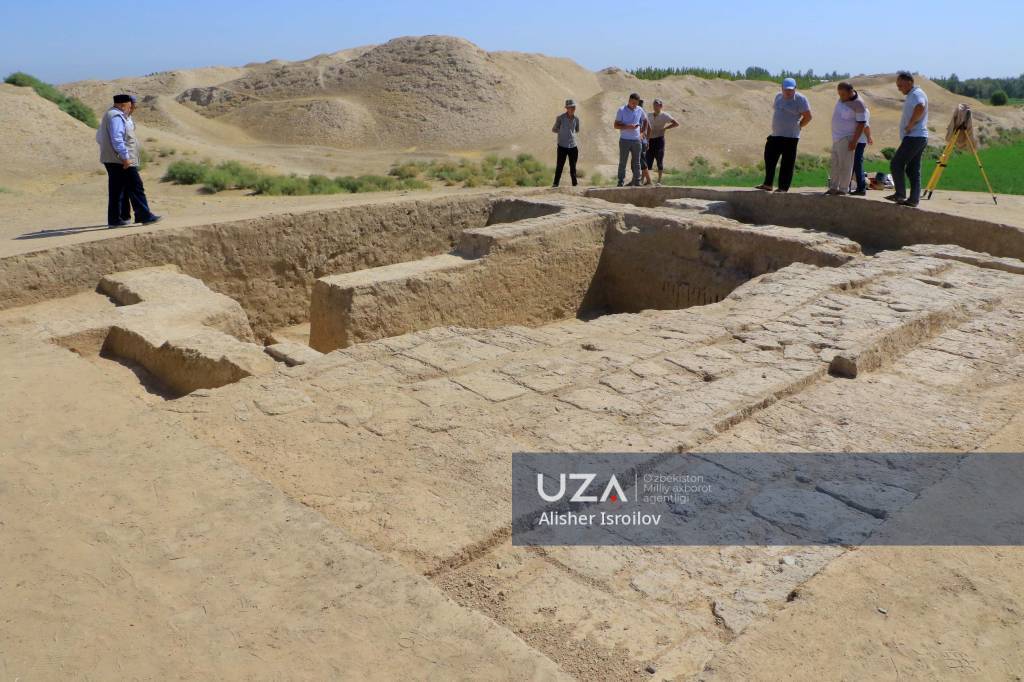
In July this year, specialists from the Samarkand Archaeological Institute named after Y.Gulamov carried out excavations on the territory of the Rabinjon monument (in some sources – Arbinjon) in “Toshkurpik” mahalla of the district.
“As indicated in medieval sources, Rabinjon was one of the major cities of Central Sogd. It was located on the branch of the Great Silk Road connecting Samarkand and Bukhara. The city occupied 150 hectares of area, consisting of a fortress (ark), a settlement, and a suburb. The population lived in the settlement, the ruler lived in the arch, and artisans and military men lived in the suburb. The sources mention that there were many residents in Rabinjon. They were engaged in agriculture, animal husbandry, handicrafts, and trade. During the archaeological excavations carried out by the Institute’s staff in the ancient settlement and suburb, dwellings dating back to the 11th-12th centuries and a kiln were discovered”, said Amriddin Berdimurodov, Leading Researcher of the Institute, Candidate of Historical Sciences.
According to sources, Rabinjon arose in the first half of the 1st millennium BC. It was built on the site of the ruins of the ancient city of Oromijon. In the Middle Ages, the villages of Sakon (Askon), Sankabot, Furfora, and Karzon belonged to the ancient Rabinjon. His settlement in the early Middle Ages was fortified with fortress walls. In the 9th-12th centuries, the city was expanded.
“The remains of a residential building measuring 5.5x3.5 meters, discovered in Rabinjon, were located in a part of the settlement”, says Navruz Alimov, a doctoral student at the Samarkand Archaeological Institute named after Y. Gulamov. – The thickness of the walls is from 80 cm to 1 m. In the center of the room was a hearth with a diameter of 44 cm, which was used to heat the room. Fragments of ceramics, coins, bricks, and remains of walls found here helped to determine that the finds belong to the era of the Karakhanids, that is, the 11th-12th centuries.
The pottery kiln discovered in the southeastern part of the city also belongs to this period.
“The furnace consists of two tiers: fire burned in the lower one, dishes were burned in the upper one”, says Alisher Sandiboyev, a Senior Researcher at the Institute. – Unfortunately, the upper part of the furnace has not been preserved. The lower part is wholly lined with bricks and has a round shape. Most of the ceramic products of the city of Rabinjon were made in such furnaces. At the same time, fragments of ceramics dating back to the 4th-5th centuries and later, up to the 19th century, were found on the territory of the monument. This means that there is much research work to be carried out here.
Archaeologists of the Institute continue excavations.
[gallery-13012]
G.Khasanov, photos by A.Isroilov, UzA