
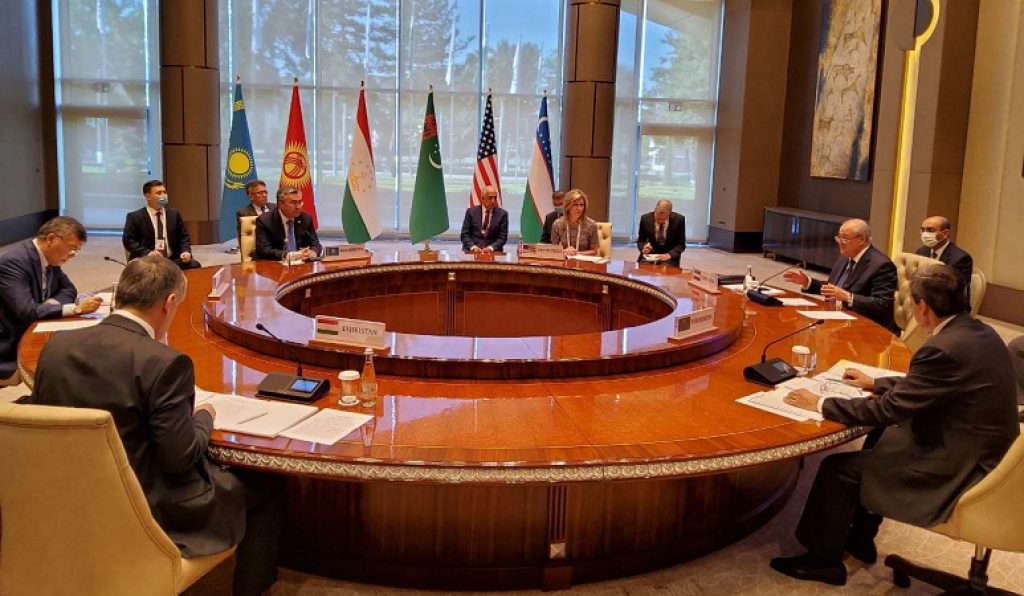
A Joint Statement has been adopted following the meeting of the dialogue format “С5+1” within the framework of the International High-Level Conference “Central and South Asia: Regional Connectivity. Challenges and Opportunities”.
As previously reported, the delegations of the Central Asian countries were led by the Deputy Prime Minister, Minister of Foreign Affairs of Kazakhstan Mukhtar Tileuberdi, Minister of Foreign Affairs of Tajikistan Sirojiddin Muhriddin, Deputy Chairman of the Cabinet of Ministers, Minister of Foreign Affairs of Turkmenistan Rashid Meredov, Minister of Foreign Affairs of Uzbekistan Abdulaziz Kamilov and the First Deputy Minister of Foreign Affairs of Kyrgyzstan Nuran Niyazaliev. The American side was represented by the U.S. Homeland Security Advisor Elizabeth Sherwood-Randall.
The text of the statement was adopted by the Governments of the Republic of Kazakhstan, the Kyrgyz Republic, the Republic of Tajikistan, Turkmenistan, the Republic of Uzbekistan, and the United States of America, on the occasion of the International Conference “Central and South Asia: Regional Connectivity. Challenges and Opportunities”, held in Tashkent, Uzbekistan July 15-16, 2021.
Below is the text of the Joint Statement of the C5+1 on the International Conference “Central and South Asia: Regional Connectivity. Challenges and Opportunities”:
“Delegations of the C5+1 – the Republic of Kazakhstan, the Kyrgyz Republic, the Republic of Tajikistan, Turkmenistan, the Republic of Uzbekistan, and the United States of America – participated in the July 15-16, 2021 International Conference on “Central and South Asia: Regional Connectivity. Challenges and Opportunities” in Tashkent.
The C5+1 countries affirm their commitment to enhancing engagement through our regional diplomatic platform and seeking opportunities to strengthen connectivity between the Central and South Asian regions via trade, transport, and energy links. The C5+1 recognizes that increased connectivity supports its shared goal of a prosperous and secure Central Asia. Visionary ideas for Central Asia’s economic growth and closer ties to the economies of South Asia also reinforce the C5+1’s commitment to strengthening the region’s security and stability, including through Afghan peace negotiations.
The C5+1 endeavors to build upon the collaborative progress it has made on connectivity, including to:
• Modernize infrastructure and transit potential in Central Asia, including through the implementation of investment projects;
• Promote increased regional cooperation in support of transboundary business-to-business connections and people-to-people exchanges;
• Improve energy sector connectivity and performance, including to expand and effectively integrate renewables;
• Meet and strengthen goals on climate adaptation, air quality, and water cooperation and protect those most vulnerable to the impacts of climate change;
• Uphold human rights and freedoms, further strengthen the rule of law and good governance, based on universal human values and the historical, cultural, civilizational, and spiritual identity of the people of South and Central Asia, restore cultural and humanitarian ties, and promote the inclusion of all people, across all efforts, to support the region’s sustainable economic development;
• Ease trade, transport, and communication between South and Central Asia, including through Afghanistan;
• Create stable and prosperous conditions favorable to the Afghan peace process, including reaffirming to all parties: the urgency of substantive negotiations on a political settlement; that the only path to a just and durable peace is through a negotiated political settlement that results in an inclusive political system and respects the fundamental rights of all Afghans; that there is no support for the imposition by force of a new government in Afghanistan; and that terrorists and third party forces must never be allowed to use Afghan territory to threaten or attack the C5+1 countries or any other country;
• Advance cooperation with Afghanistan across security, energy, economic, trade, cultural, and other lines of effort; and,
• Cooperate to address challenges and threats to regional security, prosperity, and stability”.