
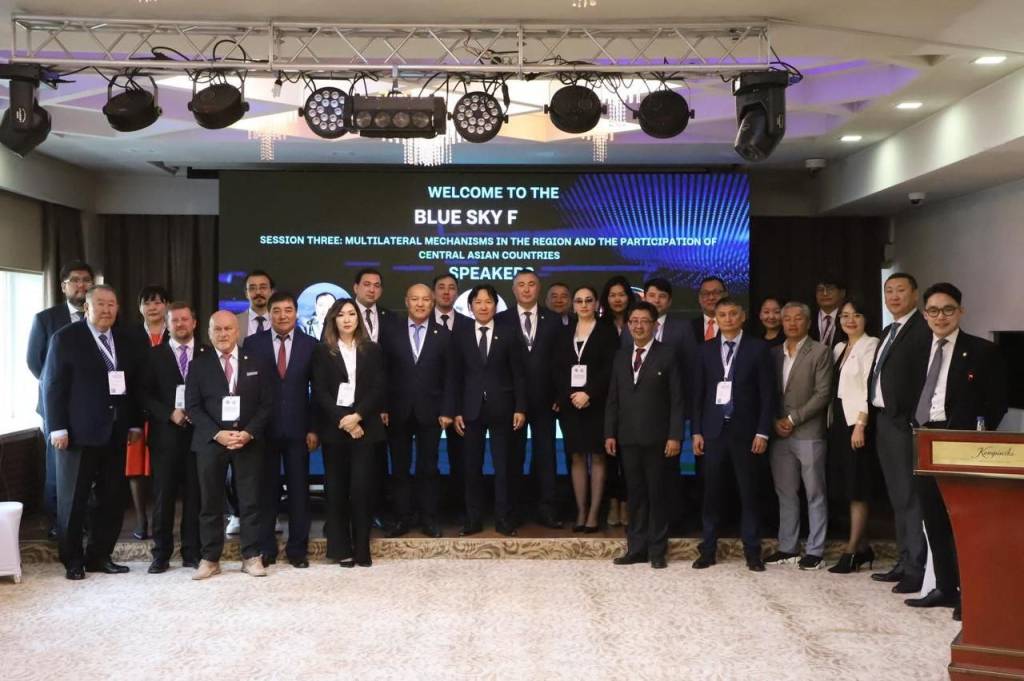
On September 18, 2024, a delegation of the Institute for Strategic and Regional Studies (ISRS), led by Deputy Director Bakhtiyor Mustafayev, took part in the first international Blue Sky Forum on Central Asia, organized by the National Institute for Security Studies of Mongolia in Ulaanbaatar.
The forum brought together experts from leading think tanks of Central Asian countries and Mongolia. Participants included representatives of the Institute of Philosophy, Political Science and Religious Studies of Kazakhstan, the National Institute of Strategic Initiatives under the President of the Kyrgyz Republic, and the Center for Strategic Research under the President of Tajikistan. Mongolia was represented by specialists from the Institute for Strategic Studies and the Fiscal Stability Council.

The main agenda of the forum was dedicated to the prospects for developing cooperation between the countries of Central Asia and Mongolia in the political, economic, cultural, and humanitarian spheres.
B. Mustafayev made a report on the issues of interaction between the countries of Central Asia and Mongolia in countering climate challenges.
As the expert emphasized, Central Asia and Mongolia face similar challenges in climate change today. In this regard, they presented ideas for possible cooperation in this area.
First, according to the expert, to rationally use water resources, an exchange of practices for the introduction of water-saving technologies is proposed.
Uzbekistan has introduced water-saving technologies on 1 million hectares out of more than 4 million hectares of irrigated land. As a result of the developed approaches, 2 billion cubic meters of water were saved, which is equivalent to the annual consumption of an entire region of Uzbekistan. Thanks to active measures in this direction, today, the country already ranks 7th in the world regarding implemented water-saving technologies after Israel, the United States, Russia, Spain, Brazil, and Italy.
Second, according to B. Mustafayev, developing a Joint Research Program to Combat Desertification is necessary.
More than 20% of the land in five Central Asian countries, with a total area of approximately 400 million hectares, is subject to degradation. A third of the region’s residents are already suffering from desertification. The Central Asian states are trying to solve this problem both within the framework of regional cooperation and at the sites of international organizations.
Thus, in 2023, the first-ever UN meeting on desertification, land degradation, and drought was held in Samarkand, where the problem of dust and sand storms was raised. Uzbekistan has successful experience in combating desertification at the bottom of the Aral Sea. In recent years, saxaul and other desert plants have been planted on the dried seabed on an area of 1.7 million hectares, and the area of green spaces has been increased by 2 million hectares.
Third, according to the Deputy Director of the Institute, it is essential to increase cooperation in the development of renewable energy sources through the development of green technologies.
Mongolia and the Central Asian countries have similar targets in promoting green energy and have enormous potential for solar and wind energy. In addition, the Central Asian region has extensive reserves of rare earth metals, the demand for which is steadily increasing in countries actively lobbying for the green agenda.
In this context, the expert cited research data from the Center for Energy Research of the Norwegian Institute of International Affairs that Central Asia will become a significant global supplier of certain critical materials for environmentally friendly energy technologies.
Considering these factors, the expert concluded that there are prospects for establishing cooperation in constructing solar power plants and the production of essential components for developing renewable energy sources.
Following the forum, the Mongolian side expressed a strong interest in establishing and deepening cooperation with Central Asian countries. The need to strengthen trust and expand interaction at all levels was noted, including through active expansion of contacts at the level of experts, diplomats, and academics.
The National Institute for Security Studies was established in 2018 and studies global and regional political and socio-economic trends, traditional and non-traditional challenges, and threats affecting Mongolia’s national security.
UzA