
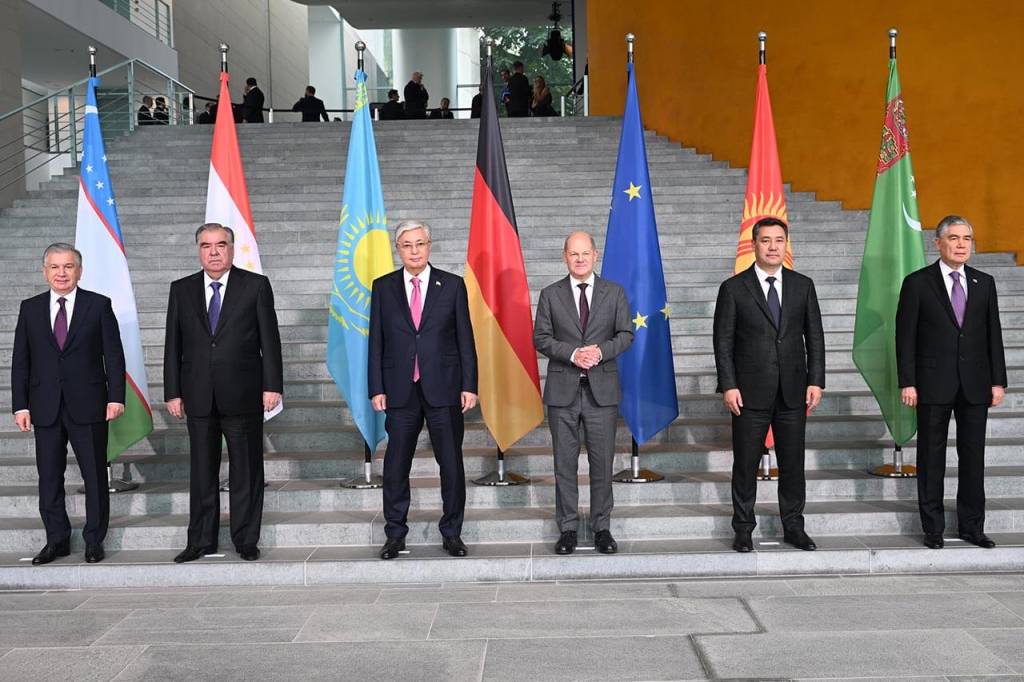
The first summit of the heads of state of Central Asia and the Federal Republic of Germany, which took place on September 29 in Berlin, opened a new milestone in the relations between the participants.
At the meeting, the leaders agreed that the “Central Asia – Germany” format is an effective platform for open dialogue and forming a new agenda for practical cooperation between the region and the German side.
Important issues such as strengthening economic cooperation, achieving energy security, and green and sustainable development were raised.
It is important to note that Central Asian countries are actively interacting with Berlin in attracting green investments and implementing joint projects to adapt to climate change and the efficient distribution of transboundary water resources.
In January 2020, the German Federal Foreign Office launched the Green Central Asia initiative to promote regional dialogue on climate security.
Thanks to this initiative, four projects are being implemented in the region for 50 million euros, including climate risk and water management, integrated land use, and establishing transboundary dialogue on climate, environment, and security.
In addition, the implementation of the Green Central Asia initiative resulted in research work on the study of glaciers using modern German technologies together with Central Asian specialists.
In August this year, representatives of scientific institutions and ministries of Central Asia, together with the Helmholtz Centre Potsdam, conducted a scientific expedition to the Tuyuksu Glacier in Kazakhstan.
Training modules were also created on climate, rational use of water resources, conservation of biological diversity, drought forecasting, ensuring the safety of tailings dumps, and preventing emergency water pollution in Central Asia.
“Tashkent Lectures” on water security are held on an annual basis, the last of which took place on December 15 last year in Potsdam together with the National Research University Tashkent Institute of Irrigation and Agricultural Mechanization Engineers and GFZ-Potsdam.
In addition, a Regional Working Group was created from representatives of the relevant ministries of the five countries in the region, which adopted the Regional Action Plan for Joint Political Dialogue on Climate, Environment and Security. This document represents the charter of the Regional Working Group and the action plan of the dialogue platform “Green Central Asia”.
Since 2022, working group members have been developing a Regional Strategy for Adaptation to Climate Change in Central Asia and discussing mechanisms for water-energy cooperation and glacier monitoring.
It is noteworthy that at the Central Asia + Germany summit, the President of Uzbekistan Shavkat Mirziyoyev called for Germany’s active participation in creating a Platform for water-saving technologies in the region and forming a Central Asian climate dialogue.
Germany is known for its outstanding contributions to developing water-saving technologies, including introducing the first drip system in 1880. This example of Germany’s exceptional experience and achievements in the efficient use of water resources can be a valuable source of inspiration for the agro-industrial sector of Uzbekistan, helping to reduce water losses and achieve more sustainable water use.
Moreover, the President of Uzbekistan invited Germany to co-organize the International Climate Forum under the auspices of the United Nations, which will be held next spring in Samarkand. This step will strengthen cooperation between Tashkent and Berlin in achieving the carbon neutrality targets outlined in the Paris Agreement, which is especially important in the context of the increasingly negative consequences of climate change.
In general, climate change, environmental balance, and the green transition have a central place on the political agenda, and international cooperation in this area is a key factor in achieving sustainable development.
Considering the existing level of interaction, further deepening cooperation with Germany in these areas represents a valuable opportunity for the countries of Central Asia, which will facilitate the exchange of experience and technology, help the region more effectively cope with the challenges of climate change and move towards a sustainable, green future.
The article was prepared with the assistance of the Press Service of the International Institute for Central Asia in Tashkent.
Gayrat Khonnazarov, UzA