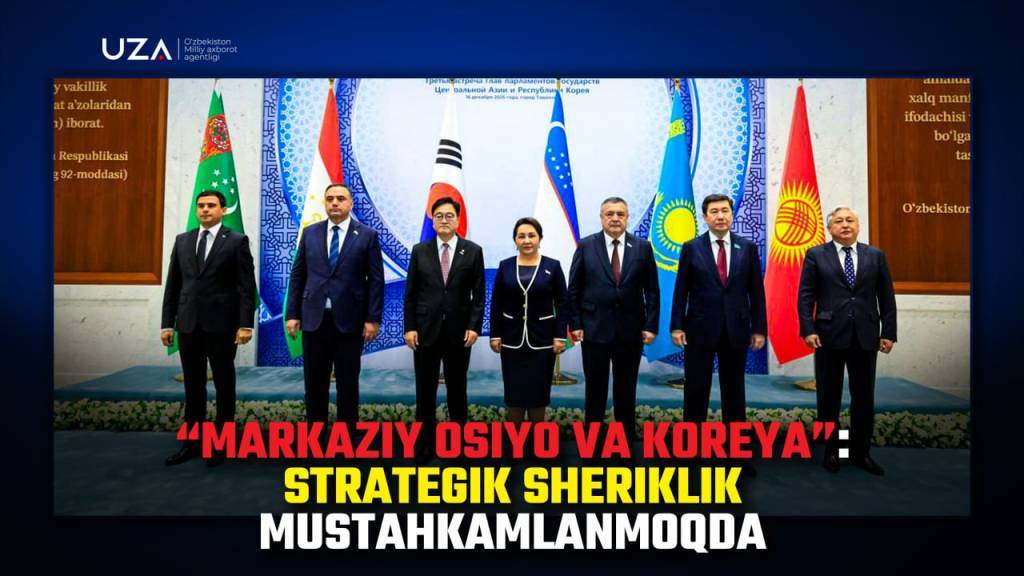
Tashkent hosted the third meeting of the heads of parliaments of the Central Asian states and the Republic of Korea.
Participants included Speaker of the National Assembly of the Republic of Korea Woo Won-shik, Chairman of the Mazhilis of the Parliament of the Republic of Kazakhstan Yerlan Koshanov, Deputy Chairperson of the Majlisi Namoyandagon of the Majlisi Oli of the Republic of Tajikistan Aziz Qodir Giyozoda, and Ambassador Extraordinary and Plenipotentiary of the Kyrgyz Republic to the Republic of Uzbekistan Duishonkul Chotonov.
In her address at the plenary session, Chairperson of the Senate of the Oliy Majlis of the Republic of Uzbekistan Tanzila Narbayeva noted that this meeting plays a vital role in shaping emerging political dynamics and strengthening inter-parliamentary trust and dialogue in the Central Asian region.
It was emphasized that high-level dialogue among Central Asian countries has become systemic, strengthening the region’s position on the global stage and establishing inter-parliamentary cooperation as an essential foundation for this process.
In their remarks, the heads of parliaments highlighted the importance of regular meetings, noting that this format has become a key platform for dialogue between Central Asia and the Republic of Korea.
As part of the meeting, a session titled “Economic Cooperation, Digital Transformation, and Industry: Pathways to Regional Prosperity” was held, during which major joint projects already implemented, expanding partnerships, and growing mutual trust between the two regions were highlighted.
Following the session, agreements were reached to prioritize economic cooperation, establish joint technological and industrial clusters, and implement near-term projects in digital integration and the green economy.
At the session “Sustainable Development and Environmental Protection: The Role of Parliaments in Ensuring the Implementation of Environmental Initiatives”, special attention was paid to the role of parliaments in advancing environmental initiatives, improving the legislative framework for environmental protection, and the responsibility of legislative bodies for achieving the Sustainable Development Goals.
Participants emphasized the importance of expanding inter-parliamentary cooperation in environmental protection, climate action, and sustainable development.
A roundtable titled “Scientific and Analytical Support for Parliaments in Central Asian Countries and the Republic of Korea: Experience and Future Trends” was also held, during which issues related to developing practical guidelines to enhance the effectiveness of legislative and oversight processes in the context of digital transformation were discussed.
As part of the prestigious forum, joint sessions of the heads of the parliaments of the Central Asian states and the Republic of Korea were held, along with bilateral meetings, sessions of inter-parliamentary commissions, meetings of parliamentary friendship groups, and discussions of best practices in legislative activity involving representatives of parliamentary think tanks and the academic community.
An evening of culture of the peoples of Central Asia and the Republic of Korea was held.
Following the forum, agreements were adopted by the parliaments of the Central Asian states and the Republic of Korea, along with a Joint Declaration to identify promising areas for further cooperation.
Norgul Abduraimova, UzA