
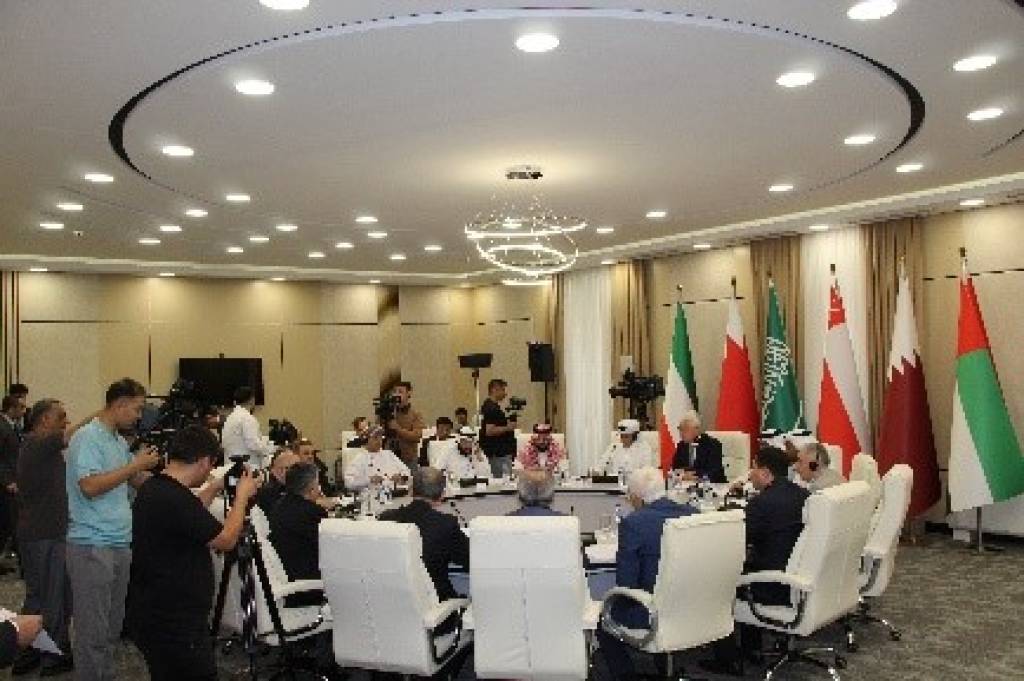
At the initiative of the International Institute for Central Asia (IICA), a roundtable discussion was held on “Central Asia and the Cooperation Council of the Arab States of the Gulf: Priorities and Prospects”.
The event was attended by heads of diplomatic missions and senior diplomats of the Gulf countries: the Ambassadors of Qatar, Kuwait, the UAE, the KSA, and the Charge d'affaires of the Embassy of the Sultanate of Oman.
The Central Asian countries were represented by the Ambassador of Kazakhstan, the Advisor-Envoy of the Embassy of Tajikistan, and the Advisor of the Embassy of Kyrgyzstan.
The roundtable discussion was also attended by the head of the Arab Center for Research and Policy Studies and representatives of national analytical centers and research institutes - the Academy of Sciences, IACIR, CERR, ISRS, and the Islamic Academy.
At the event, the participants discussed the results of the First Summit of the Gulf Cooperation Council and Central Asian countries in Jeddah, exchanged views on the prospects for cooperation, and outlined priority areas for strengthening ties between the regions.
The parties exchanged views on promising areas of cooperation between the parties in politics, security, economy, trade, investment, energy, transport, agriculture, and ecology.
Deputy Foreign Minister Bakhrom Aloyev noted that the President of Uzbekistan, in his speech at the summit, emphasized the deep historical connectivity of the peoples of Central Asia and the Gulf region, which is based on close trade relations, common values, and traditions, the holy religion of Islam.
Director of the Center of Information and Arabian-Russian Studies based in Riyadh Dr. Majed Al-Turki highly appreciated the proposals of the Head of state, especially in terms of increasing economic cooperation, developing joint projects, and creating an investment fund, introducing a visa-free regime for visiting the country.
Vice-President of the Academy of Sciences of the Republic of Uzbekistan, Director of the Institute of Oriental Studies Bakhrom Abdukhalimov noted that the summit opened up new opportunities for the region's states in cooperation in cultural-humanitarian and tourism spheres.
The Ambassador of Qatar Hassan bin Hamza Hashim noted that the rich historical heritage of the countries is the basis for the consistent development of fruitful and effective ties between both regions.
The need was noted to increase cooperation in various areas of mutual interest. Among the priorities are creating platforms and working mechanisms of collaboration in innovation, artificial intelligence, green economy, digitalization, smart agriculture, nano, and biotechnology.
Over the past six years, large-scale reforms were implemented in Central Asia. Thanks to the political will of the leaders of the states, investment cooperation has intensified in the region, and the implementation of significant cooperation projects in trade, industry, energy, transport, agriculture, cultural and humanitarian spheres, and other sectors has begun.
G.Khonnazarov, UzA