
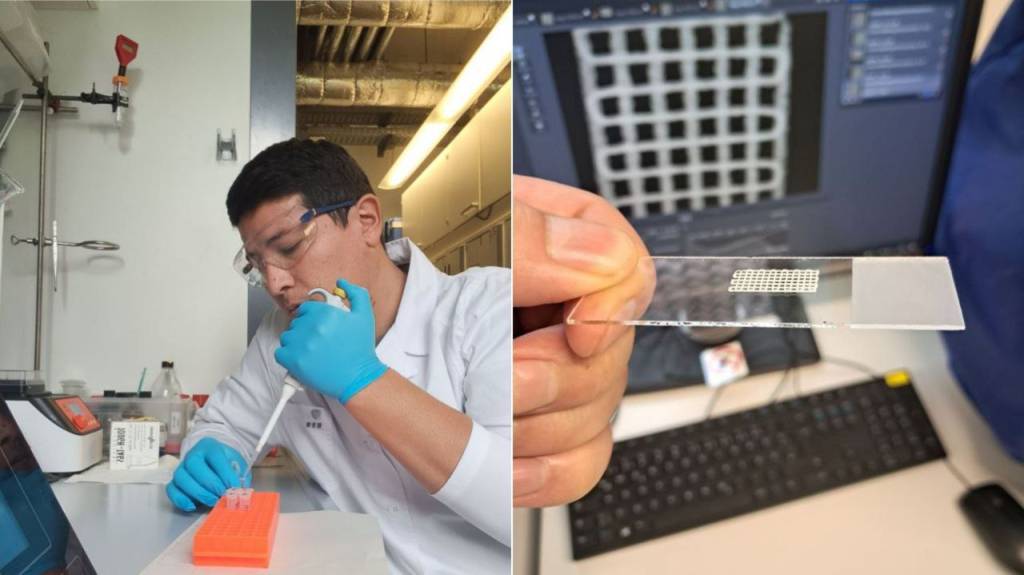
An important scientific achievement has been made in the country, opening up possibilities for printing human organs using a 3D bioprinter.
According to the Agency for Innovative Development of Uzbekistan, Olimjon Boymatov, a researcher at the Institute of the Chemistry of Plant Substances of the Academy of Sciences of Uzbekistan, has developed a method to produce bioink for bioprinters using local plants. He notes that domestic scientists have for many years been developing bioinks that are fully compatible with the human body, safe, cost-effective, and suitable for production under local conditions. Despite certain achievements in this field, there has still been no effective solution that could be widely applied in practice.
Significant progress was achieved following a research internship in Germany at the prestigious Leibniz University Hannover, where modern bioprinting technologies and hydrogel production methods were studied.
“In 2024, I took part in an internship competition announced by the Agency for Innovative Development of Uzbekistan, won, and studied modern bioprinting technologies and new methods for producing hydrogels at the prestigious Leipzig University”, says Mr. Boymatov. “As a result, I obtained positive findings regarding a bioink that enables the printing of human organs using a 3D bioprinter. The new hydrogel is based on polysaccharides derived from local plants and supports the viability and development of human iMSC cells. This opens up prospects for creating artificial organs and tissues distinguished by high biocompatibility, safety, and adaptability”.
The Intellectual Property Agency of Uzbekistan has reviewed the development, reached a positive conclusion, and the patenting process is underway.
Nasiba Ziyodullayeva, UzA