
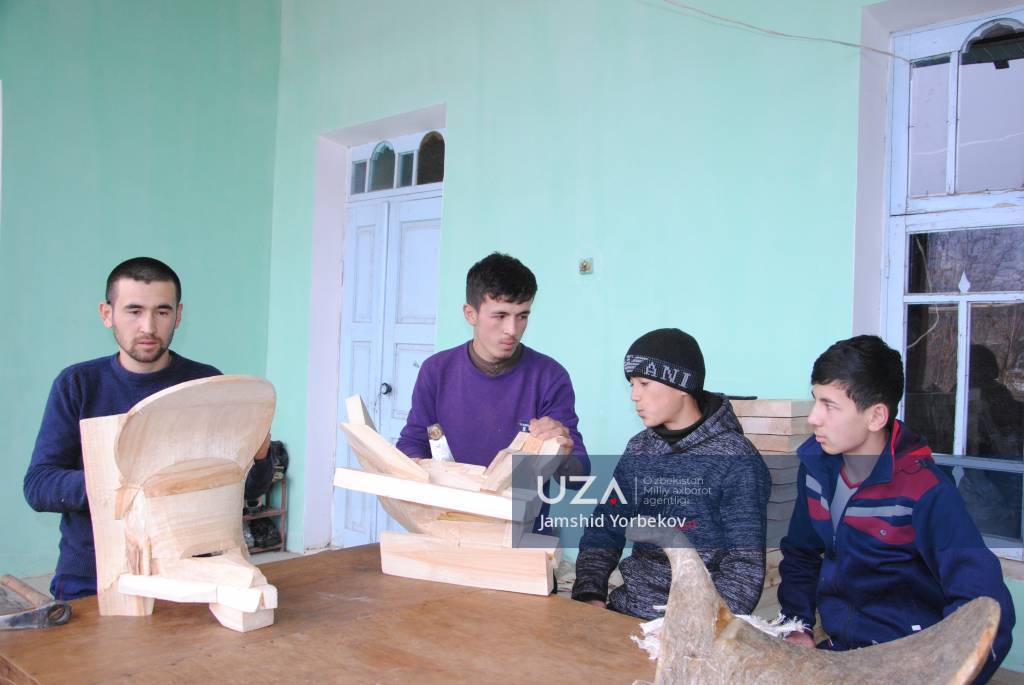
Novqa village of Bakhmal district in Jizzakh region is famous for its masters who are engaged in making saddles, one of the most unique types of Uzbekistan national handicrafts. Saddles made by the rural craftsmen are popular not only in the country but also among riders of neighboring Kyrgyzstan and Kazakhstan.
Novqa is one of the oldest settlements in the country. As a result of research conducted by the Institute of Archeology named after Yahyo Gulomov of the Academy of Sciences of Uzbekistan, it was found out that the city of Nauqat was located in the summer caravan route from Sughd to Shosh, which was destroyed during the Mongol invasion. The historical monument of Novqa Ota here, inscriptions from tombstones, and other archeological finds show that this assumption is close to the truth.
The fact that ancient handicrafts such as household items, horse harnesses, saddles, blankets, stirrups, knives have been passed down from generation to generation as a cultural monument of the country’s people also testifies to the distant past of the village. Especially, saddle making is one of the unique types of handicrafts of Uzbekistan people.
[gallery-821]
The uniqueness of this craft is that the type of saddle, which is called “red saddle” among horsemen and riders, is made only by Novqa masters. Today, a dynasty of about a dozen family craftsmen in the village continues this ancient craft.
The popularity of Novqa saddles is in their durability. It turns out that even if the horse falls during the Kupkari, the saddle will not break. The reason why a saddle made of ordinary willow is so strong is that when the wooden part is ready, the ligament of the cattle is glued on it with special glue. The top of the ligament is then covered with birch bark and is called a ‘red saddle’ because it is given a red dye. This is work that requires a lot of time and perseverance. It takes up to a month to make a saddle. Each saddle is made to order.
T. Beknazarov, photos by J.Yorbekov, UzA