
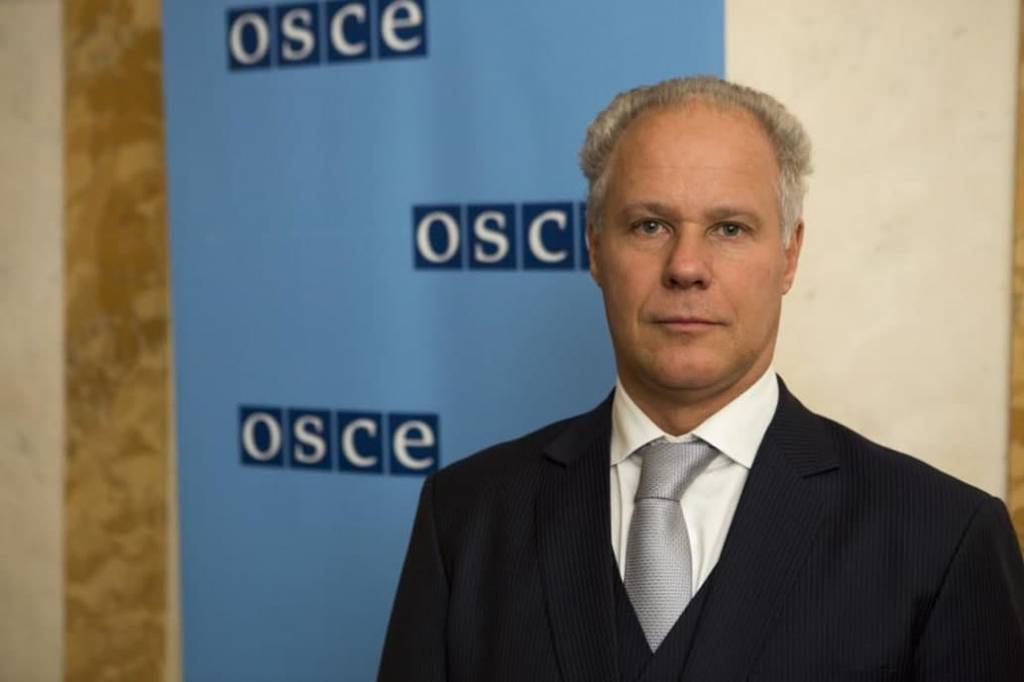
January 30 is the day of Uzbekistan’s accession to the Organization for Security and Co-operation in Europe (OSCE). On the occasion of this date, UzA (National News Agency) Correspondent Behruz Khudoiberdiev interviewed the OSCE Project Co-ordinator in Uzbekistan, Ambassador Dr. Pierre von Arx.
– Mr. Ambassador! It is known that 30 years ago the Republic of Uzbekistan joined the Organization for Security and Co-operation in Europe. It is not a short span of time. What areas of co-operation have been in priority over the past period?
– I would like to start by congratulating the Republic of Uzbekistan, its leadership and citizens on the 30th anniversary of the accession to the OSCE. I also wish to express my deep gratitude for the excellent co-operation we enjoy with the host authorities and the civil society. It is a great pleasure for all my team to work in such an able environment.
With 57 participating States, the OSCE is the biggest regional security organization in the world and its aim is to develop security through co-operation. The OSCE’s comprehensive approach to security means that we co-operate in areas ranging from politico-military aspects and preventing transnational threats, through to economic and environmental security as well as humanitarian security, including human rights.
The National Development Strategy developed under the leadership of President Shavkat Mirziyoyev guided our work over the past years and is very much in line with OSCE principles and commitments. This helped us to develop a dynamic partnership between Uzbekistan and the OSCE.
It is important to understand that the work done by the OSCE is developed at the request of its participating States. For the office of the OSCE Project Co-ordinator in Uzbekistan (PCUz), it means that we work in close co-operation and a mutual understanding with the Uzbek government, and our primary partner is the Ministry of Foreign Affairs. You might see the role of PCUz as a platform for enhancing and facilitating co-operation with your country in implementing OSCE principles and commitments developed and agreed by the 57 OSCE participating States, including Uzbekistan. The OSCE Office in Uzbekistan provides assistance in developing and supporting the implementation of national strategies based on the priorities of the country and its specific objectives.
– What OSCE projects are currently implemented in our country and what can you say about prospects for future co-operation?
– The Republic of Uzbekistan is one of the most active among the 57 OSCE participating States. The Uzbek authorities and civil society are closely co-operating not only with the OSCE Project Co-ordinator in Uzbekistan, but also with the Secretariat in Vienna, and OSCE institutions such as the OSCE Parliamentary Assembly (PA), the Office for Democratic Institutions and Human Right (ODHIR), the High Commissioner on National Minorities (HCNM) and the Representative on Freedom of the Media (RFOM). This co-operation was reinforced by high-level visits during the past years.
Furthermore, Uzbekistan is a dynamic member in the different fora and Committees of the OSCE, bringing important contributions, experience and expertise. This active participation in the undertakings of the Organization shows the importance that Uzbekistan attaches to multilateral diplomacy, thus contributing to peace, stability and security in the OSCE region.
The prospects for future co-operation are very positive. We will continue to work with many institutions on judiciary reforms, the rule of law, reforming the electoral system, advancing human rights and preventing the use of torture. We co-operate with the authorities and civil society in supporting the right of persons with disabilities, promoting women’s participation in political and economic life. The PCUz will continue its support aimed at strengthening good governance fighting corruption and supporting economic development of the country. Strengthening environmental security will also be part of our activities. We will continue to assist the government in its efforts in preventing and countering terrorism, enhancing cybersecurity capacities, developing democratic policing and security sector governance, thus contributing to security and stability in the host country.
– Your assignment in Uzbekistan commenced during the pandemic. What can be expected from the 250 thousand EUR project developed for external labour migration and migrants re-integration issues in 2022?
– The impact of the pandemic is immense. It affects the lives of people and societies and disrupts economies around the world. Labour migrants were one of the most affected groups during the COVID-19 pandemic. Many labour migrants from Uzbekistan have faced adverse difficulties caused by the lack of possibility to return home, loss of jobs and struggles to find new employment. In response to this humanitarian and economic emergency, the PCUz started several initiatives to help migrants and will continue to implement them in 2022. In particular, we supported the creation of an online consultation platform, in the form of a web-portal and a mobile application within the official website of the Agency for External Labour Migration. Immediately after its launch, hundreds of labour migrants approached the platform in search of the necessary legal, social, informational and advisory assistance. Today the platform provides better access to up-to-date information, expert consultancy, legal, and employment assistance to thousands of citizens. PCUz also organizes capacity-building training courses to help re-integrate returning labour migrants and build their professional and entrepreneurship capacities. Finally, we provided humanitarian aid that included protection masks, gloves, mugs and bags as well as personal hygiene products, detergents and antibacterial agents. This year we will continue to support capacity building and will be focusing more on women migrants.
– Uzbekistan pays special attention to the expansion of cultural and humanitarian ties with foreign countries and building a tourism industry in the country. What is the role of the OSCE in this process?
– I would like to commend the Republic of Uzbekistan for building friendly ties with foreign countries as well as for its efforts in developing the national and regional economies. The impressive developments taking place in Uzbekistan represent a positive example and a very positive agenda. The Uzbek authorities and citizens can be rightly proud of the reforms towards the creation of a modern Uzbekistan, which contributes to peace and security in Central Asia and beyond.
The Republic of Uzbekistan has much to offer; this includes further enhancing its tourism industry and strengthening cultural ties with foreign countries. Concerning reinforcing the ties with other countries, the OSCE is supporting Uzbekistan to adhere to important conventions, for example in the humanitarian sphere or enhancing judicial co-operation, and to join international initiatives. Almost all our projects support the consolidation of international relations.
As already mentioned, the OSCE has a mandate to develop security through co-operation in a comprehensive way, which includes not only “hard security” and human rights, but also economic and environmental security. Our green economy and environmental projects will indirectly facilitate developing modern tourism, by making Uzbekistan environmentally friendly. Many small and medium enterprises developed with OSCE support will benefit from tourism and contribute to its development.
– How do you evaluate efforts of Uzbekistan’s leadership to ensure regional security given its proximity with Afghanistan?
– Since 2016, the leadership of Uzbekistan has taken significant steps to improve good relations and security in the region and contribute to improving the stability of the Central Asian region. Uzbekistan takes a pragmatic and reasonable approach in establishing constructive relations with its neighbors, including Afghanistan, and developing confidence-building measures such as enhancing economic connectivity and security dialogue. Uzbekistan counts itself as an important partner to the Afghan people especially in delivering humanitarian aid, with Termez becoming an international hub. This way Uzbekistan plays an important role in stabilizing the situation in and around Afghanistan.
This is in line with Uzbekistan’s foreign policy developed under President Shavkat Mirziyoyev, which has among main priority the creation a zone of stability, steady development and good neighborliness in the area including the five Central Asian states and Afghanistan. By doing so, Uzbekistan has become an active partner for many countries, as well as establishing partnership ties with regional and international organizations. There is a growing understanding in Uzbekistan that with the world becoming increasingly interconnected, global challenges need a co-operative approach.
The OSCE is supporting these efforts, such as improving economic connectivity, enhancing border security while facilitating trade, supporting the organization of international events, and promoting enhanced cooperation among Central Asian states to name few.
– Our readers are also interested to know what regions of Uzbekistan you have visited and what is your impression of our country and people?
– Uzbekistan is at the crossroad of multiple cultures between East and West, and North and South, and possesses a rich cultural heritage. This rich history has shaped the country and influenced the behavior of its people. I have great respect for the tolerance and acceptance that I have witnessed between communities of different religions and between ethnicities that have been living in harmony for centuries. Mutual respect is admirable. It is likely because of this attitude of peaceful living; Tashkent has been home to the signature of major peace agreements and has hosted numerous international events.
Peace, art and progress, along with old and modern culture that are melted together here, are perhaps the recipes of the exceptional hospitality and kindness of the people. I feel the positive energy in beautiful Uzbekistan and feel comfortable. I appreciate interacting with people from all over the country and their desire to share their experiences. Uzbek citizens are sophisticated people, which is probably the result of a rich secular culture. They also show modesty, humbleness and great interest in our work.
Uzbekistan is a multiethnic, multi-religious and multicultural country. I believe Uzbekistan has definitively a bigger role to play in regional and global connectivity. I am convinced that the development of modern Uzbekistan that advances with respect for its traditions will bring peace and prosperity.
– Thank you for the informative conversation and detailed information! On behalf of the UzA team, we wish you great success in your honourable and responsible assignment.
UzA