
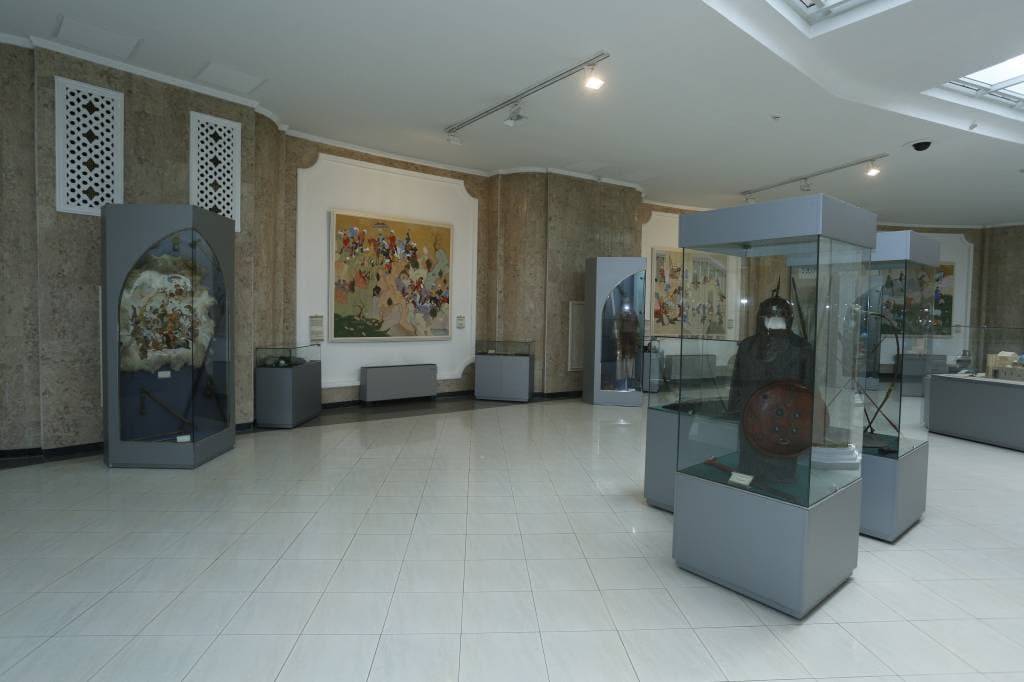
A museum is a mirror of culture, a scientific and spiritual-enlightenment institution that collects, stores and studies historical, material and spiritual monuments. The museum carries out scientific outreach and spiritual-educational activities through expositions and exhibitions.
The expositions of the State Museum of Timurids History reflect the life of Amir Temur not only as a great military commander, a major statesman, but also as a creator, and the continuation of creative foundations laid by him by the current generation.
The first floor of the museum has exhibits of the era of Amir Temur. One of them is a copy of the Quran, delivered from Saint Petersburg in 1905. The copy was written 100 years ago. There is a miniature to the work “Zafarnoma”, a copy of the bowl of Hussein Bayqara, stored in the Metropolitan Museum of Art. There are portraits of the rulers of Mawarannahr Umarshaykh Mirzo (the second son of Amir Temur), Khalil Sulton Mirzo, Ulugbek Mirzo, Abdullatif Mirzo and others.
On the second floor, there is a genealogy of the dynasty of Amir Temur, miniatures depicting the process of receiving ambassadors, silver and copper coins on which the names of Amir Temur and Sulton Mahmudkhon are minted. There is the original of the book “The Code of Temur”, horsemen armor, the globe of Ulugbek Mirzo, the model of Tajmahal ensemble, erected at the behest of the Baburids.
In addition, heads of state, ambassadors of Egypt, Iran, Russia, Georgia, France, Italy, Spain and many other countries left their impressions about the museum in the Guest Book.
Nigora Rahmonova, UzA