
Summing up the year, positive changes in our country come to mind one by one. Over the past year, the Ministry of Tourism and Sports has implemented several major projects and hosted many international events.
A team of qualified specialists from the Ministry’s Cultural Heritage Agency studied the past and present of our ancestral heritage and historical monuments. They are taking necessary measures to pass on the invaluable cultural heritage of our nation to future generations, explaining to our compatriots that each object of cultural heritage has its place and significance. It is noteworthy that along with the repair and restoration of world-famous monuments, the use of such historical monuments as a cultural and enlightenment place has begun.
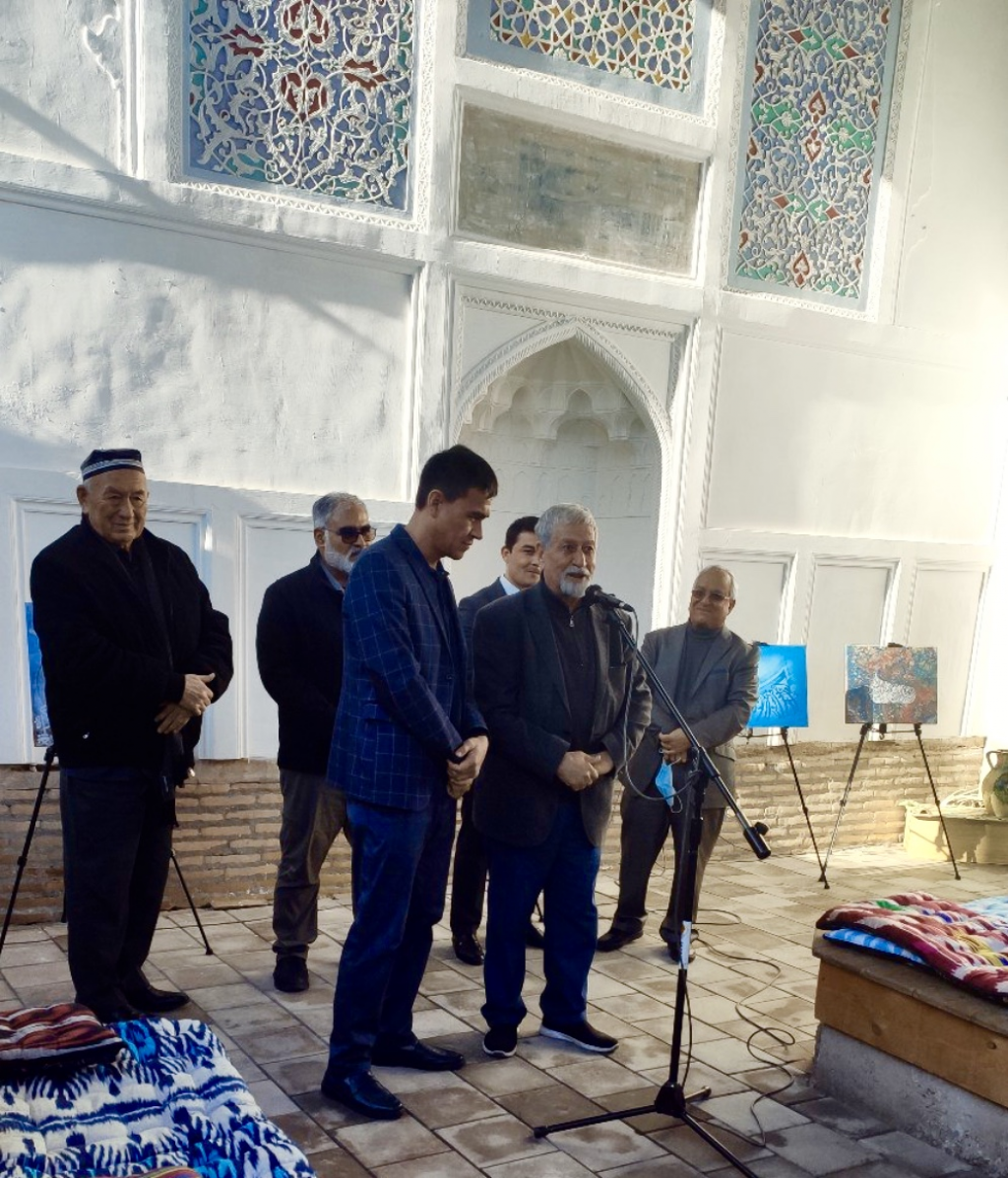
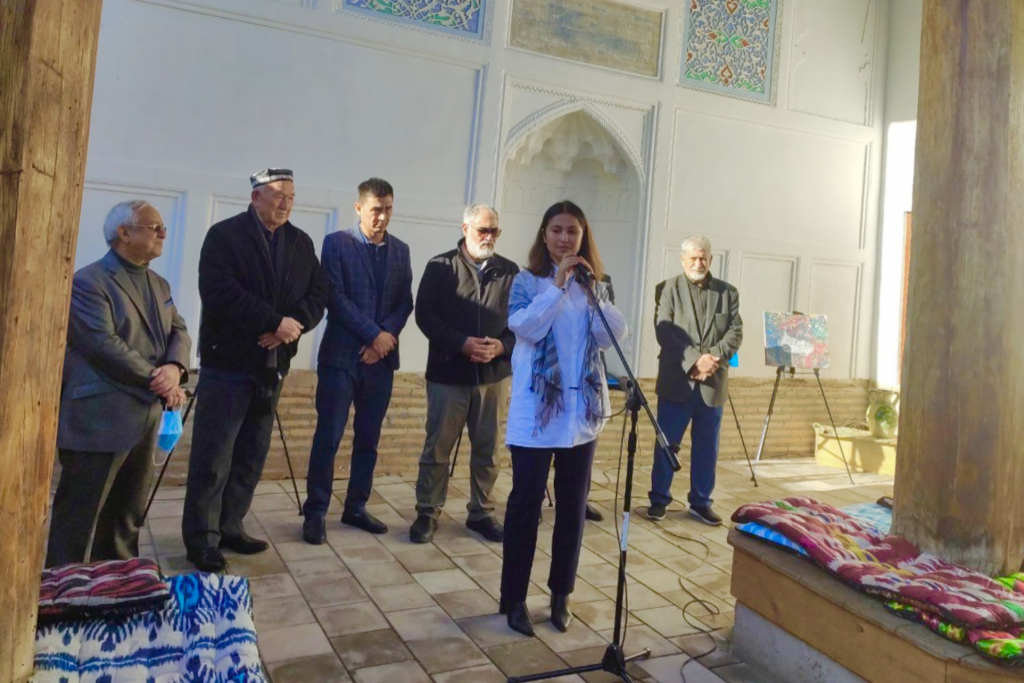
One of such noble events is the grand opening of the exhibition “Qushtut” and “Uzbek writing and book art”. It is the architectural monument of the 19th century and is listed in the National Cultural Heritage of Uzbekistan. This gallery is located in the center of “Pichoqchilik” mahalla, one of the oldest monuments in the Almazar district in Tashkent. The event began with an introductory speech by Madina Aripova, Founder and Director of the Qushtut Gallery:
– This unique historical and architectural monument, where the Qushtut Gallery is located, was built at the expense of Sharofeybay Zaynageddinov, an enlightened merchant from Tashkent. It is only a small fragment of the whole complex that has survived to our time. This person was a wealthy merchant, philanthropist, statesman and public figure. He donated much of his wealth to the cause of enlightenment and faith-building madrasahs, schools, mosques, roads, and houses for the poor.
This architectural monument was built in 1869. About 200 students studied at the madrasah next to this building. By 1937, the madrasah was demolished. The building was used as a prison, a warehouse, a shoe workshop and as a car repair shop until the initial years of independence.
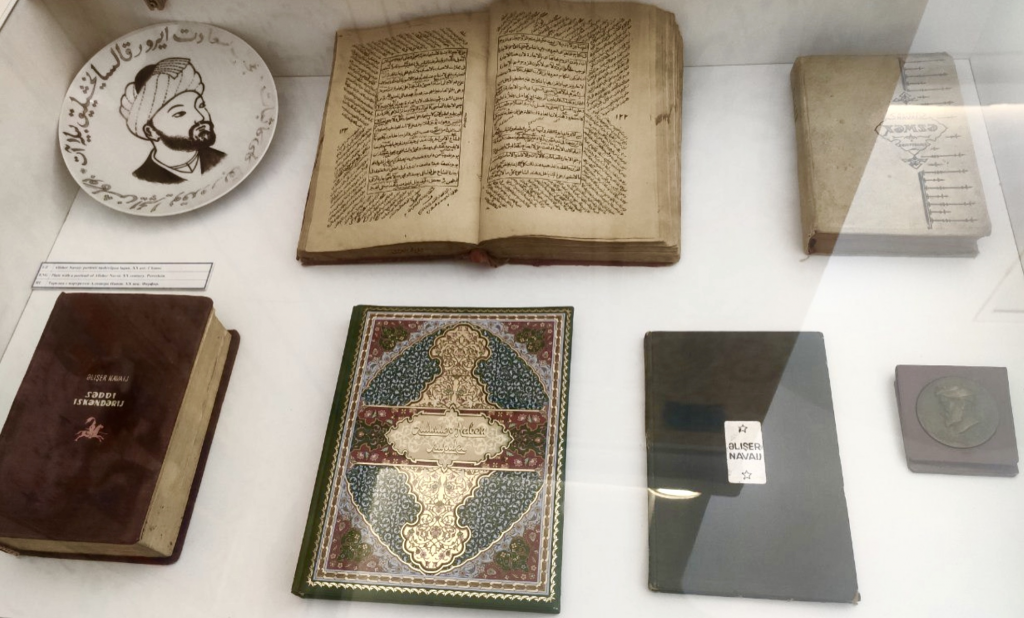
Since 2013, a group of local historians, community activists have studied the history of the monument. It was buried, saline-covered, neglected wall and rotten pillars were dug up to the foundation. To restore the spiritual significance of this monument, the most appropriate was selected from various proposals. Following the proposal, the entrepreneur invested in the creation of the Qushtut Gallery, which is engaged in spiritual, enlightenment and scientific activities. A permanent exhibition “Uzbek writing and book art” was formed in the building. The exposition includes rare and valuable pieces of ceramics, tiles, old terracotta and candles that were found and purchased by the residents of this neighborhood during the excavation of their backyards. There are also pencils, architectural ornaments, fragments that were used by the Tashkent Jadids and unique manuscripts in Uzbek, Turkish, Arabic and Persian, lithography and lithotypography books published in the first lithotypography in Tashkent in the 19th century.
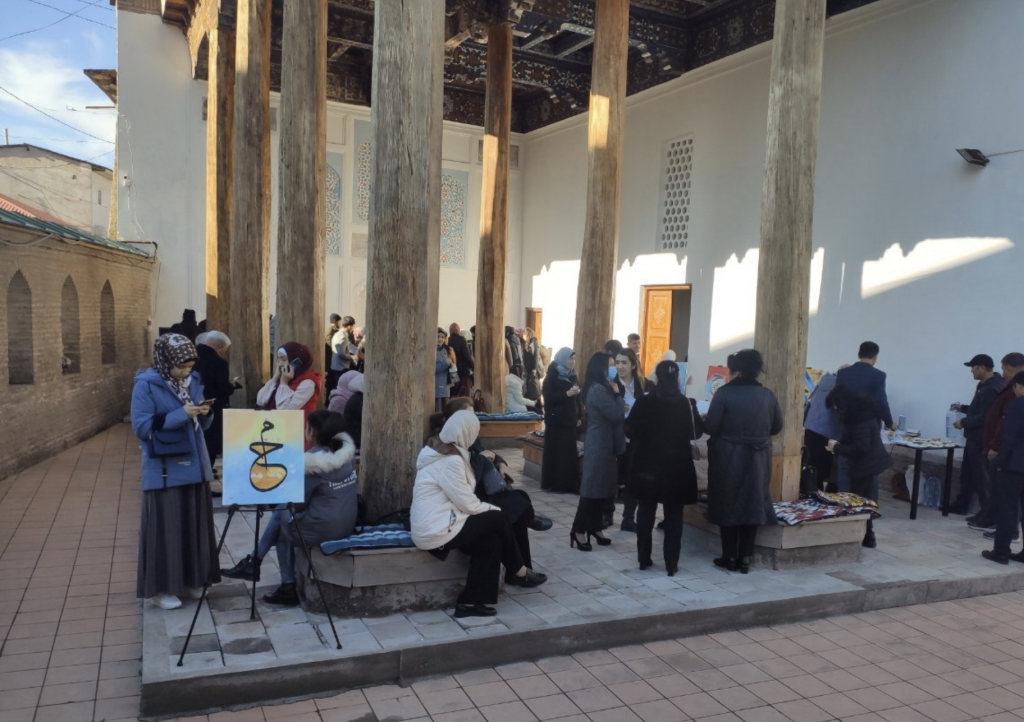
The unique architectural monument’s dome and exit device, which was built in the original architectural style, is very attractive. 5 rooms, summer and winter hall altars are not found in other monuments. Kufic calligraphic inscriptions on the walls facing the Qibla, the shapes and patterns made by very talented and skillful Kokand painters have not lost their color for nearly two centuries.
Luxurious and the 8 pine columns are decorated by ganch carvings on the walls of the porch itself, intricate girih and islimi patterns of the art of painting on the ceilings. Тhe two-tiered carved doors leading to the three sides of the building are also a rare example in historical architectural monuments.
It is noteworthy that in December 2021, several cultural and enlightenment events were held by the Ministry of Tourism and Sports of the Republic of Uzbekistan, the Ministry of Culture, the State Museum of Applied Arts and Crafts of Uzbekistan, the University of World Languages of Uzbekistan, Minnesota College in the United States. This indicates that our cultural heritage will continue to function as an object of tourism, as well as a source of spirituality and enlightenment, to return to its original essence.
The organization of an international calligraphy exhibition and master class “Calligraphy – patterns of my heart” at the Qushtut Gallery on the eve of the New Year is a clear example of this.
The gallery courtyard was crowded with guests from abroad, the staff of the Uzbek State University of World Languages media, representatives and students.
Honored Cultural Artist of Uzbekistan, well-known calligrapher, winner of the Golden Pen International Award – Habibullo Saliev, well-known American calligrapher, Dr. Al Hajj Wafaa, Dean of the Uzbek State University of World Languages Rivojiddin Karimov and Iraqi journalist, professor Ahmad Abuzayd also spoke about the role and place of Uzbek calligraphy schools and calligraphy in world culture.
“The art of Samarkand, Kokand, Bukhara, Khorezm and Tashkent calligraphy schools, which have flourished in history, is a perfect work of art not only in calligraphy, but in all its elements. That is why today our national art is experiencing the Renaissance and is being reborn. In particular, the growing interest of the younger generation in the art of calligraphy is a sign that the time has come to appreciate the cultural heritage of our ancestors, – said the calligrapher Habibullo Saliev.
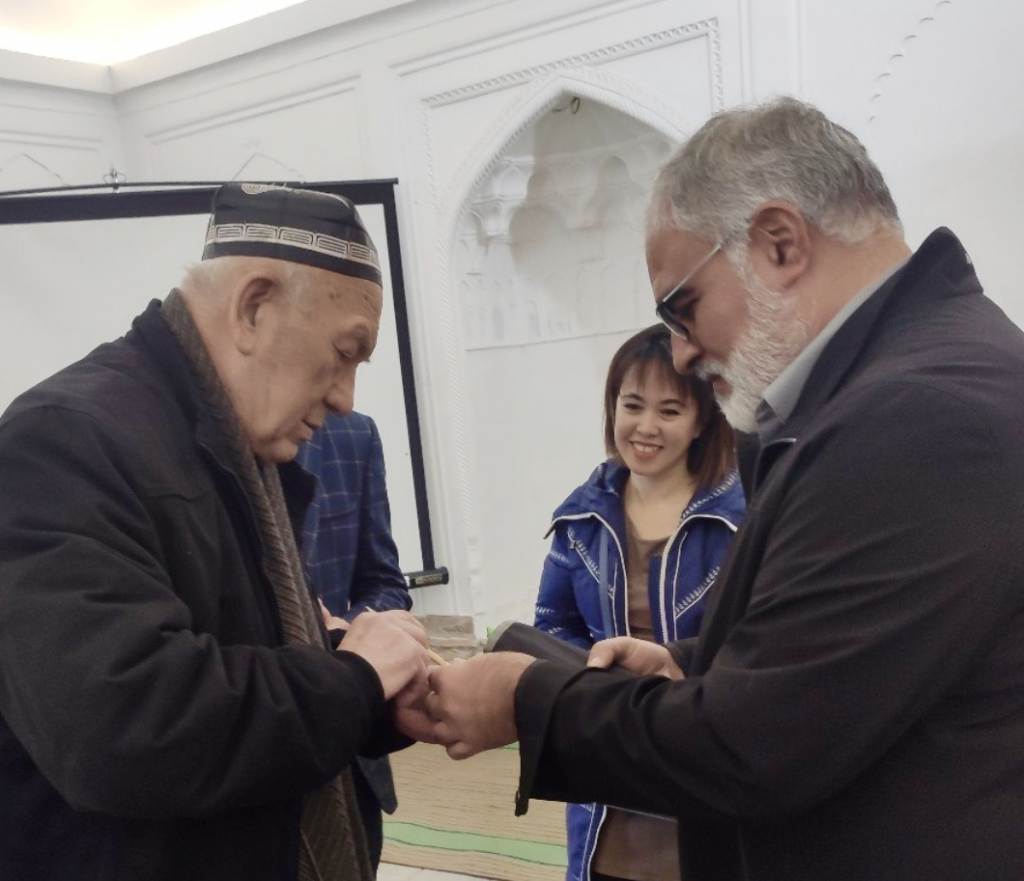
After the guests got acquainted with the exhibition, an interesting creative competition between calligrapher Habibullo Saliev and Dr. Al Hajj Wafaa became an unexpected event for our youth. The two calligraphers displayed their skills and art in front of everyone. They exchanged their pencils with each other as a symbol of friendship and cooperation. Dr. Al Hajj Wafaa conducted a master class in calligraphy for the youth. During the event, the guest presented his works to the Tashkent city administration, the Center for Islamic Civilization, the State Museum of Applied Arts and Crafts of Uzbekistan and the Qushtut Gallery, which contribute to the preservation of cultural heritage. Director of the Qushtut Gallery Madina Oripova awarded calligraphers with certificates of honor.
– The exhibition features 50 contemporary calligraphic compositions, which are based on the ancient calligraphic traditions of the world of Arabic writing”, said calligrapher Al Hajj Wafaa. – Calligraphy was originally the art of calligraphy for the Islamic world with the advent of the Arabic alphabet occurred. Especially due to the spread of the Arabic script, such a historical process as the highest and unprecedented prosperity of calligraphy took place in Mawarannahr, that is, in the territory of Uzbekistan. The unique art of calligraphy appeared. Although the first specimens of Arabic calligraphy appeared in Madinah, Saudi Arabia, its flourishing was formed precisely in your country. For example, Chinese calligraphy, one of the oldest, has only two writing styles. And in Arabic calligraphy, there are countless types of writing styles. In this type of calligraphy, works of art were created with reeds or bamboo pencils, and today the world celebrates “Arabic Writing Day”.
I am glad to see the patterns of girih and Islamic calligraphy in the tile decorations of both historical and modern buildings in Uzbekistan ...
Many guests, especially young people, visited the gallery. Some guests had a heartfelt conversation with the exhibitors. Taking into account the wishes of young people, it was agreed to hold online classes by calligraphers in the upcoming days. Even a visitor from across the ocean expressed satisfaction to attend such class, despite the long distance.
– Calligraphy is the king of all arts. The opening of an international calligraphy exhibition at the Qushtut Gallery is a historic event. To be honest, I was amazed that this place was full of students, and that our young people were eager to learn the art of calligraphy. I realized that such cultural events should be held more and more widely, – said the master potter, artist Abdulvahid Karimov. – I was glad to see that our young people could easily speak to our foreign guests in English, French, German, Russian, Arabic and that they were intelligent and I’m very grateful to the organizers of this event. I think that the art of calligraphy will develop in our country in the future.
The event was a lesson of true spirituality and enlightenment. The students were very impressed:
– Participating in the International Calligraphy Exhibition held at the Qushtut Gallery, I became convinced that such events can greatly contribute to the acquisition of knowledge and skills by our youth, – said Bilolkhon Habibullaev, a second-year student of the Uzbek State University of World Languages. – I am very interested in the art of calligraphy. So now I am constantly looking to increase my knowledge of this branch.
The Head of our state is carrying out extensive work for our youth. The arrival of qualified teachers from abroad to teach us is a great opportunity to develop our knowledge. While my teacher Ala Said taught us Arabic grammar perfectly in a short time, I also learned from Dr. Al Hajj Wafaa the secrets of the order of Arabic writing, the use of papers, and the preparation of ink.
I am glad to say that such events and exhibitions are very important for young people. Although the architectural monument where the Qushtut Gallery is located has suffered a lot in its history, it has begun to serve the tourism potential of our country, for young people to study the history of the country, as well as the city of Tashkent.
Nilufar Jabborova, Cultural Heritage Agency, Journalist