From stability to connectivity: Central Asia’s new status at the United Nations
In an international system where states increasingly struggle to find common ground, Central Asia has emerged as one of the few regions around which a broad consensus has been built.
An important political development took place in May of this year: the United Nations General Assembly (UNGA) adopted the resolution “Strengthening regional and international cooperation to ensure peace, stability and sustainable development in the Central Asian region”.
The initiative was put forward by the President of Uzbekistan Shavkat Mirziyoyev during the General Debate of the landmark 80th session of the UN General Assembly in September 2025.
Notably, the resolution was adopted by consensus, without a vote. This reflects an important feature of Uzbekistan’s diplomatic approach: rather than seeking to impose its position, it demonstrates an ability to put forward initiatives, formulate them with due regard for the interests of a diverse range of states, and build a broad coalition around them.
The resolution was co-sponsored by 66 countries representing different regions of the world. These included all Central Asian states, as well as China, Russia, Germany, Brazil, Türkiye, the Republic of Korea, and other countries.
At a time of growing geopolitical fragmentation, such a consensus carries political significance. It shows that regional cooperation in Central Asia can bring together the interests of countries with differing foreign policy orientations.
The substance of the resolution reflects not merely broad support for regional stability but also an already established regional agenda: the development of economic integration and connectivity, the free movement of people, goods, and services, industrial cooperation, and interaction among small and medium-sized enterprises.
At the global level, the document clearly formalized what has become a new political reality in the region in recent years: Central Asia is gradually evolving from a group of five states linked primarily by bilateral relations into a more closely interconnected regional system capable of developing common approaches and representing collective interests on the international stage.
Just ten years ago, Central Asia was viewed primarily as a geographical space comprising five independent states, but not always as a distinct political region.
Unresolved border issues persisted between the countries, transport links were limited, mutual trade remained low, and trust was scarce. Individual states largely shaped the regional agenda through their relations with external partners, while indigenous multilateral mechanisms were virtually nonexistent.
Today, the situation is changing. The regular Consultative Meetings of the Heads of State of Central Asia, initiated by the President of Uzbekistan Shavkat Mirziyoyev in 2017, have become the central platform for discussing common issues without an external intermediary.
Importantly, the Consultative Meetings have not remained merely a forum for political dialogue among heads of state. A multi-level architecture of regional cooperation has gradually developed around them, ranging from meetings of relevant ministers and economic forums to expert-level contacts, interactions among business communities, parliaments, women, and youth, and mechanisms for industrial cooperation and interregional engagement.
This was followed by the creation of new instruments of cooperation and the adoption of strategic documents, including the Concept for Cooperation within Multilateral Formats, the development of the “Central Asia 2040” framework for regional cooperation, and the Concept of Regional Security and Stability.
At the same time, the economic foundations of cooperation were shifting. According to the Eurasian Development Bank, the regional economy grew by about 7% in 2025, and mutual trade among the five countries reached $12.3 billion, nearly four times the 2016 level. Central Asia’s combined economy is expected to exceed $600 billion for the first time in 2026.
Behind these figures lies a more significant qualitative shift: regional connectivity is gradually acquiring not only a political but also an economic dimension.
Former sources of tension are becoming areas of cooperation. What once divided the states is now a basis for joint solutions. Key border issues between Uzbekistan and Kyrgyzstan and between Uzbekistan and Tajikistan have been resolved, transport links have been restored, and the movement of people and goods has expanded. Even in the water and energy sector, which was a major stumbling block on the regional agenda for years, joint projects are now being implemented.
In other words, the region has shifted from limited interaction to durable interdependence.
In 2018, at Uzbekistan’s initiative, the UN General Assembly adopted the resolution “Strengthening regional and international cooperation to ensure peace, stability and sustainable development in the Central Asian Region” by consensus.
Eight years later, a new resolution has emerged, this time focusing on regional cooperation and economic integration.
The difference between the two documents illustrates how profoundly the regional agenda has changed. In 2018, the international community was invited to support the process of building a more stable Central Asia. In 2026, the focus is already on supporting deeper cooperation among states that have built sufficient trust to move to the next stage.
Over eight years, the agenda has shifted from stability to connectivity.
Uzbekistan’s new role is clearest here.
For Uzbekistan, it is essential that regional policy become an integral part of the national strategy rather than remain an external addition to it. It is becoming one of the instruments for its implementation. The distinctive feature of this approach is that the growth of the country’s own potential is accompanied by expanding opportunities for neighboring states.
Within this logic, the more stable the region, the greater its volume of mutual trade and the denser its transport links, the more significant its role becomes in international relations.
As Shavkat Mirziyoyev has noted, “a strong, consolidated, economically interconnected, open, and stable Central Asia serves the strategic interests of all our partners.”
This is how a model is taking shape in which Uzbekistan’s national interests are increasingly linked to the strengthening of the region.
However, international recognition of regional cooperation is not the result.
The next stage is to convert the accumulated political trust into sustainable economic interdependence.
The necessary foundation has already been laid. Uzbekistan’s trade turnover with the countries of Central Asia increased from $2.4 billion in 2016 to $8.3 billion in 2025, an approximately 3.5-fold rise. The number of enterprises with capital participation from regional partners exceeded 2,000, a more than sixfold increase.
Transport connectivity is developing in parallel: the China – Kyrgyzstan – Uzbekistan railway project is underway, links with the Trans-Caspian route are expanding, and the Trans-Afghan Corridor is advancing.
These projects are reshaping the region’s economic geography. Central Asia is gaining the opportunity to serve as a link between the major markets of East and West, North and South, while intra-regional ties become part of broader Eurasian supply chains.
It is telling that as Central Asia becomes more closely connected internally, its external opportunities broaden. Intra-regional connectivity lays the foundation for integration into larger transport, trade and production chains.
The May 20 resolution marked an important milestone in this process. Its significance extends beyond diplomatic recognition of regional cooperation.
In recent years, Central Asia has developed its own mechanisms for political dialogue, strategic documents, and practical instruments for cooperation.
This regional momentum has now received broad support at the UN General Assembly. This provides further evidence that the countries of the region can formulate their own priorities and secure international support for them.
For Uzbekistan, this creates additional space for foreign policy engagement. Advancing the regional agenda at the United Nations, developing ties with neighboring countries, and strengthening economic connectivity are gradually converging into a single strategic course: increasing the country’s international standing by strengthening the surrounding region.
Under these circumstances, the task is to consolidate progress achieved through practical results: growth in trade, joint production projects, stronger transport connectivity, energy cooperation, and expanded people-to-people contacts.
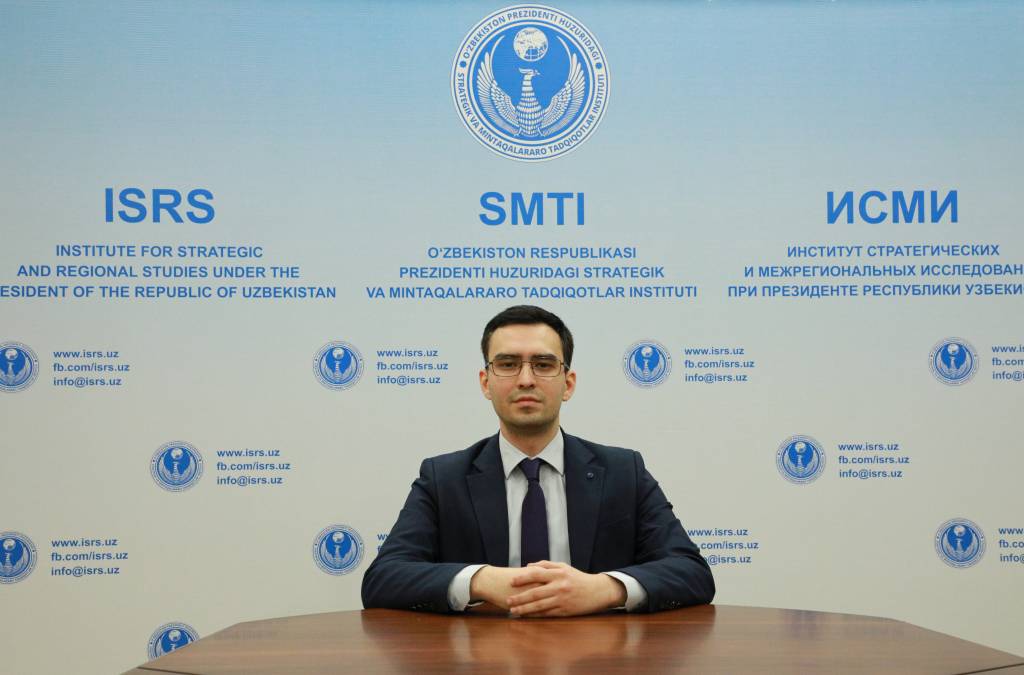
Bekzod Normatov,
Leading Research Fellow,
Institute for Strategic and Regional Studies under the President of the Republic of Uzbekistan