Pierre Gerber: “Professionals in healthcare, veterinary medicine, agriculture and ecology must work together”
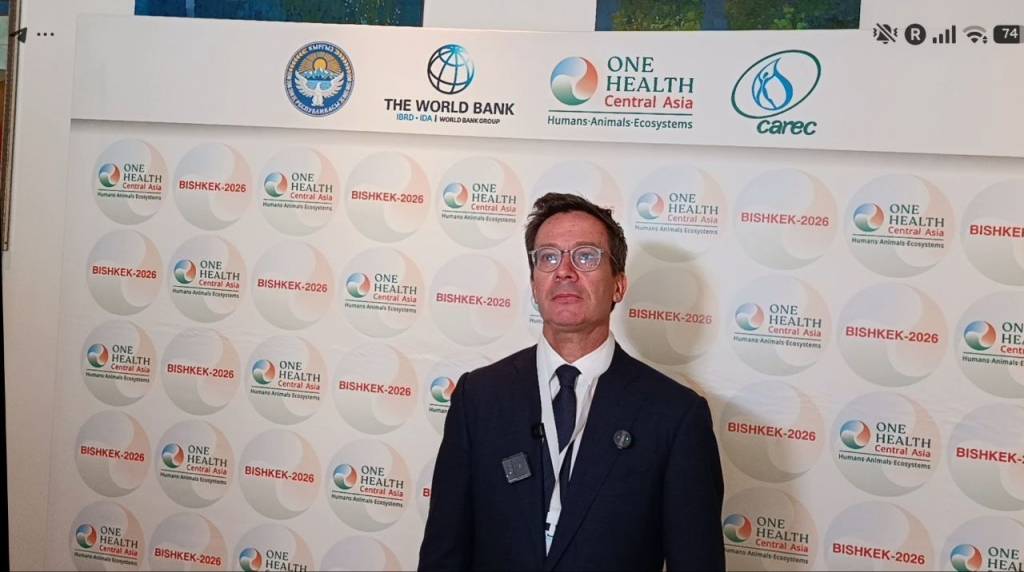
Central Asia is an important crossroads of global trade and transport routes, but along with economic opportunities, cross-border risks are also growing, ranging from infectious diseases to threats to food safety.
Pierre Gerber, Senior Agriculture Economist at the World Bank, spoke about how the One Health approach helps countries in the region develop their economies without risking the health of citizens and ecosystems.
– Mr. Gerber, what is the primary aim of the regional conference held in Bishkek?
– This is the second regional conference of the One Health Program in Central Asia. We are gathered here for several key tasks. First, to continue strengthening intersectoral and interstate cooperation in implementing this approach; second, to accelerate the practical implementation of projects on the ground and coordinate actions to maximize the program’s effectiveness.
Finally, a major focus of our work is science. One Health is a relatively new field that requires in-depth research and constant knowledge exchange. Therefore, we dedicated an entire day of the conference exclusively to scientific issues.
– For many people in Central Asia, the term “One Health” still sounds unfamiliar. Could you briefly explain the concept?
– Everything is based on a simple truth: the health of people, agricultural and wild animals, as well as the state of the environment are inextricably linked. Humans and animals share diseases. Environmental pollution can enter food and lead to disease.
The One Health concept brings together specialists from healthcare, veterinary medicine, agriculture, and ecology, rather than working in isolation. This is a direct investment in the future: disease prevention, preparedness for possible pandemics, and the ability to respond promptly to crises. At the same time, this approach yields tangible economic dividends, for example, by increasing livestock productivity and stimulating regional trade.
– What are the primary challenges and risks facing Central Asian countries today?
– The region plays a key role as a bridge between East and West, China and Europe. At the center of these global flows, Central Asia receives a significant boost in economic growth and job creation. At the same time, the risks of introducing dangerous pathogens and spreading infections are also increasing. The One Health approach gives the region the opportunity to fully realize its economic potential while protecting it from these threats.
The second major challenge is food safety. We must guarantee that the products on citizens’ tables are free from dangerous pathogens or toxic pollutants, a goal that requires collaboration among veterinarians, doctors, and environmentalists.
– What role does the One Health concept play in the World Bank’s global strategy?
– One Health is not just a separate project. It is a fundamentally different way of working. The World Bank finances many programs in environmental protection, health, agricultural productivity, and trade. This approach links these investments together. By joining the efforts of different industries, we achieve a synergistic effect that greatly enhances the return on each dollar invested, both by creating new jobs and by ensuring sustainable economic growth throughout Central Asia.
Roman Bondarchuk, UzA